I live in sunny Napier/Ahuriri, Aotearoa/New Zealand. I write about day to day life and occasionally, write speculative fiction.
My stories are reflective, character-focused, and richly detailed, exploring the nuances of memory, curiosity, and the subtle wonders within everyday life.
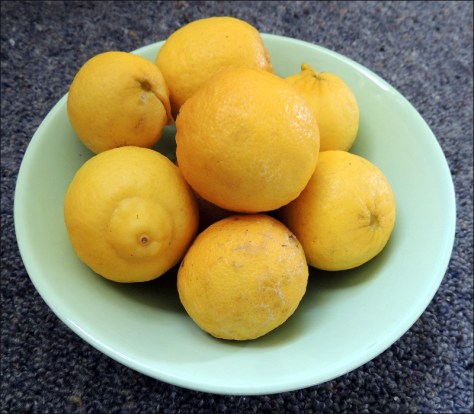
This year has been a great season for citrus, and we currently have more limes than we can eat (or drink, for that matter – thinking of the weekend looming and Margaritas on the horizon). We do grate the zest and freeze the juice in cubes for later, but it’s great to actually use these limes while they’re fresh.
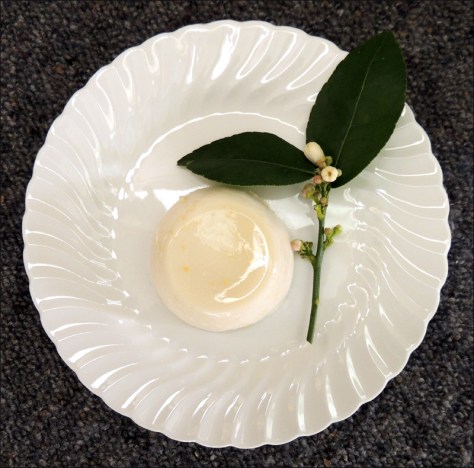
With this in mind, I sourced a Panna Cotta recipe online and have adapted it to incorporate this zingy fruit. And for those who need to know, the dessert is Vegan and Gluten-free and it’s a very acceptable 170 calories per serving. Not bad for a dessert!
3 tablespoons of genuine maple syrup (or your sweetener of choice)
2 teaspoons grated lime zest and 3 tablespoons fresh lime juice (about 1 lime’s worth)
1 bay leaf (I love the flavour of bay in a creamy dessert)
Equipment
Heavy-bottom saucepan
Rubber or silicone spatula
Measuring spoons,
Fine grater
4 small ramekins or jelly moulds (if you wish to turn the panna cottas out, grease them lightly with a plain-tasting oil, e.g., sunflower).
How to make them…
Pour the coconut cream into a saucepan and sprinkle the Jel-it-in on top. Stir until the powder is completely dissolved, then add the bay leaf, the maple syrup, and the lime (zest and juice). Gently bring to the boil, stirring occasionally. Allow it to boil for a minute or two, then remove from the heat and allow to cool a little.
Remove the bay leaf. Pour into the four ramekins and let them cool a little more, then cover and refrigerate. I tend to leave them out of the fridge until they are quite cold, so that when I cover them, they don’t steam up inside and cause condensation on the top of the desserts, but it’s no biggie, either way.
You can serve the Panna Cotta garnished with a slice of lime – very tangy! or with whatever you like, really – chopped nuts, sliced fruit, whatever is around.
Snow fades to reveal
shadow tree in bright water.
Twilight silhouette.
It’s been a long winter for the people of Asahikawa, reaching back to the first snowfalls in October. And it certainly seemed chilly to me when I arrived, coming from the humid heat of a South Head autumn. But since then, the lowest temperature I’ve experienced has been around -5 C, and today it had reached 17 C by about 5 pm. (It’s not so long ago that it was regularly -15 C). The gratifying thing I’ve observed, however, is that as soon as the snow starts to melt and the bare earth is exposed, new growth begins.
Left to Right: Pussy Willow (Salix chaenomeloides) in bud, and a tree showing the hint of new growth
It’s already more than a week into Cherry Blossom Festival down south in Tokyo, but this far north most of the trees are barely in bud; you can in a certain light, however, discern a golden-green tinge along the branches of some. The Pussy Willows are in flower already. The sight of their fuzzy protuberances reminds me of spring in Dunedin, and more specifically, of my much-loved garden at St Leonards, where the fattening buds were also one of the first signs that winter was finally over.
‘Shibazakura’ or Moss Phlox (Phlox subulata). When in flower it’s one of the most vivid of early Summer displays in Hokkaido.
Along the walkways in Tokiwa Koen, the edges of stone walls are emerging from beneath the snow, and I was surprised see Moss Phlox growing there, as green as if it hadn’t been entombed for months. It’s the very phlox I rely on at home to brighten up the edges of my front borders… how versatile it is (!) and I wonder if it’ll flower before I head back to New Zealand.
Left to right: Pheasant’s Eye (Adonis amurensis), Crocus (C. sativus) and Japanese Sweet Coltsfoot (Petasites japonicus)
I glimpsed some crocuses pushing up through a patch of dead grass in an otherwise barren strip of dirt at the base of a city apartment building. The familiarity of both this cheerful flower and the phlox help me feel ‘at home’ in this otherwise different environment. I’m discovering unfamiliar plants too, such as the golden, yellow flower Adonis amurensis (a member of the buttercup family) and the chartreuse new shoots of Petasites japonicus.
Behind the phlox-frilled edges of the gardens in Tokiwa Park, rows and rows of bulbs are sending up their first green or ruddy shoots… I wasn’t sure what these could be when they first appeared, but with a few day’s growth under their belts, I suspect they may be tulips.
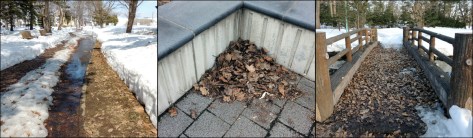
One of the odd things about the snow melting, is that it exposes great drifts of dried leaves, most of which have no doubt been buried since October or November. It is an incongruous sight… you could almost think you were looking at a scene from autumn, rather than from spring, what with the bare branches on the trees, the patches of snow and the masses of leaves .
The Places You Sit
Toilets often present a mind-boggling array of personal options.
Toilets in Japan deserve a special mention. The first surprise was that most of the toilets in public places, i.e., stores, cafes, railway stations and airports, have heated seats. The first time I experienced this I was perplexed as I was certain that the cubicle had been unoccupied prior to my arrival. As well as the cosy seats, toilets have a mind-dazzling array of ‘personal’ options. You can wash and dry your nether regions, or you can play ‘privacy’ sounds (music or the sound of running water) to disguise any accidental or unseemly noises.
Each time I’ve visited one of these small rooms, I’ve been so tangled up in layers of winter clothing that I haven’t had the inclination to ‘relax’ into the experience, but who knows, as the days grow warmer, and I’m wearing less clothing…
Electric wires
Dark lines across clear blue skies
Sparks flare in my heart
Asahikawa is a sprawling city, first settled by mainland Japanese in 1889. The name ‘Asahikawa’ can be directly translated to mean ‘Sun (or ‘Morning Sun) River’. It lies along the Ishikari River (Ishigari-gawa) in the agriculturally important Kamikawa Basin. The river’s name is derived from an Ainu term, ishikaribetsu, meaning ‘greatly meandering river’, which describes the flow of its lower course. To the east of Asahikawa is the Daisetsuzan National Park and very close by are ski fields (comprising the ‘Hokkaido Powder Belt‘). It also has a well-known zoo. I’m staying at a central location, close to Tokiwa Koen.
Takiwa Koen
I’ve walked through Takiwa Koen a couple of times already. The park is still mostly blanketed with snow, and while many of the paths are exposed, you still have to negotiate around slick, icy patches and there are whole areas that are completely obscured. With daily temperatures ranging from 3 to 7 C this week, it won’t be long until all the snow has melted.
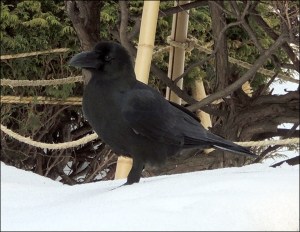
Large Billed Crow, Corvus macroryhnchos
The park is home to many crows. There are two species here – the Carrion, Corvus Corone, and the Large Billed, Corvus macrorhynchos. The Large Billed look especially comical and somehow ‘human’, with their fat beaks and high ‘foreheads’ – the beaks remind me of lips that have been treated with botox. There’s also a pair of mallards that I’ve seen paddling on areas of the lake with moving water, and there are other birds that I can hear chirping up high in the bare branches, but have so far have been unable to capture with my camera.
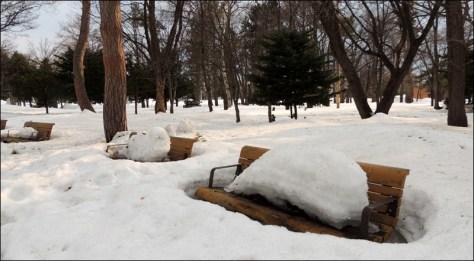
One thing I noticed yesterday was the emergence of the park benches. A couple of days ago they were nowhere to be seen, well-camoflagued under drifts of snow. Now they’re appearing here and there, decked with large and irregularly shaped white lumps.
Local Scenery
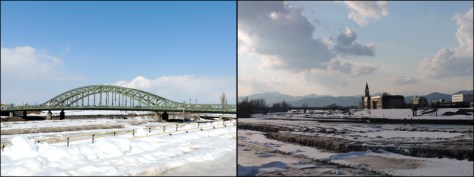
Left: The Asahibashi Bridge; Right: Bell Classic building (with the tower)
On Wednesday I walked through the park late in the afternoon, then headed across the Asahibashi; the large green bridge that spans the Ishikari river. I was curious about a structure on the northern bank, which reminded me of something more typical of Eastern Europe, than Northern Japan. It’s called ‘Bell Classic‘ and is a venue for weddings and so forth.
Strange New Things
When I arrived a week ago, there were many things that were strange or unexpected, standing out ahead of the more subtle differences. In any new environment, ‘first impressions’ quickly become commonplace and I can feel this happening already, so I’ve decided to focus on one of these ‘differences’ each time I write, (or at least until I run out of ideas!).
Cables, Pipes and Wires
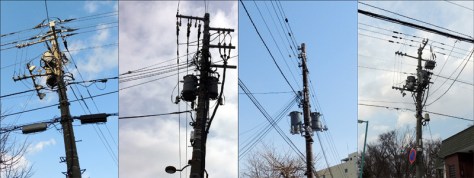
Powerlines! They’re everywhere, and not just the overhead wires, all the trappings associated with electricity are above ground, silhouetted against every skyline. They’re thick and black and many extend down into the pavement, often wrapped in bright yellow and black stripped casings.
Until seeing the lines here, I hadn’t realised how much of New Zealand’s electrical cabling is below ground or tucked away discreetly. As far as I’ve been able to work out, part of the reason is convenience. If everything is out in the open and easily accessible it saves time (and money) when repairs need to be made.
Left and right: Tall poles with many wires; Centre top: Wires extend into the pavement; Centre bottom: Household gas meter
This also applies to household meters, such as those for gas. In the apartment I’m staying in, for example, the pipes just come up through the floor in the living area; the meter can be easily read. But I’ve also read that there are issues with their being so many wires above ground, both when it comes to safety (earthquakes are a risk further south, and heavy snow frequently brings lines down), and on the other side of the equation is the huge cost of converting them all to underground.
Even as I write this, I’m aware that I barely notice these wires any more. They are merely part and parcel of the scenery.
My flight to Japan was scheduled for the ungodly time of 1.15 on a Thursday morning. I arrived at the airport well in advance of this and after a less than enthusiastic circuit of the duty free stores, settled myself into the Koru Lounge for a long wait. I was barely hungry and not in the mood to drink more than a 1/2 glass of chardonnay at such an early hour, so I spent most of the time writing notes in a diary and contemplating the six weeks ahead of me.
Asahikawa is the second-largest city in Hokkaido (the northern-most island of Japan) with a population of around 350,000. To get there from Auckland you have to first fly to Tokyo, and then on to Sapporo, leaving the island of Honshu behind. After that, you can either take a train or a bus for the remaining 138 km. Asahikawa‘s latitude is around 43.77N and if you were to head roughly due west for 850 km (over the Sea of Japan), you’d end up in Vladivostock, Russia – that’s how far north it is.
During my flights from Auckland to Sapporo, and on the train journey from Sapporo to Asahikawa, the reality that I was travelling to an entirely foreign country with a completely different season only became apparent in stages. The first indications emerged while I was waiting in the boarding lounge at Auckland airport, where I metamorphosised into a member of the minority culture. But it was just something I noticed – the situation didn’t feel that different. I could’ve just as easily been on the AUT campus during Orientation Week.
Then there were the suppers and breakfasts served on the Air NZ flight. On both occasions, the ‘Japanese’ option sounded more appetising, which is not to say it actually was appetising (although I have the feeling that it was better than the alternative. ‘Chicken Sausage’ never sounds appealing as a breakfast choice).
Then there was the fact that for every interruption to the films I was watching (and there were announcements at regular intervals) there was a follow-up broadcast in Japanese, timed for about a minute later, just when I’d manage to re-acquaint myself with the plot. (If anyone’s interested, I watched ‘Lion‘ and ‘Manchester by the Sea‘ and enjoyed both.) The Japanese explanations seemed to take a lot longer, and I couldn’t help wondering if I was missing something.
Auckland to Tokyo
The flight from Auckland to Tokyo takes about 10 hours. I expected to notice differences when disembarking and entering Narita airport, but there were English translations everywhere, and announcements in both Japanese and English, and it was a nice surprise to not feel vertically challenged for once. Customs control and baggage checking went smoothly and before I knew it I was free to do my own thing. I made my way from International to Domestic to board my flight to Sapporo. I had a couple of hours to wait but had already gone through the ‘point of no return’ before this dawned on me. So I was stranded in another waiting room, with not much to keep me occupied. I made a note to make sure I picked up some cash before catching the train from Sapporo.
The lounge at Narita airport.
Probably the worst aspect of the trip was the size of my suitcase. The large dimensions meant that I couldn’t use the escalators in the airports and railway stations and had to drag it behind me while I hunted around for elevators. I couldn’t even lift it higher than about 15 cm off the ground.
Tokyo to Sapporo
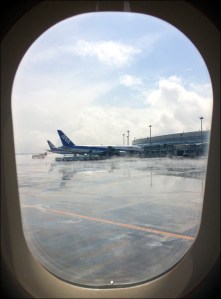
My first view of Sapporo – steam rising from the heated tarmac.
The flight from Narita to Sapporo took an addional 2.5 hours, but thank goodness it was an older style airbus. The cabin was much less stuffy than on the long-distance flight, and I had a window seat so could look out at the snowy terrain unfolding below. The land started out flat then became more hilly, then mountainous. When we flew over the Tsugaru Strait I saw many container vessels and it must’ve been windy as the charcoal-grey water was dotted with the white crests of waves. Then we were on the way down. And as we taxi’ed along the runway at Sapporo, it looked COLD, with grey skies, bleak buildings, and small piles of snow here and there.
Sapporo to Asahikawa
I’d been given detailed instructions on how to get from Sapporo to Asahikawa, including the purchasing of the train tickets, and finding the correct platforms and lines, so the actual ‘finding my way’ part was reasonably straight-forward. But it had been a long, tiring trip and by the time I was safely seated on the ‘Kamui‘, with my huge bag tucked tightly beside me, I was both tired and hungry.
A fleeting view of houses – I’d only just focus on a group, and then they’d be gone.
The Kamui is a fast train and soon it was whoosing along, out of Sapporo and through the countryside. For most of the journey the terrain was flat, with almost everything covered with a blanket of snow. The houses in the small settlements we passed looked very different from those in New Zealand – they were boxy or angular, coloured with plain earthy tones, or shades of white, or in bright pastels.
Similarly, the trees seemed to rush by.
And as we travelled further north, the views reminded me of Finland, with forests of bare tree trunks crowded closely together on low, mounded hills. Unlike Finland, there were occasional glimpses of snowy peaks in the distance, but this was my first impression.
A very special rose. This gift from a friend holds the memory of someone taken much too soon.
Record rainfall followed by hot sun
After a late summer of seemingly endless blue skies, South Head received an unseasonal 124 mls of rain between 08 and 14 March. On the first soggy day we were grateful as the water tank was getting low, but by the end of the second day the novelty had worn off. The rain followed by sun has turned the vegetable garden into a jungle through which I can barely navigate.
A carpet of green
A tangle of kūmara, melon and squash.
In early November, we planted three rows of kūmara tupu. ‘Tupu’ are the rooted shoots that grow on a kūmara tuber. The vines are very vigorous and are spreading all over the garden. I’m very excited about this. We’ve had mixed success with potatoes and I’d much prefer to grow kūmara if possible. We’ll have to wait until the leaves start to die down before seeing what’s hidden in the soil. This could be any time from the end of March onward and looking at our plants I suspect it’ll be more like April.
After harvest (assuming there is actually something growing underneath all those leaves) we’ll set the best aside to start a new crop next October.
Left to right: Basil jostling with carrots; okra; rhubarb; kale and silver beet (chard, to those of you from the northern hemisphere).
Our one surviving rhubarb plant is gigantic. The stalks are fat and juicy and despite baking them into Rhubarb Tarte Tartin and adding them to cereals and desserts, many will go to waste. We also have more than we can eat of basil and silver beet, and I’m curious to see how the okra turns out. Growing okra is another ‘first’ for me, and in my ignorance, I allowed some pods to grow too long, so have cut them all off and am hoping that more will be produced before it gets cooler.
Left to right: Limes; habanero peppers; ‘Big Chief Butternut’ squash; bell peppers.
Continuing with the green theme, it looks like we’ll beat our record for limes as both trees are very well-endowed this year and also have a decent crop of new flowers. My favourite chile pepper, Habanero, is looking very fine, with each of the plants laden with flowers and young fruit. I also sowed a handful of seeds for a different squash, ‘Big Chief Butternut’, which apparently grows to 2 – 3 kg. And it is HUGE. And the capsicum (bell pepper) plants have become so large that we’ve had to support them with sturdy wooden stakes.
Zucchinis and tomatoes
This summer we’ve had the heaviest crop of both zucchinis and tomatoes since living at South Head, with green beans, coming a close third.
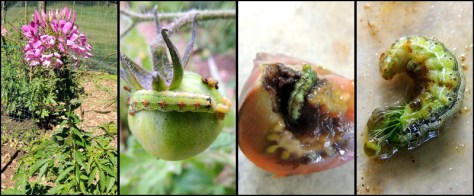
Left to right: Pretty Cleome spinosa (Spider flower); a tomato fruitworm tucking into a green tomato; the disturbing sight of a grub inside a tomato; same grub after removal.
Scattered around the vegetable garden are self-sown Cleome. I planted a half dozen a few years back to attract green vegetable bugs and the Tomato Fruitworm, Helicoverpa armigera ssp. conferta. The Cleome attract both insects really well, but there haven’t been so many green vegetable bugs this year, and I’ve been picking off the damaged tomatoes when I come across them. The hens like drawing the fat green caterpillars out. I must admit that when I overlook one, and the tomato goes rotten from the inside, I can’t bear to look at them, let alone touch them. All that ‘goopy’ decay turns my stomach.
I’ve been freezing tomatoes in 400 gram packs for use over winter; the neat thing about outside-grown tomatoes is that they are easy to peel, which saves time later. And I’ve also bottled a batch of tomato sauce. I’ve used the zucchini for pickles and we’re eating them every other day. My favourite recipe is to slice them thickly before sautéing them with mashed garlic in a little olive oil. At the last moment, to throw in a few sage leaves. Because the Costasta romanesco variety of zucchini isn’t at all watery, the sage leaves quickly go crispy and add a delicious flavour.
And still there’s more…
There are some vegetables I haven’t really bothered with… lettuces, for example. We rarely get around to eating them and while I do have a row growing and gradually aging right now, there are several earlier plants that I’ve let go to seed; the fuzzy down drifts around the garden with the slightest breeze. Lettuces are unlikely to become a problem if they sprout everywhere… I allowed a golden turnip plant to go to seed in Spring and we now have them growing in a couple of the pathways. There are only single rows of beetroot, carrots, parsnips, golden turnip and rocket – not that you’d ever need any more than one row of rocket!
Left to right: Asparagus still sending up shoots; zucchini Costasta romanesco; parsley; bulb fennel.
Grapes and honey bees
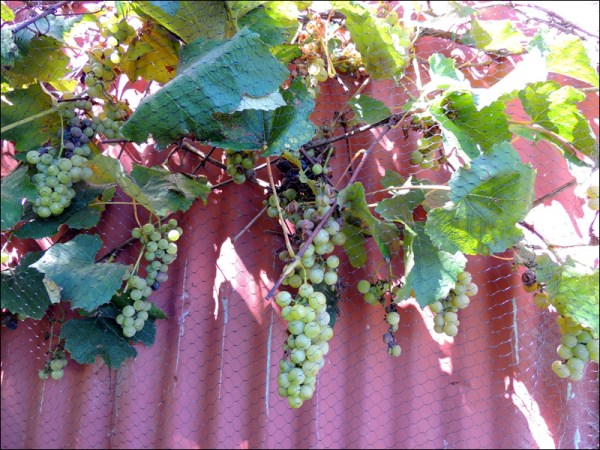
Yet another amazingly productive crop we’ve had this season is grapes. The vine stretches along the sun-drenched, north-facing wall of the barn and I’ve never seen as many. We can’t keep up with eating them, so they are all beginning to split and ferment on the vine.
Honey bees (Apis mellifera) gorging on the over-ripe grapes
Grapes are particularly attractive to honey bees – more so in the morning, and in the evenings I’ve seen the German wasp, Vespula germanica hovering around, so I’m hoping to observe them at dusk at the end of one of the fine Autumn days we have ahead of us, to see if we can ascertain the location of their nest.
The picked grapes are sweet and juicy.
Northern Japan in springtime
In about a week’s time I’m heading to Asahikawa in the north of Hokkaido for about five weeks. The contrast in weather will be a shock, I’m sure – going from the mid 20s to low 30s Celsius to close to 0 degrees (at least, for the first week or so), but I’m very much looking forward to my very first visit to Japan and am planning on writing about my impressions while I’m there. Because I won’t have the distraction of the garden, I should have much more time to write, which will be something I’m really looking forward to.
Micro fiction is a form of flash fiction that features extremely short stories. A common description defines micro fiction as ‘any story of less than 300 words’, but they are often much shorter.
Once a year, Flash Frontier runs their Micro issue, in which the word limit is a mere 100 . This year I was lucky to have my story Grandma’s House accepted for publication.
In this story I drew on childhood memories. Places visited when very young can inspire vivid images that linger as we grow older. My grandmother’s wooden villa in Wellington Road becomes jumbled up with the dark carpeted hallway in Uncle Fred’s Palmerston North house. The remembered smell of dusty carpet still tickles my nose, and the fall of sunlight in a particular way still evokes the recollection of golden light on shadowed corners. I recall the monochromatic photo of the smiling girl and the warm smell of freshly-baked shortbread.
These are places I can no longer physically reach. My micro story becomes the distillation of many memories into a single experience.
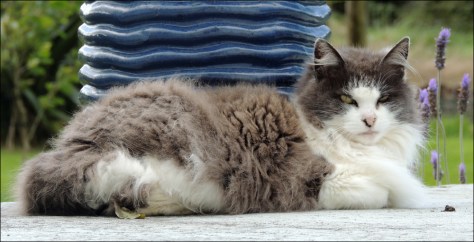
At least the birds are happy now. No longer any risk of being stalked by a furry, grey and white, four‑legged predator. I can hear them chirping away as I type, flitting around in the feijoa trees outside the window on this first sunny day since (it seems like) forever.
Sixteen years is a big chunk of my life. And it feels like she was always there. Peel Street, Wernham Place, Otitori Bay Road… here. Mornington to Birkenhead to French Bay to South Head. Of course I understand that it’s natural to feel these knives of grief in my chest. And I know she was merely a cat, not a child, or a parent, or a friend, or a lover. But the pain is sharper than I’d expected.
Just now, when I was outside checking the garden, with the bright sunlight and a gentle breeze, and the sweet smell of macadamia flowers in the air, I realised that I’m also going to physically miss her actually ‘being around’, not just miss her as my pet.
I don’t mind being alone here; in fact I like it. But up until now, Molly’s always been nearby. Often following me around. Finding me when I’m hanging out the washing, or jumping over the gate to join me when I’m in the vegetable garden, or setting herself down in a sunny spot not far from where I’m weeding. Because of this, I’ve never felt particularly alone out here, even when it’s been just me. And in the evenings, god knows she’d exasperate me by always trying to jump on my lap if I ever sat still for long enough. I’d be wanting to get up and do something and there she’d be. Purring away. Settled.
For the past week or so, she’d gotten back into the habit of sleeping pressed up against the backs of my legs at night. Being a night owl, I’m always the last to muck around and ready myself for bed. I’d turn off all the lights and see Molly, seemingly sound asleep on a dining chair, or on the sofa, or in front of the wood burner when it was cold. But the minute I’d settle into bed with a book, I’d hear a gruff “miaow”, and again, there she’d be. Ready to sleep on whatever item of clothing I’d left on the floor, or to settle herself down beside me. When I couldn’t sleep at night, I’d hear either her loud purr or the sound of her continually cleaning herself. It didn’t help.
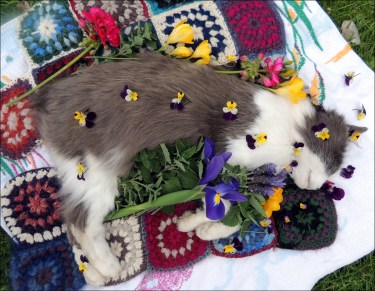
And now she’s gone. She was alive at 7.45 am on Tuesday morning when we bundled her into her cat carrier and drove to the vet in Helensville. By 9.00 am she was dead. I didn’t expect it and I wasn’t prepared for it.
Goodbye Molly. If I’d only known, I’d have made such a fuss of you these past few weeks.
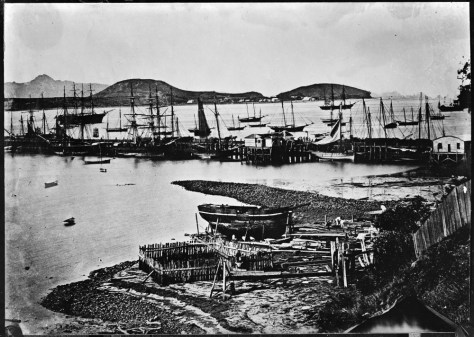
Queen Street Wharf, Auckland, by Daniel Manders Beere, 29 February 1864. (Alexander Turnbull Library, 1/2-096102-G)
Newell Gascoyne
One of the family stories I’d heard, was that my great-great-great-grandfather, Newell Gascoyne, had been murdered. This seemed a somewhat significant way to die, so when I first moved to Auckland in 2006, I decided to fill in time by checking out some early newspapers. I took myself off to the Auckland Public Library to peruse their archives. Surely there’d be something written somewhere?
It was remarkably easy, I’m sure helped by the fact that he had an uncommon name.
The report transcribed below was published on page 5 of The New Zealand Herald of Saturday 16th April, 1864. It provides a somewhat different version of events. A less memorable version, but no less devastating for his wife Isabella and their 3 children. My great-great-grandmother, also named Isabella, was 16 and newly-married; her younger brothers, Newell and Daniel, would have been 14 and 11 respectively.
Coroner’s Inquest
An inquest was held yesterday, at the Clanricarde Hotel, on the body of Newell Gascoigne, who died on the 13th inst., through injuries received by falling down a cellar, in Queen-street, on the 7th inst., while in a state of intoxication.
Frederick Sims, stated: I keep the Wheat-sheaf Inn, Queen-street. I knew deceased, who came to my house about 9 o’clock, a.m., on the 7th inst., and asked for some grog, which I refused to give him, and put him outside the door. Some one coming in soon after, I heard there was a man in the cellar, and went to the door. I saw some policemen and others engaged in lifting the deceased out of the cellar of Mr. Kemp’s house, next door to mine. Deceased appeared then only dead drunk, and made no noise. Deceased was then taken away in a truck. The depth of the cellar is about four feet, and the floor is covered with bran. There was nothing in the cellar that deceased could have struck against.
James Jackson, police constable, said, that on Thursday, the 7th inst., he heard there was a man hurt, and went and found deceased lying on his back on the pathway, outside the cellar of Mr. Kemp’s house, in Queen-street. The man was insensibly drunk. I got a truck, with two other policemen, and removed him to the lock-up. He did not appear in any pain, and I did not think there was anything wrong except being drunk.
Francis Jones, stated: I am a carter. I was employed by Mr. Kemp, carting some bran from his cellar, the day before the accident, and I came early on the morning of the 7th inst., to get another load. I had put one bag into the cart, and coming back for another, I saw a man in the cellar, who must have fallen in. He was lying on his back just below the grating. On getting him out of the cellar, he appeared drunk, but I could not see that he was hurt. The cellar was between three and four feet deep.
Thomas B. Kenderdine, stated: I am a legally qualified medical practitioner. I was called in to see the deceased on Friday, the 8th inst. He was in his own house. I found him in bed, lying on his back, with the lower half of his body paralysed. He complained of a great pain in his back. He was sensible and able to speak and swallow. He lived until the 13th inst. I consider the cause of death to have been injury to the spinal marrow, producing paralysis. I did not make a post mortem examination.
The Sergeant-Major of the Police stated he had given up the deceased to his wife on the night of the 7th inst., about 9 o’clock. He was then sober, and complained of pain in his back, and being unable to get up. He was taken to his house on a stretcher.
The jury, having consulted, returned a verdict – That deceased died from the effects of a fall received while in a state of intoxication.
Nothing is as new as something that’s been long forgotten (German Proverb)
Stories from the past are interesting. Especially when they’re about our own families. But the problem is that so little is passed down. You are handed the bare bones without the flesh. Even the Coroner’s Report leaves me with more questions than answers. The records are merely black print on faded paper; they don’t fill in the details I’m curious about.
I have a copy of Newell Gascoyne’s Death Certificate. It succinctly states: Newell Gascoygne, Mariner, Male 35, Paralysis caused by injury of the spine. 13 April 1864, Auckland.
Did he stumble and fall into the cellar? Is that what his family believed? Or did they suspect he’d been the victim of foul play, hence the story about being ‘murdered’? Or was it that they were ashamed that he’d been ‘insensibly drunk’ at 9.00 o’clock in the morning, and subsequently passed on a different version to their children?
The past holds its secrets close to its chest.
View of Auckland 1864, ‘Sir George Grey Special Collections’ Auckland Libraries, 5-2624
Family Tree
Newell Gascoyne (c.1829-1864) & Isabella Barr (c.1825-1880)
↓
Isabella Gascoyne (1847-1916) & Antonio Jose de Freitas (1843-c.1898) (Married: 7 January 1864, St Patrick’s Catholic Church, Auckland)
↓
John Antonio de Freitas (1872-1937) & Jane Eliza Manderson (1880-1949)
↓
William Peter Joseph (1900-1969) & Nina Geary (1895-1972)
↓
My Mum
↓ Me
Additional Information
In the old records, Gascoyne is variously spelled Gascon, Gasgoine, Gascoigne, Gascoyne and Gaskong. Newell Gascoyne’s occupation is first noted as mariner, and later as sawyer. They also show that his children Isabella, Newell and Daniel were all born in Auckland, and that when younger Isabella applied to get married in January 1864, she was resident at Mills Lane, Auckland (and had lived there for 4 years).
The Mills Lane address is also supported by a report in The New Zealander, Vol. XIX, Issue 1879, where in a report about ‘A Determined Thief’, Isabella (senior) is referred to as the ‘wife of Newell Gascoigne, Mill’s Lane’. She was giving evidence about the movements of a Thomas Hill, who had been ‘lodging for two weeks at her house’. (27 May 1863)
















 Heni Irihapeti's Blog