All posts by Hēni Irihāpeti

I live in sunny Napier/Ahuriri, Aotearoa/New Zealand. I write about day to day life and occasionally, write speculative fiction. My stories are reflective, character-focused, and richly detailed, exploring the nuances of memory, curiosity, and the subtle wonders within everyday life.

Skeletons in the Closet

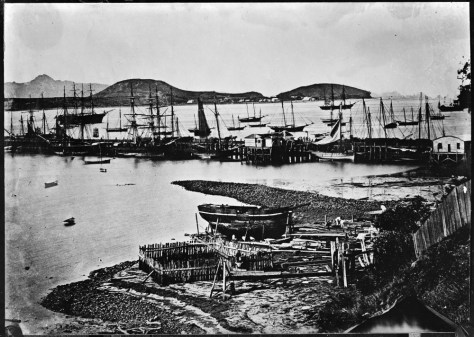
Auckland shorefront 1864
Queen Street Wharf, Auckland, by Daniel Manders Beere, 29 February 1864. (Alexander Turnbull Library, 1/2-096102-G)

Newell Gascoyne

One of the family stories I’d heard, was that my great-great-great-grandfather, Newell Gascoyne, had been murdered. This seemed a somewhat significant way to die, so when I first moved to Auckland in 2006, I decided to fill in time by checking out some early newspapers. I took myself off to the Auckland Public Library to peruse their archives. Surely there’d be something written somewhere?

It was remarkably easy, I’m sure helped by the fact that he had an uncommon name.

The report transcribed below was published on page 5 of The New Zealand Herald of Saturday 16th April, 1864. It provides a somewhat different version of events. A less memorable version, but no less devastating for his wife Isabella and their 3 children. My great-great-grandmother, also named Isabella, was 16 and newly-married; her younger brothers, Newell and Daniel, would have been 14 and 11 respectively.

Coroner’s Inquest

An inquest was held yesterday, at the Clanricarde Hotel, on the body of Newell Gascoigne, who died on the 13th inst., through injuries received by falling down a cellar, in Queen-street, on the 7th inst., while in a state of intoxication.

Frederick Sims, stated: I keep the Wheat-sheaf Inn, Queen-street. I knew deceased, who came to my house about 9 o’clock, a.m., on the 7th inst., and asked for some grog, which I refused to give him, and put him outside the door. Some one coming in soon after, I heard there was a man in the cellar, and went to the door. I saw some policemen and others engaged in lifting the deceased out of the cellar of Mr. Kemp’s house, next door to mine. Deceased appeared then only dead drunk, and made no noise.  Deceased was then taken away in a truck.  The depth of the cellar is about four feet, and the floor is covered with bran.  There was nothing in the cellar that deceased could have struck against.

James Jackson, police constable, said, that on Thursday, the 7th inst., he heard there was a man hurt, and went and found deceased lying on his back on the pathway, outside the cellar of Mr. Kemp’s house, in Queen-street.  The man was insensibly drunk.  I got a truck, with two other policemen, and removed him to the lock-up.  He did not appear in any pain, and I did not think there was anything wrong except being drunk.

Francis Jones, stated: I am a carter.  I was employed by Mr. Kemp, carting some bran from his cellar, the day before the accident, and I came early on the morning of the 7th inst., to get another load.  I had put one bag into the cart, and coming back for another, I saw a man in the cellar, who must have fallen in.  He was lying on his back just below the grating.  On getting him out of the cellar, he appeared drunk, but I could not see that he was hurt.  The cellar was between three and four feet deep.

Thomas B. Kenderdine, stated: I am a legally qualified medical practitioner.  I was called in to see the deceased on Friday, the 8th inst.  He was in his own house.  I found him in bed, lying on his back, with the lower half of his body paralysed.  He complained of a great pain in his back.  He was sensible and able to speak and swallow.  He lived until the 13th inst.  I consider the cause of death to have been injury to the spinal marrow, producing paralysis.  I did not make a post mortem examination.

The Sergeant-Major of the Police stated he had given up the deceased to his wife on the night of the 7th inst., about 9 o’clock.  He was then sober, and complained of pain in his back, and being unable to get up.  He was taken to his house on a stretcher.

The jury, having consulted, returned a verdict – That deceased died from the effects of a fall received while in a state of intoxication.


Nothing is as new as something that’s been long forgotten (German Proverb)

Stories from the past are interesting. Especially when they’re about our own families. But the problem is that so little is passed down. You are handed the bare bones without the flesh. Even the Coroner’s Report leaves me with more questions than answers. The records are merely black print on faded paper; they don’t fill in the details I’m curious about.

I have a copy of Newell Gascoyne’s Death Certificate. It succinctly states: Newell Gascoygne, Mariner, Male 35, Paralysis caused by injury of the spine. 13 April 1864, Auckland.

Did he stumble and fall into the cellar? Is that what his family believed? Or did they suspect he’d been the victim of foul play, hence the story about being ‘murdered’? Or was it that they were ashamed that he’d been ‘insensibly drunk’ at 9.00 o’clock in the morning, and subsequently passed on a different version to their children?

The past holds its secrets close to its chest.


Auckland 1864 - Sir George Grey Special Collections, Auckland Libraries, 5-2608
View of Auckland 1864, ‘Sir George Grey Special Collections’ Auckland Libraries, 5-2624

Family Tree

Newell Gascoyne (c.1829-1864) & Isabella Barr (c.1825-1880)

Isabella Gascoyne (1847-1916) & Antonio Jose de Freitas (1843-c.1898) (Married: 7 January 1864, St Patrick’s Catholic Church, Auckland)

John Antonio de Freitas (1872-1937) & Jane Eliza Manderson (1880-1949)

William Peter Joseph (1900-1969) & Nina Geary (1895-1972)

My Mum

Me


Additional Information

In the old records, Gascoyne is variously spelled Gascon, Gasgoine, Gascoigne, Gascoyne and Gaskong. Newell Gascoyne’s occupation is first noted as mariner, and later as sawyer. They also show that his children Isabella, Newell and Daniel were all born in Auckland, and that when younger Isabella applied to get married in January 1864, she was resident at Mills Lane, Auckland (and had lived there for 4 years).

The Mills Lane address is also supported by a report in The New Zealander, Vol. XIX, Issue 1879, where in a report about ‘A Determined Thief’, Isabella (senior) is referred to as the ‘wife of Newell Gascoigne, Mill’s Lane’. She was giving evidence about the movements of a Thomas Hill, who had been ‘lodging for two weeks at her house’. (27 May 1863)


Training this Human for 16 Years

Molly

molly_mound

Molly’s curled up by the fire. A rounded hummock not unlike the curved mound of a hill, although grey and white, not green. The kind of hill that catches the eye while driving past. Something about the shape so pleasing that you have to look back.

Oh Molly! You’re growing old and I wonder that you still look the same. Or almost. No tail of course. That fluffy appendage dislocated from your body (we think) by a dog, eighteen months ago. The nub of your spine still twitches when I pat you.

Your life has run alongside mine for so many years. Through relationship changes, children turning to adults, and the rotation of the seasons. From the bracing frosts of Dunedin, to the humid summers up here on The Kaipara.

We began our journey in Mornington and ended up at South Head, with brief stints in Birkenhead and Titirangi. From hilltop to suburbia, from dense kauri to verdant farmland. We’ve negotiated roosters and toddlers (each has its challenges), and been together ‘through thick and thin’, as the saying goes.

I know that you’ll be my last moggy… we both love the birds around here too much and actually, I don’t think you’re replaceable. But for now, I like the way you curl up close to me each night, and talk to me with gruff miaows.


molly_sweet william

Nebraska in February

Menter_farmstead_(Big_Springs,_NE)_3
Menter Farmstead, Big Springs, Nebraska.

Jagged stubbles of corn lie in parallel rows. They stretch away on tawny fields as far as the eye can see. The wide sky is wintry pale, dissected only by the vapour trails of jets, and it seems larger than life, with no hills between where I stand and the horizon, no matter which direction I look. Deciduous trees form random clumps. Bereft of foliage, their skeletal branches are exposed to the elements.

With the melting snow and ice comes an intense smell of cattle. Indeed, the countryside is dotted with farmlets; each has large reddish-brown beasts grazing the corn stubble, or standing in pens set upon rich, dark earth. Ancient barns contrast with shiny metal silos. Houses are picturesque – mostly painted white with steep-angled, grey shingle roofs and gables.

In the shady places where a little icy snow still lies, the earth is hard and frozen underfoot. Every blade of grass is dead and brown. The roots lie far below, waiting for warmer weather before sending their tender shoots upwards.

Yesterday we drove to nearby Branched Oak lake, and as I stood in the setting sun gazing out across the wide expanse of blue ice, a huge flock of Canada geese honked loudly from their roosting place at the lake’s centre.

For a person accustomed to hills, mountains and the ever-present sea, to trees that retain their foliage all year round, to grass that still needs mowing in the heart of winter, the very vastness of this land astounds me. As does the uniformity of colour – the blue of the daytime sky, the pale gold of the vast, rolling fields, the grey and white of the houses.

There is contrast, too. In the bright colours splashed on the landscape by progress. Every gas station or fast food outlet sports an enormous pole with a garish advertising sign on top. And there are fat round water towers, painted blue or white, which break the line of vision.

Every evening, the sun sinks low on a flat horizon and the sky is lit with flaming fingers of orange, rapidly changing to crimson, to ruby, and suddenly to midnight blue. The great dome above becomes awash with stars, the air becomes crisp and frosty, and the silence of the winter’s night descends upon us.


Adapted from a piece first published in Nerdnosh Vol. 4, #49; Story 4 — Feb 19, 1996


The Trivialisation of Important Issues

sky
Clouds move across the evening sky. The land remains and yet we drift across it, frequently uncaring; ignoring the mistakes made by previous generations.

Last Thursday evening (May 5th) I happened to catch the tail end of an item on the TV One current affairs programme, Seven Sharp. I was flicking through the channels at the time, and to be honest, Seven Sharp is something I’ve never more than glanced at before. But I caught part of an interview with New Plymouth mayor, Andrew Judd, who was explaining the reasons he wouldn’t be standing for re-election this year. He used the very powerful term ‘recovering racist’ to describe himself and this is what grabbed my attention.

Mr Judd was talking about how his attitude to Maori had undergone a change during his three years as mayor. That at first he was ignorant of the relevant issues – in fact, when he first became mayor, he knew nothing of local history and hadn’t even stepped foot on a marae. As he became better-informed, he concluded that Maori should have a voice on his own city council. This caused a backlash from Pakeha in his constituency who disagreed. The personal abuse he received ranged from threatening letters to being spat on in public. At one point, Grey Power put together a petition that led to a referendum to vote against the council having a Maori member.

The kinds of things he was talking about are nothing new, of course. But it was reassuring to hear a non-Maori person of some status speaking about this on national television.

It evoked a mixture of emotions in me… the strongest being disappointment that so little had changed since I co-led Treaty of Waitangi workshops in Otago in the 1990s. I also felt admiration that Andrew Judd was prepared to tell it as it really is. It’s clear that he’s hiked a very hilly and personally-challenging path since being elected mayor in 2007.

As the story drew to a close, what I didn’t expect was the opinionated response from presenter Mike Hosking. His words displayed an ignorance that is inappropriate in someone fronting a primetime current affairs programme. It’s left me feeling much more despondent about the state of affairs in our beautiful country. About how attitudes don’t change and how they can be perpetrated and reinforced by a few well-chosen words, spoken to a captive audience by someone who, by being in that position, is taken seriously by many of those watching.

There is an enormous gulf between what he said and what is actual reality. And there is layer upon layer of history lying beneath that reality.

I don’t usually write on this kind of topic. But it just upset me. Attitudes won’t change unless we know and understand our own history. Unless we teach our children to know our own history. Obviously, we won’t get any help on that as long as our schools can pick or choose which parts of NZ history to include in the curriculum.

(Of course, I’m referring to the fact that we still don’t require the New Zealand Wars to be a compulsory component.) But that’s a whole different blog.

Link to Seven Sharp, 05 May 2016


“We need to look after our indigenous people. If we can’t do that how on earth are we going to grow and become this multicultural country we say we are going to be.”
Andrew Judd, Seven Sharp, 05 May 2016

He moana pukepuke e ekengia e te waka.
A stormy sea can be navigated.
Māori whakatauki/proverb


Around the Block

pomegranate
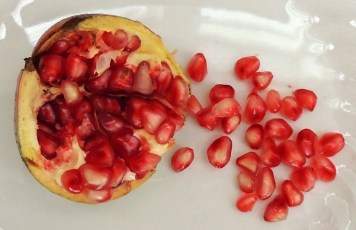
An Autumn pomegranate, spilling seeds.

Around the Block, a flash fiction piece I wrote for Flash Frontier, has been published in their April edition.

Flash Frontier’s theme for April is ‘slow’ and as with other stories I’ve written, Around the Block is a fictional piece with its origins in my own experience. (In December 2015 I wrote about the mix of fact and fiction for Headland magazine, when they posed the question, “Do we write what we know?” in Seeds of a Story.)

I really enjoy reading flash fiction and I’m especially fond of the New Zealand variety – I like to read our own narratives. And reading a complete story restricted to a mere 250 words reminds me of the surprising burst of flavour you get when you bite into a tiny pomegranate seed.

I hope you’ll take the time to visit Slow. I think it’s fascinating to discover how other writers interpret a simple theme. And the stories pack plenty of punch!

A good piece of flash fiction should leave you thinking.

Or satisfied.

Or… well, I think you should find out for yourself.


The Seven Wonders of the World Hotel

Hanging_Gardens_of_Babylon
Hanging Gardens of Babylon, Maarten van Heemskerck

2016 Science Fiction Fantasy Short Story Award

Au Contraire 2016, New Zealand’s 37th National Science Fiction & Fantasy Convention, is being held in Wellington over Queens Birthday Weekend (June 03 – 05).

As part of the convention, Au Contraire runs a Science Fiction and Fantasy Short Story Award.

The winners were announced earlier today: –

1st       To the Centre of the Earth, by Robinne Weiss
2nd      The Wasp-keeper’s Mother, by Andi Buchanan
3rd       Tane Mahuta, by A J Fitzwater


The Seven Wonders of the World Hotel

I was delighted to hear that my submission, The Seven Wonders of the World Hotel, was ‘highly commended’.

The Seven Wonders of the World Hotel is about about what happens to Max, the site supervisor on the Intergalactic Hotels project, on a Saturn’s Day night when he’s called out to investigate a problem near Sector 3B, The Hanging Gardens of Babylon.

stink bug
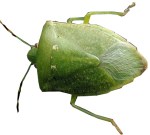
NZ Stink Bug, Glaucias amyoti


Northeasterly

leaves

Northeasterly

The windows rattle.

Outside, the lawn is mottled with smashed leaves
from the cottonwood.
Flax pods heavy with rain thud against each other.
A tui clings for dear life, and is whisked away.

The Northeasterly is not kind to my garden.
Branches snap, flowers shred,
hens scatter.

It passes through the mosquito mesh.
Invisible fingers lift the tapa cloth off the wall
then let if fall.
I’m reminded of Nalauaki.

Torrential rain is its companion.
Waves break against the stainless steel flue.
A million tiny coral flecks rattling with shells.

It’s been so long since it’s been windy.
I’d almost forgotten.

Jane Percival, March 2016


Poutu-te-rangi / March

edge
Dry maize rustles musically in the breeze

From Sweltering Summer to Temperate Autumn

The maize along the fenceline is ready for harvest. It’s a visual reminder that summer is over. The days are slow to lighten and early to darken, and the grass is thick with dew when I make my way to the barn in the early morning. The gravel road is dry and whenever a large truck rattles by, great dusty clouds drift across to settle on our solar panels.

It’s been several weeks since I’ve written about South Head. Or about anything, for that matter. It’s been difficult to knuckle down to writing after taking time off over the Christmas/New Year period.

While it’s been a very long and hot summer, we’ve also had a decent amount of rain, which of course has meant that everything has just kept on growing. We’ve created enough gardens here to keep us busy every daytime hour, and for the first time I’ve been wondering if it’s too much. What with the dead-heading, the trimming, the watering, the sowing, the harvesting… not to mention the tying, the squashing (caterpillars), the sampling, the digging and the weeding, always the weeding. (It’s making me exhausted all over again, writing about it.)

alpaca
Kumeu A & P Show: curious alpaca & disinterested rooster

So… we’ve mostly been home over the weekends slaving away in an attempt to keep everything under control, with a couple of diversionary breaks visiting the local A & P Shows – I like to check out the poultry while Ben looks longingly at the tractors. 🙂


 Bounty from the Garden

preserves
A selection of home preserves, from left to right: Beetroot; ‘Look Alike’ Lemon Curd; Spicy Tomato Sauce; Zucchini Pickle; Greek Tomato Paste

Since I last blogged we’ve harvested a parade of fresh produce, including grapes, lettuces, carrots, rhubarb, cannellino beans, sweet basil, garlic, cucumbers, peas, beans (green, yellow, purple), main crop potatoes (Agria), beetroot, silver beet, shallots, buttercup squash, tomatoes, butternut pumpkins and LOTS of of zucchini.

produce.jpg
A selection of produce, from left to right: white table grapes; cannellino beans; Rhubarb Tarte Tartin

To use up the rhubarb and zucchini I’ve made several Rhubarb Tarte Tartin and a few jars of Lemon Curd Look-Alike, as well as some zucchini pickle. But the neat thing about this year is that we haven’t had too much of one particular vegetable. Everything we’ve grown we’ve either eaten fresh, or I’ve cooked up, preserved, frozen or baked into something.

Tomatoes and Zucchinis

toms and peppers
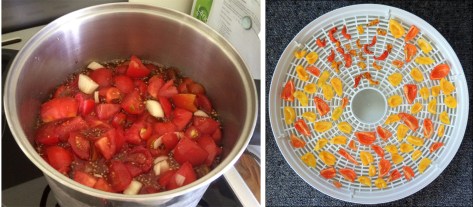
Left to right: tomatoes & onions ready to be cooked for Tomato Relish; red and yellow habanero slices, arranged for drying

The tomatoes have been great, but I picked the last one yesterday and I know I’ll miss having them on hand at meal times. I’m glad that I preserved a good amount this season (Spicy Tomato Sauce, Tomato Relish, Greek Tomato Paste) and that I also froze about a dozen packs of frozen skinless tomato flesh for use during the cooler months.

Recipes

One of the easiest salads to throw together involves mixing chopped tomatoes with a handful of fresh basil (made into a paste), a generous squirt of extra virgin olive oil and finely sliced or diced zucchini or cucumber. I read somewhere that raw zucchini helps you feel ‘more full’ than some of our other salad vegetables, and it’s lovely and light when sliced thinly.

I love cooked zucchini, too. It’s such a versatile vegetable. My favourite quick recipe involves slicing the zucchinis thickly, then sautéing them in a small amount of olive oil along with crushed garlic and sage leaves. The sage leaves turn crispy and add a delightfully fragrant ‘crunch’ to the dish.

Habanero

peppers
3 stages of habanero peppers – fresh to dry

Our habanero chiles are ripening as I type, so I’m picking them each day, drying them, then nuking them in a small food processor. We’ll use the chile powder all through the year to jazz up our meals. One of my favourite uses is to sprinkle a liberal amount into cheese toasted sandwiches. Yum!! (It’s very hot, though – not for the chile uninitiated.)

I’ve also raised a pink variety of habanero this year. It’s currently at the flowering stage, so, no fruit, but I can’t wait to see what they look like!

Pears

pears
Autumn pears & the finished product

March in New Zealand is the month for pears and melons. Our old pear tree has produced a good amount of sound fruit this year and yesterday I bottled a small sample in a light syrup. Not sure why I haven’t processed our pears this way before – I usually freeze them for desserts – but I do like to see the finished product in our pantry. And it’s so easy to preserve them using the water-bath method.

I didn’t remember until after I’d finished that you’re supposed to pack the fruit tightly into the jars to avoid having them float to the top of the syrup… oh well… next time!

Melons

melons
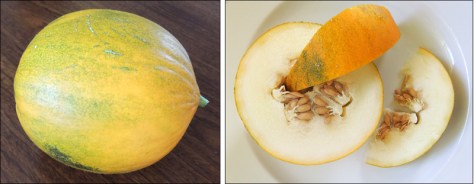
Melon, ‘Collective Farm Woman’ (Cucumis melo)

I sowed seeds for a different melon this year, Collective Farm Woman. It’s a small Ukrainian melon from the Black Sea area, about the size of a honeydew, with pale flesh, the flavour delicately sweet and slightly evocative of bananas.


 Bantams!

bantams
Our new bantam hens (left) and Charlie

We picked up a trio of Bantams at the recent Helensville A & P Show. They’ve settled in well and having Charlie (the rooster) crow loudly at 5.15 am hasn’t been too much of a shock.

When we first let the bantams join the rest of the flock, they kept to themselves, but they’re now walking around alongside the others. They choose to sleep outside  – the rooster up high in a branch of one of the feijoa trees, and the two girls on the fence below. Not sure if they’ll ever voluntarily join the hens in the barn. Perhaps we’ll have to manually move them there in Winter when it gets cold at night.

That reminds me… feijoas! They’re growing plump on the trees. And just now I can see two fat kereru perched up on the yellow guava, eating the first of the golden yellow fruit. The kereru started visiting again a couple of weeks back – I guess our garden is part of their seasonal food cycle, too.


sunrise
Autumn: Looking across The Kaipara at dawn


Summer Recipes

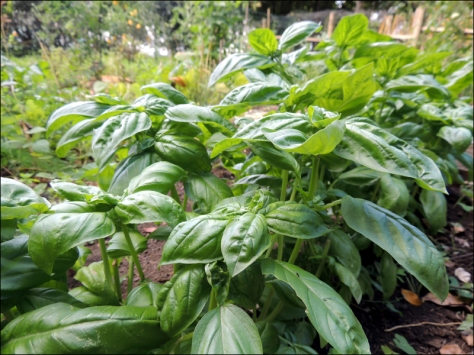
basil
Basil ‘Genovese Giant’

This time of year I have more basil than I know what to do with. And who doesn’t love pesto? This time I decided to make a batch that could also be consumed by the vegans in our family.

Vegan Basil Pesto

Makes approximately 300 grams
109 Calories per tablespoon (15 grams)

I substituted miso paste for the traditional Parmesan cheese. You can use either red or white miso, whichever is your preference. If you like your pesto saltier, add a little more miso to taste.

Ingredients

  • 2 tightly packed handfuls of fresh basil leaves (about 70 grams)
  • 3 large cloves of garlic
  • ½ cup pine nuts (70 grams)
  • 2/3 cup extra virgin olive oil
  • 2 tablespoons miso paste

Process

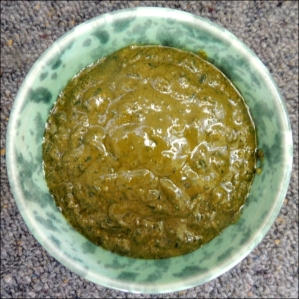
Throw everything except for the olive oil into a food processor and blend thoroughly. Then with the machine still running, gradually add the olive oil until the required consistency is reached.

pesto

If you like your basil chunkier, I’d suggest making it the conventional way, using a pestle and mortar.

Pesto can be kept in the fridge for several weeks. Spoon it into a decent-sized jar and pour on a thin film of olive oil. This will prevent the top discolouring – you can just stir it in each time you use it. It’s pretty yummy though… can’t see my batch lasting long.

You can also freeze small portions of pesto in an ice-cube tray then keep free-flow in your freezer for those winter months when you don’t have the luxury of fresh basil in your garden. It’s great with pasta, or as an addition to just about anything. 🙂


Nuts About Cream

Macadamia Nut Cream Experiment #1

Macadamia Nuts prior to cracking.

Nut Creams in General

We have so many macadamia nuts that we forget to use them. I’ve been meaning to experiment with making Macadamia Nut Cream for some time – not just for the vegans in the family but also as an alternative to dairy creams. Up until now I kept forgetting about it! (This is very typical of me… bright ideas, best intentions, etc…)

Last night we duly cracked some of our nuts and ended up with about 1 3/4 cups (230 grams) which I soaked overnight in cold water.

I had previously looked up a couple of recipes. The first I decided to adapt is for a regular nut cream, using cashews. Cashews, either alone or combined with almonds, appear to be the most commonly used nuts for nut creams and I can imagine why – they are so creamy and have such a lovely flavour. I’m not sure if our macadamia nuts will be ‘flavoursome’ enough.

The second recipe I’ll try is a recipe for Macadamia Nut Cream Topping. This combines macadamia nuts and coconut milk (among other things). But just now, I’ve tried the first recipe.

Nut cream on a spoon

Links to both of these recipes are here: –

Vanilla Cashew Cream
Pumpkin Pudding with Macadamia Nut Cream Topping

Recipe: Vanilla Macadamia Cream

For Experiment #1 I replaced the cashews with macadamia nuts.

Ingredients

  • 1 3/4 cups raw macadamia nuts, soaked overnight in water
  • 200 mls water
  • 2 tablespoons real maple syrup
  • 1/2 teaspoon natural vanilla extract
  • a pinch of sea salt

Process

I nuked all the ingredients in one of our blenders until it was smooth, keeping an eye on the amount of water to add. It was that easy!

The Finished Product

Vanilla Macadamia Cream - the finished product
Vanilla Macadamia Cream – the finished product

We’re pretty pleased with the result. The macadamia nut cream has a different texture from dairy cream – you can tell it’s nuts, I guess. It’s noticeably whiter and the taste is creamy and slightly sweet, not overly vanilla or maple syrup. Ben reckons it will taste great on French Toast. And it would be an excellent topping for a sweet pie or shortcake. I could easily eat it like ice-cream.

Calories

This yummy nut cream does come at a price, however.
One tablespoon (approximately 10 grams) equals 42 calories.

teaspoon
A dollop of yummy macadamia nut cream on a dessert spoon.

I’ll post about the second recipe, once we’ve finished this lot! It will be interesting to compare this adapted recipe with one written specifically for macadamia nuts.