Tag Archives: Ishikari River

JAPAN DIARY

十六 – Release of salmon fry into the Ishikari River

Asahibashi Bridge, Asahikawa.

Not for the thinly jacketed

It was bitterly cold on the day that I accompanied my daughter and two grandchildren to observe the release of salmon fry into the Ishikari River, on a stretch of land adjacent to the Asahibashi bridge.

In Spring each year, the local Ainu perform a ceremony to celebrate the life cycle of the salmon, after which,  baby salmon are released into the Ishikari River. This year, this event was celebrated on 31 March, and in our case, the children from local youchien (kindergartens) had been involved in raising the salmon fry from eggs.

What I hadn’t expected was how cold it would be. Down by the edge of the river, the wind was searing along the snowy foreshore like a razor-edged reaper. It scoured the shoreline, tossing the carefully spoken ceremonial chants into the wind.  It was difficult to stand still in a respectful manner, especially for the small children, some of whom were crying miserably.
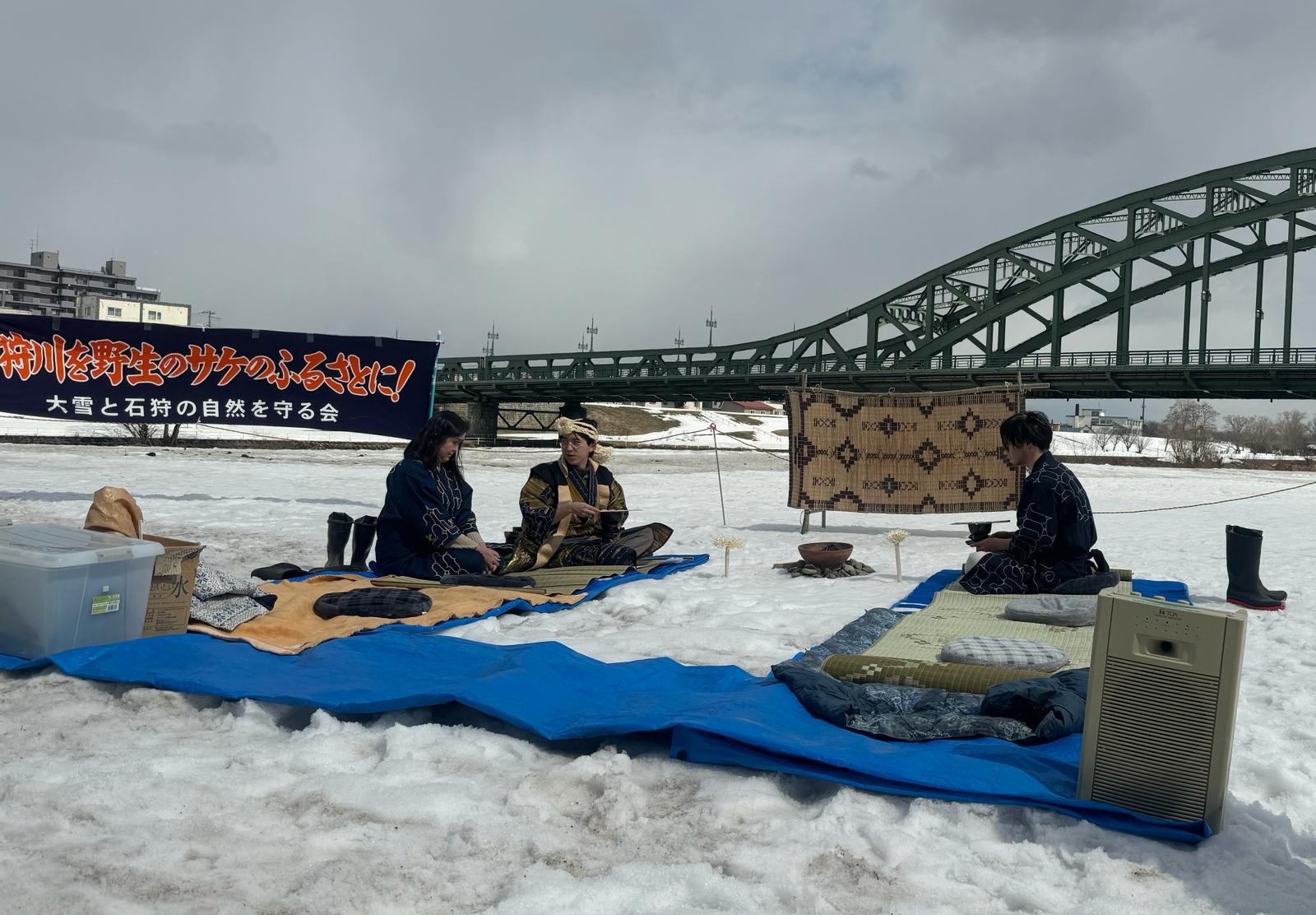
Local Ainu on the snow-covered foreshore of the Ishikari River.
Part of the ceremony involved the lighting of a small fire.

The small cluster of observers and particpants comprised mainly of the parents and children, a few interested locals, some Asahikawa officials, and the Ainu themselves, who were seated on woven mats between the spectators and the bridge.  There was no shelter.

The children had brought various containers in which to carry the baby fish.

The baby salmon were energetically swimming around in a large pastic tub. We stood in a straggly line, clumping together in small groups to keep warm. Once the ceremonial side of things was completed, and the officials had made their speeches, we stood with our backs to the wind, and made our way to the tub, where each child was given a scoop of babies into their containers. These were gripped tightly in their small mittened hands.

After this we slowly walked down to the river’s edge, with many stops and starts. The track through the snow had been roughly dug, and was a little steep and slippery, so only a small number of children and parents at a time were allowed to carry their precious cargo to the water.

Releasing the tiny fish into the bitterly cold water of the Ishikari River.

At the water’s edge the children first had to dip their containers into the icy river water so that the fish could acclimatise to their new environment. Then they held the cups partly submerged until the tiny fish swam out. Baby salmon released this year will make their way to the sea, a journey that will take about a month, and can be fraught with danger. Those that survive, will return to the river in three to five years’ time, to lay their eggs and restart the life cycle.

After we’d said goodbye to our fish, we made the way back through the snow to the car. The line was long and meandered like a mottled snake, and I was extremely grateful that we’d been standing near the front and were getting away first.

The wild salmon of Hokkaido

I have read that in in the past, salmon was a critically important food source for Ainu, and that they took great care not to exploit this resource, only catching the number they needed for their own survival. The fish were caught either directly prior to spawning for immediate consumption (fat salmon filled with eggs are unsuitable for preserving), or later on, at which time the fish would be dried.

As we left, I looked back and saw that the local Ainu representatives were packing up their mats and ceremonial gear, and I was relieved to see them pulling on warm jackets.


Traditional Ainu method for drying salmon
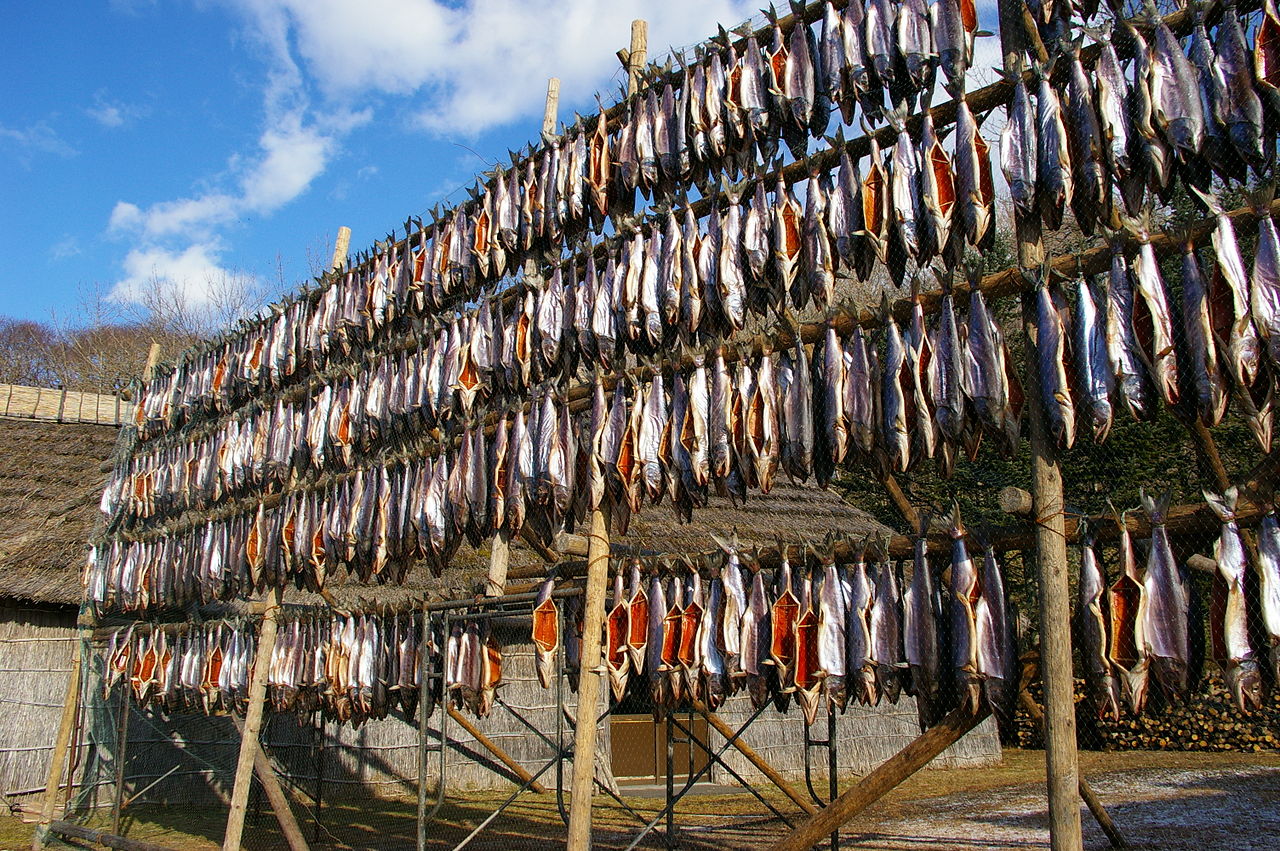
‘Salmon dried in the cold wind’, Ainu Museum in Shiraoi, Hokkaido, Japan, December 2008. (Wikipedia Attribution-ShareAlike 2.1 Japan licence)


By the Ishikari River

Stopbank walk 02
Walking at dusk alongside the Ishikari River.

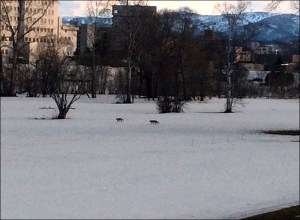
Walking along the bank above the grey green waters of the Ishikari, running full and fast due to snow melt, I disturbed a fox. It was up ahead, sniffing by a wooden post, tawny-coated below the silver-gold sky of a setting sun. It turned my way then ran down towards the water, a dark blur against the snow, brush tail flouncing.

There it rested beneath a bare branched willow and I saw that there were two. They were larger than I expected and I later read that they were most likely Kitakitsune. I tried to capture them with my iPhone but it was twilight, they were far away and on the move, and after three attempts my phone’s batteries expired and it shut down.

two foxes
Two foxes in the distance, bounding over the snow.

I walked on a little then turned and looked back. They’d stopped running and were standing immobile, heads raised, watching. I resumed my walk with a feeling of loss. It’s unlikely I’ll see those two again. Ahead, the sun dropped below the clouds and a sharp wind picked up dry leaves from the snow at my feet. A solitary Tobi circled high in the sky above.

The Kitakitsune, the Tobi, the fluttering leaves, the roiling river, and me. Nothing else moved in the silent landscape. To my left, the Ishikari flowed swiftly to the north, banks stacked with dirty piles of snow sculpted into strange shapes by wind and sun. To my right, rows of pastel houses, shabby-seeming in the twilight, displayed yellow-glowing windows.

You can walk in a foreign country and forget to see the differences while you tread the unfamiliar city footpaths and unexplored tracks by the river. You can investigate routes through powdery snow or earthy tree litter, while disregarding the strange smells and ignoring the different angle of the sun. You can choose to be in the moment or to let your mind drift away.


Japanese Diary

Ni – Asahikawa

Electric wires
Dark lines across clear blue skies
Sparks flare in my heart

wires 3 8 10 11

Asahikawa is a sprawling city, first settled by mainland Japanese in 1889. The name ‘Asahikawa’ can be directly translated to mean ‘Sun (or ‘Morning Sun) River’. It lies along the Ishikari River (Ishigari-gawa) in the agriculturally important Kamikawa Basin. The river’s name is derived from an Ainu term, ishikaribetsu, meaning ‘greatly meandering river’, which describes the flow of its lower course. To the east of Asahikawa is the Daisetsuzan National Park  and very close by are ski fields (comprising the ‘Hokkaido Powder Belt‘). It also has a well-known zoo. I’m staying at a central location, close to Tokiwa Koen.

Takiwa Koen

I’ve walked through Takiwa Koen a couple of times already. The park is still mostly blanketed with snow, and while many of the paths are exposed, you still have to negotiate around slick, icy patches and there are whole areas that are completely obscured. With daily temperatures ranging from 3 to 7 C this week, it won’t be long until all the snow has melted.

crow
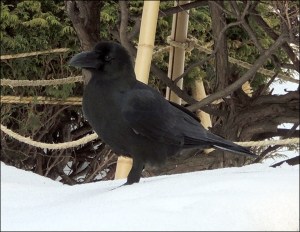
Large Billed Crow, Corvus macroryhnchos

The park is home to many crows. There are two species here – the Carrion, Corvus Corone, and the Large Billed, Corvus macrorhynchos. The Large Billed look especially comical and somehow ‘human’, with their fat beaks and high ‘foreheads’ – the beaks remind me of lips that have been treated with botox. There’s also a pair of mallards that I’ve seen paddling on areas of the lake with moving water, and there are other birds that I can hear chirping up high in the bare branches, but have so far have been unable to capture with my camera.

benches appearing

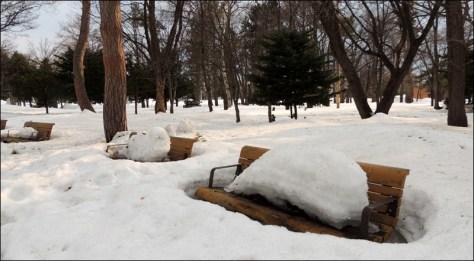
One thing I noticed yesterday was the emergence of the park benches.  A couple of days ago they were nowhere to be seen, well-camoflagued under drifts of snow. Now they’re appearing here and there, decked with large and irregularly shaped white lumps.

Local Scenery

bridge and building
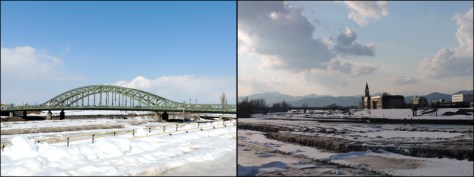
Left: The Asahibashi Bridge; Right: Bell Classic building (with the tower)

On Wednesday I walked through the park late in the afternoon, then headed across the Asahibashi; the large green bridge that spans the Ishikari river. I was curious about a structure on the northern bank, which reminded me of something more typical of Eastern Europe, than Northern Japan. It’s called ‘Bell Classic‘ and is a venue for weddings and so forth.

Strange New Things

When I arrived a week ago, there were many things that were strange or unexpected, standing out ahead of the more subtle differences. In any new environment, ‘first impressions’ quickly become commonplace and I can feel this happening already, so I’ve decided to focus on one of these ‘differences’ each time I write, (or at least until I run out of ideas!).

Cables, Pipes and Wires

wires 00

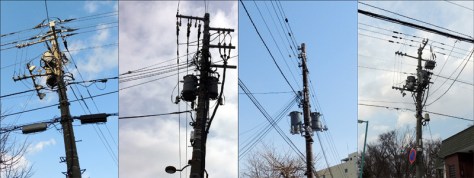
Powerlines! They’re everywhere, and not just the overhead wires, all the trappings associated with electricity are above ground, silhouetted against every skyline. They’re thick and black and many extend down into the pavement, often wrapped in bright yellow and black stripped casings.

wires 2 5 6 12

Until seeing the lines here, I hadn’t realised how much of New Zealand’s electrical cabling is below ground or tucked away discreetly. As far as I’ve been able to work out, part of the reason is convenience. If everything is out in the open and easily accessible it saves time (and money) when repairs need to be made.

1 4 7 9
Left and right: Tall poles with many wires; Centre top: Wires extend into the pavement; Centre bottom: Household gas meter

This also applies to household meters, such as those for gas. In the apartment I’m staying in, for example, the pipes just come up through the floor in the living area; the meter can be easily read. But I’ve also read that there are issues with their being so many wires above ground, both when it comes to safety (earthquakes are a risk further south, and heavy snow frequently brings lines down), and on the other side of the equation is the huge cost of converting them all to underground.

Even as I write this, I’m aware that I barely notice these wires any more. They are merely part and parcel of the scenery.


Next episode: Signs of Spring