Saying goodbye to sunny Napier–the view from the Koru Lounge window.
The Flights
Last week I embarked on my ninth trip to Asahikawa, and this time I flew Air New Zealand from Napier to Auckland to Shanghai, (where I had a six-hour stopover) to Tokyo. I must admit that the 12-hour flight from Auckland to Pudong Airport (Shanghai) wasn’t very enjoyable as the plane was completely full, no doubt due to the current reduction in flights and the inability to fly the Middle Eastern routes. And who would wish to fly via the USA? I was relieved to be flying to a safe part of the world.
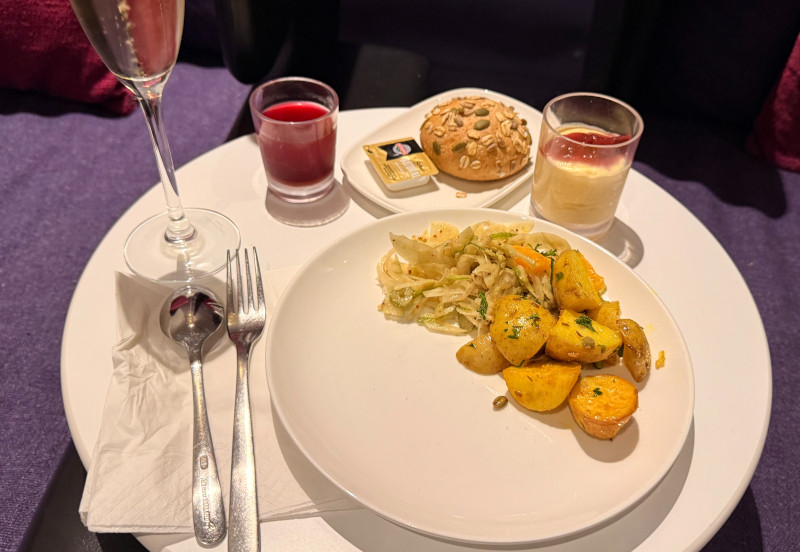
My meal in the Koru Lounge, Auckland International Airport
Auckland to Shanghai
Because the flight was so full, I was grateful to be seated adjacent to a friendly and considerate Cambodian couple from Auckland, who were travelling to Shanghai for a short holiday, before flying on to Cambodia to visit family. After my stint in the Koru Lounge, I had very little appetite, but did enjoy three films: (1) Colours of Time(La Venue de l’avenir), a French film about cousins inheriting an old 1800s mansion in Normandy, (2) Bugonia, a psychological thriller about the kidnapping of a CEO, who the kidnappers are convinced is an alien, and (3) Nuremberg, about a US psychiatrist and his relationship with Hermann Göring, leading into the Nuremberg trials post WWII.
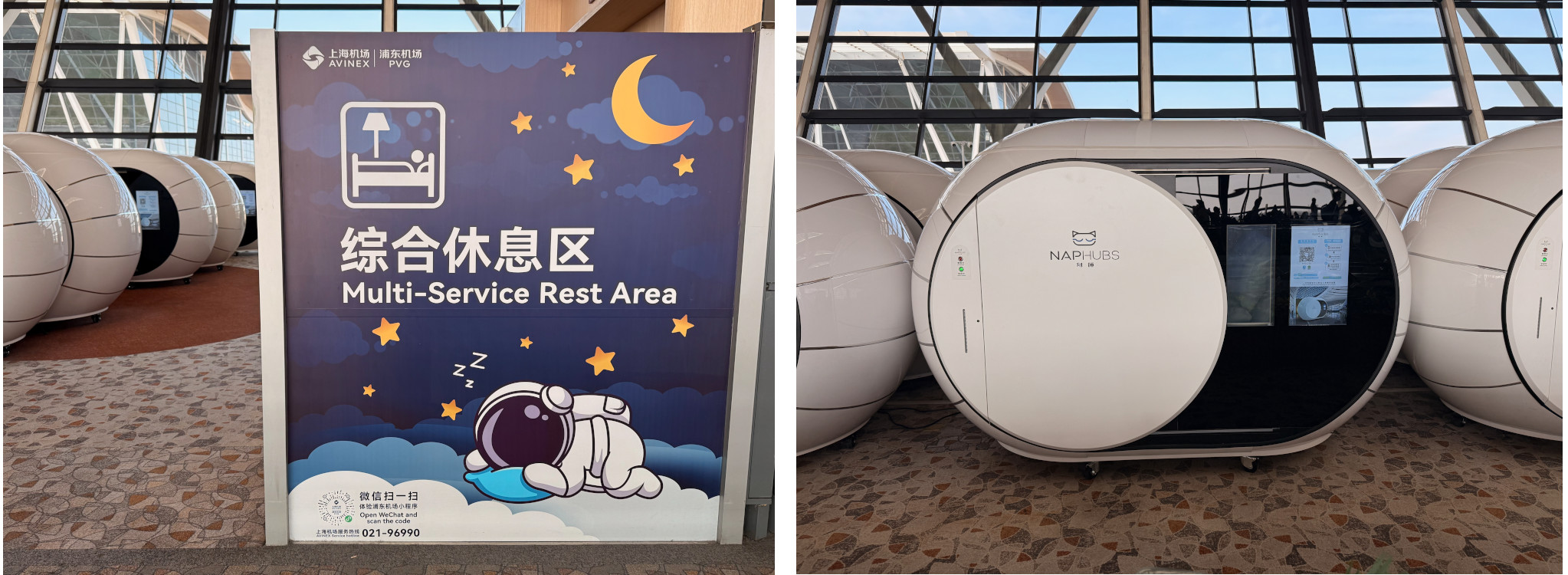
I was intrigued by these sleeping pods–very futuristic.
At Pudong, in a very tired state—I think I only managed a couple of hours’ sleep on the flight—I had to collect my luggage and go out through Customs and Security, and then retrace my steps and go back through the way I’d come, as I was flying on a different carrier (ANA) for the final leg. To be honest, that part of my trip is a complete blur, but despite being confused as to where to go a couple of times, and then initially not realising that I was ‘out’ of the international departures area, and that I had to go back ‘in’, I managed it somehow.
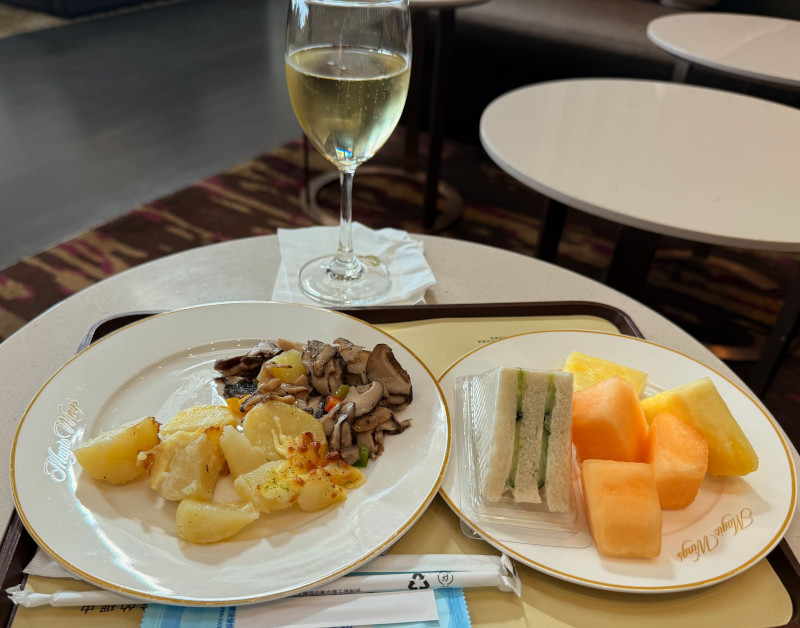
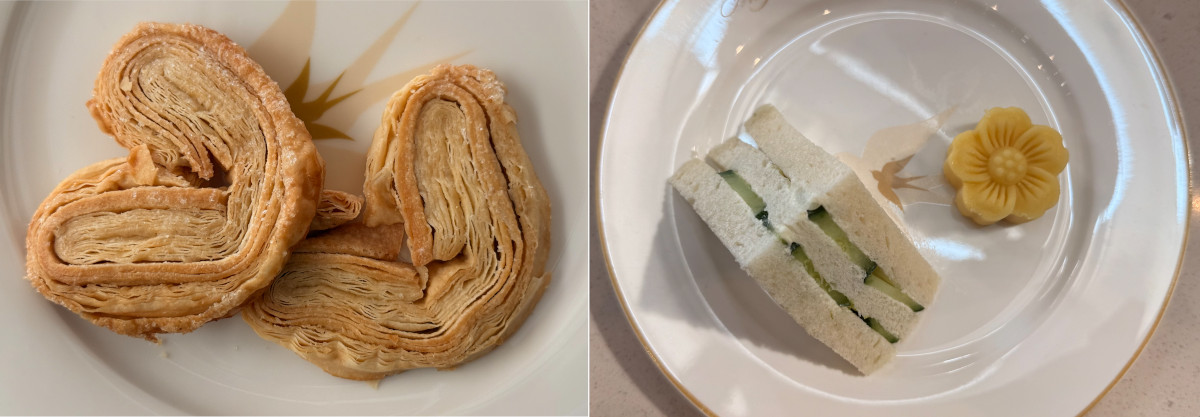
My ‘light’ meal at the China Eastern No.77 Lounge. Sautéed mushrooms and potatoes, fresh fruit and a cucumber sandwich.
Pudong airport is very clean and modern and if I’d been less tired, I’d probably have explored it more thoroughly. One of the things I liked was that there were water stations everywhere—both cold and boiling–should you need it, and they had paper cups. I was also glad that I had a Premium Lounge voucher, and once I’d found my way to the China Eastern No.77 Lounge, I settled in for the full six hours. I even slept for about 40 minutes at one point.
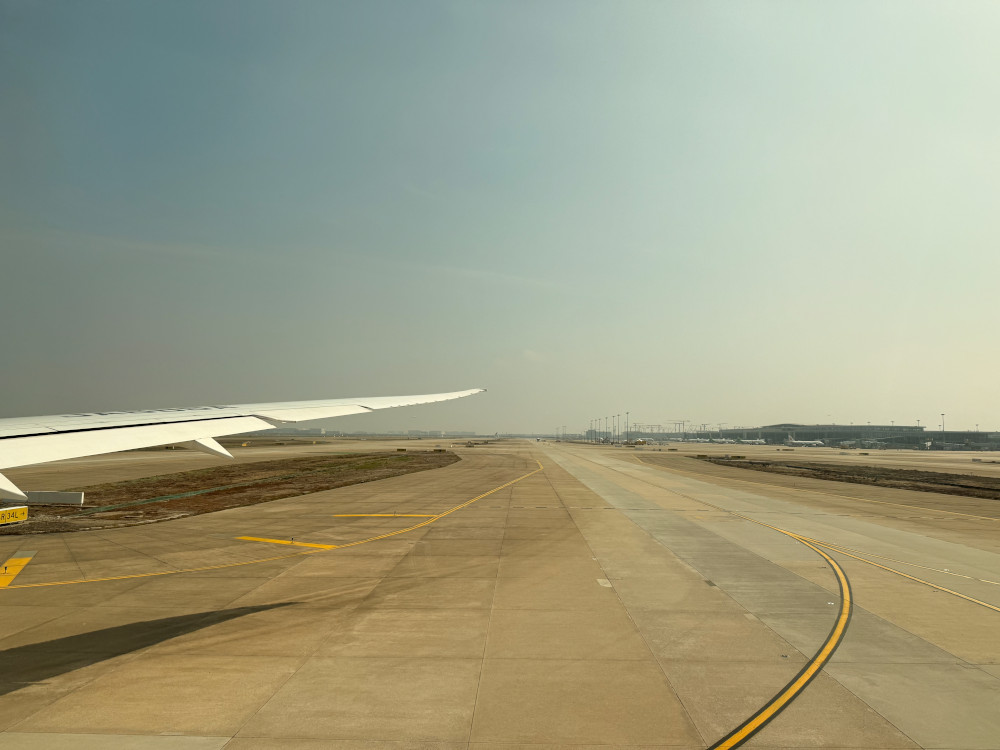
I really liked the Palmiers (right) and came back for seconds, but the cute little mung bean cake (shaped like a flower) was less to my taste. Cucumber sandwiches always go down well with me.The very hazy view out of my window as we taxied along the runway at Pudong Airport.
Shanghai to Narita
Before I knew it, I was boarding the ANA flight to Narita. This leg of the journey was pleasant and unremarkable, and I was served up a really nice Japanese-style meal, which I hadn’t expected on so short a flight.
Narita was another story—the line through to Customs and Security was the most congested I’ve encountered in all my nine trips. Except for 2022, perhaps, when I was travelling on a special family VISA after Japan first opened up to foreign visitors post COVID. That occasion would have to rate as my most stressful airport experience of all time, and if you’re vaguely interested, I wrote about it here.
So, this time round, despite the easy flight, I was beginning to feel the effects of jetlag, and when I caught sight of the long line, zig-zagging towards Security, my heart fell. I’ve been in similar, seemingly endless lines at LA and London before, but hadn’t expected it at Narita. And as is often the case, when I got to what looked like the end, I rounded a corner and realised it condensed into an even tighter set of zigzags on the other side.
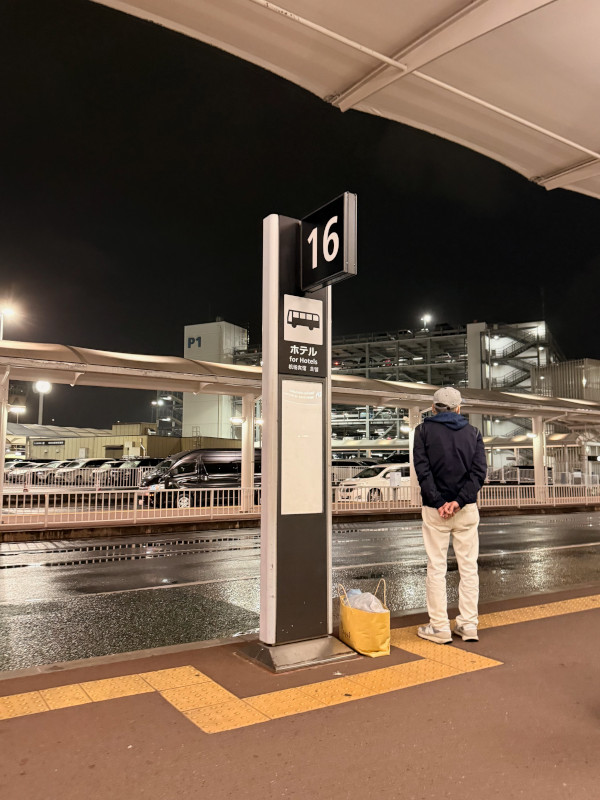
Waiting outside Narita Airport for the Art Hotel shuttle.
I did survive this experience, and thanks to the seamless electronic process available through Japan Web, going through Passport Control was plain-sailing. Before I knew it, I was out on the street—experiencing some cooler air, at last—waiting at Stop 16 for the shuttle to take me to the Art Hotel, Narita.
十六 – Release of salmon fry into the Ishikari River
Asahibashi Bridge, Asahikawa.
Not for the thinly jacketed
It was bitterly cold on the day that I accompanied my daughter and two grandchildren to observe the release of salmon fry into the Ishikari River, on a stretch of land adjacent to the Asahibashi bridge.
In Spring each year, the local Ainu perform a ceremony to celebrate the life cycle of the salmon, after which, baby salmon are released into the Ishikari River. This year, this event was celebrated on 31 March, and in our case, the children from local youchien (kindergartens) had been involved in raising the salmon fry from eggs.
What I hadn’t expected was how cold it would be. Down by the edge of the river, the wind was searing along the snowy foreshore like a razor-edged reaper. It scoured the shoreline, tossing the carefully spoken ceremonial chants into the wind. It was difficult to stand still in a respectful manner, especially for the small children, some of whom were crying miserably.
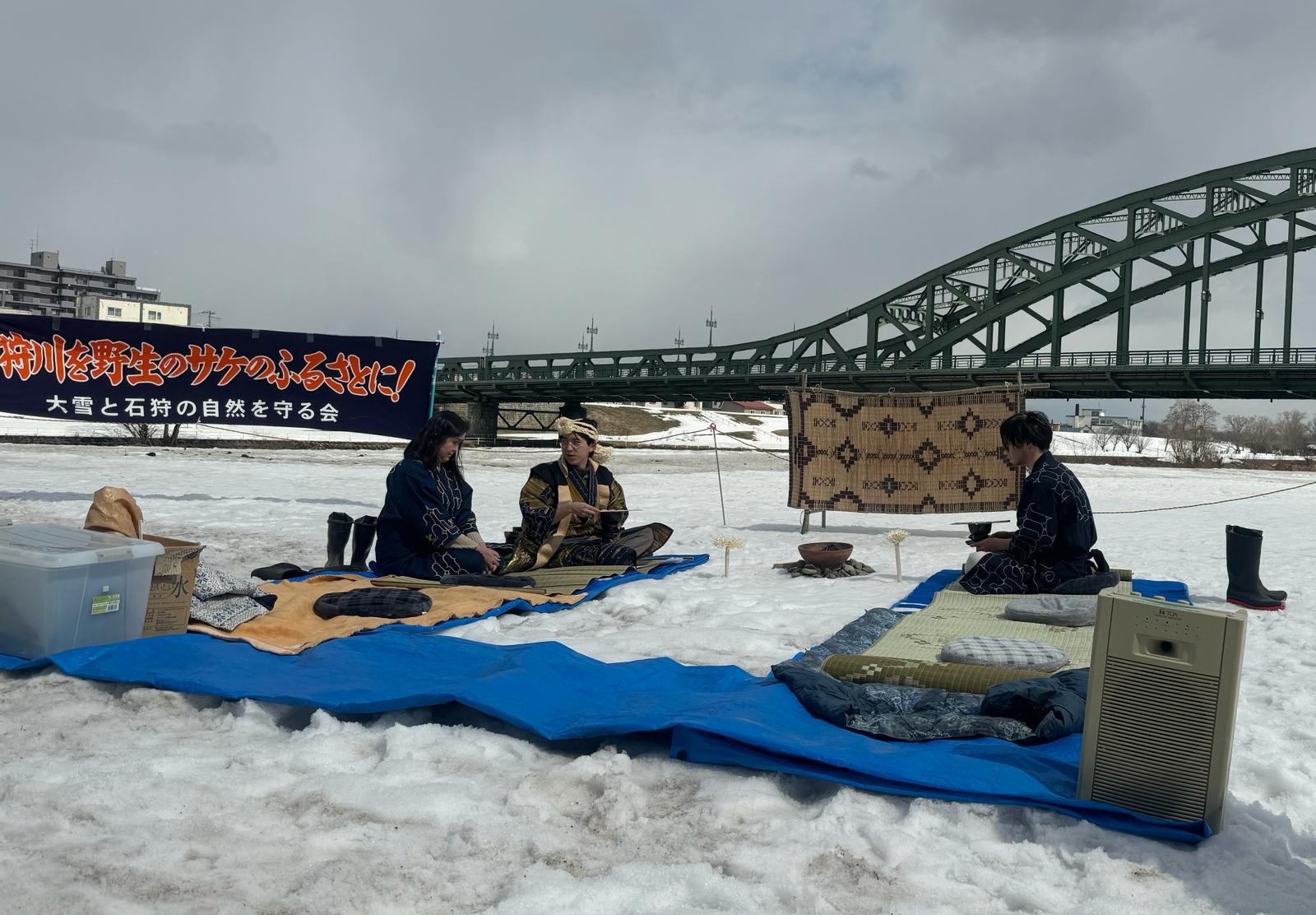
Local Ainu on the snow-covered foreshore of the Ishikari River.Part of the ceremony involved the lighting of a small fire.
The small cluster of observers and particpants comprised mainly of the parents and children, a few interested locals, some Asahikawa officials, and the Ainu themselves, who were seated on woven mats between the spectators and the bridge. There was no shelter.
The children had brought various containers in which to carry the baby fish.
The baby salmon were energetically swimming around in a large pastic tub. We stood in a straggly line, clumping together in small groups to keep warm. Once the ceremonial side of things was completed, and the officials had made their speeches, we stood with our backs to the wind, and made our way to the tub, where each child was given a scoop of babies into their containers. These were gripped tightly in their small mittened hands.
After this we slowly walked down to the river’s edge, with many stops and starts. The track through the snow had been roughly dug, and was a little steep and slippery, so only a small number of children and parents at a time were allowed to carry their precious cargo to the water.
Releasing the tiny fish into the bitterly cold water of the Ishikari River.
At the water’s edge the children first had to dip their containers into the icy river water so that the fish could acclimatise to their new environment. Then they held the cups partly submerged until the tiny fish swam out. Baby salmon released this year will make their way to the sea, a journey that will take about a month, and can be fraught with danger. Those that survive, will return to the river in three to five years’ time, to lay their eggs and restart the life cycle.
After we’d said goodbye to our fish, we made the way back through the snow to the car. The line was long and meandered like a mottled snake, and I was extremely grateful that we’d been standing near the front and were getting away first.
The wild salmon of Hokkaido
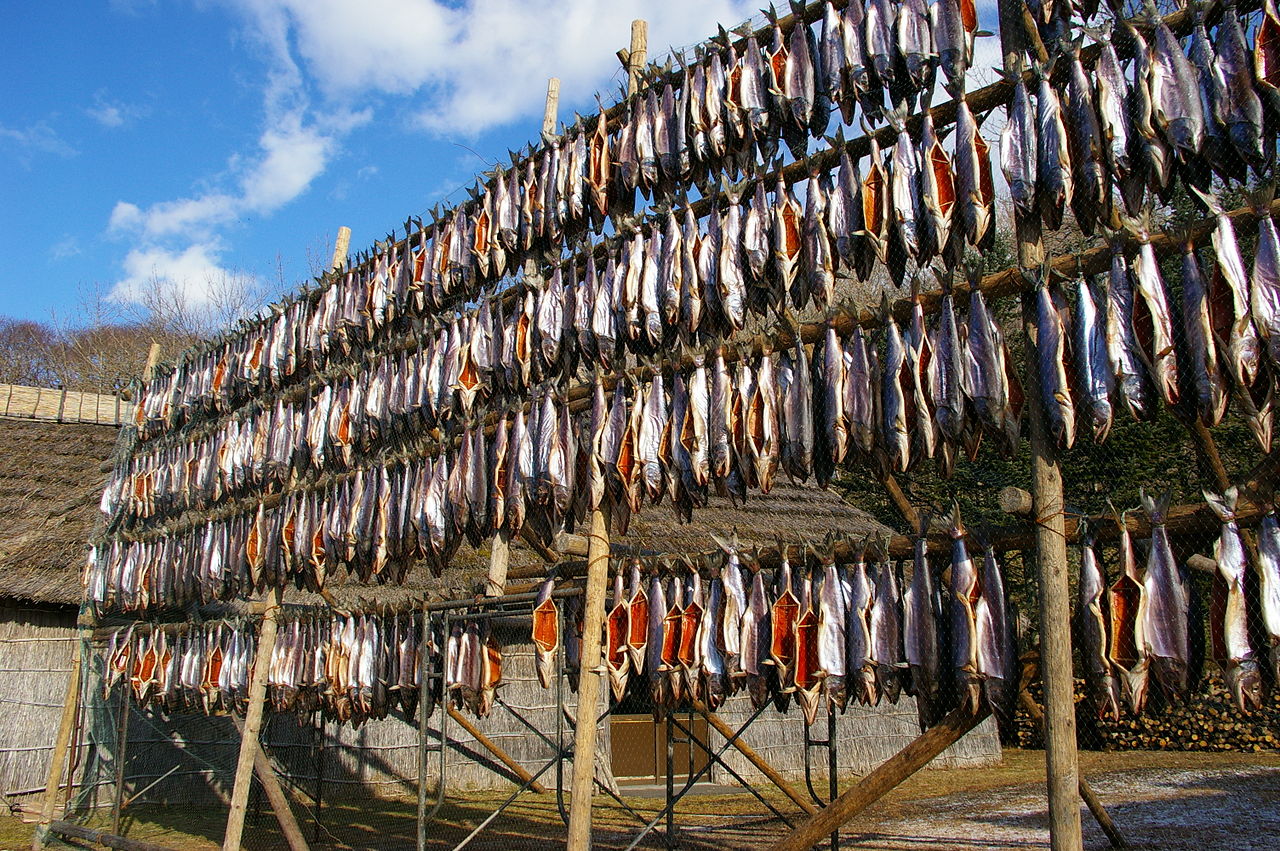
I have read that in in the past, salmon was a critically important food source for Ainu, and that they took great care not to exploit this resource, only catching the number they needed for their own survival. The fish were caught either directly prior to spawning for immediate consumption (fat salmon filled with eggs are unsuitable for preserving), or later on, at which time the fish would be dried.
As we left, I looked back and saw that the local Ainu representatives were packing up their mats and ceremonial gear, and I was relieved to see them pulling on warm jackets.
Last week, on a crisp snowy day, I visited the recently relocated Kawamura Kaneto Aynu Museum, which is the repository of cultural artifacts and information relating to the Ainu people of the Asahikawa area.
The Ainu are considered to be the native people of Hokkaido, southern Sakhalin, and the Kuril Islands. They have lived in Yaunmosir (Hokkaido) for more than 15,000 years, and are the major ethnic minority in the Japanese islands, with a distinct and unique culture and way of life.
In the 18th century, there were estimated to be 80,000 Ainu across the three areas, but by 1868, due to factors such as forced assimilation, family separation and the effects of smallpox, this number had declined to around 15,000 in Hokkaido, 2,000 in Sakhalin, and as few as 100 in the Kuril Islands. While official figures estimate the current number of Ainu to be 25,000, unofficial estimates suggest that the total is more likely to be around 200,000 as due to their almost total assimilation into Japanese society, many are unaware of their ancestry.
Immediately prior to the Meiji era (late 19th century) Japan’s northern-most island was known to its southern neighbours as Ezochi, and other than some small Japanese settlements on the southern coastline, was largely ignored. Up until this time, the Yaunmosir Ainu lived peacefully, in harmony with nature. As recorded by the early 20th century Ainu transcriber and translater, Yukie Chiri, in her book, Selected Stories of the Ainu Gods, “The people of Yaunmosir, the Ainu, honoured the natural world as kamuy (gods) and lived abundant lifestyles filled with prayers, singing and dancing: their lives were bright and busy, mixed with laughter, tears, anger and joy”.
In 1869, however, Japan was concerned about a possible Russian invasion, and in order to prepare their northern defenses, they annexed the entire island, at which time the name was changed to Hokkaido. Before long, ethnic Japanese began arriving in the Asahikawa area. The Meiji government had a colonisation policy of land reclamation, with total disregard for Ainu concepts of land ownership. In fact, at that time, many Japanese settlers regarded the Ainu as, “inhuman and the inferior descendants of dogs”.
Sadly, the Ainu story from this point, has unfolded in much the same way as that of other marginalised peoples, where they have suffered the loss of their autonomy, lands, and traditional ways of life. They have endured forcible relocation from their kotan (villages) and have been prohibited from fishing, hunting, and speaking their own native language.
Despite these terrible losses, the Ainu people have survived, and from what I have read and been told, there is a small but strong community in Asahikawa and the surrounding area. The snowy field may be vast and filled with obstacles, but the Kawamura Kaneto Aynu Museum is a priceless seed sown very deeply at its heart.
Museum history
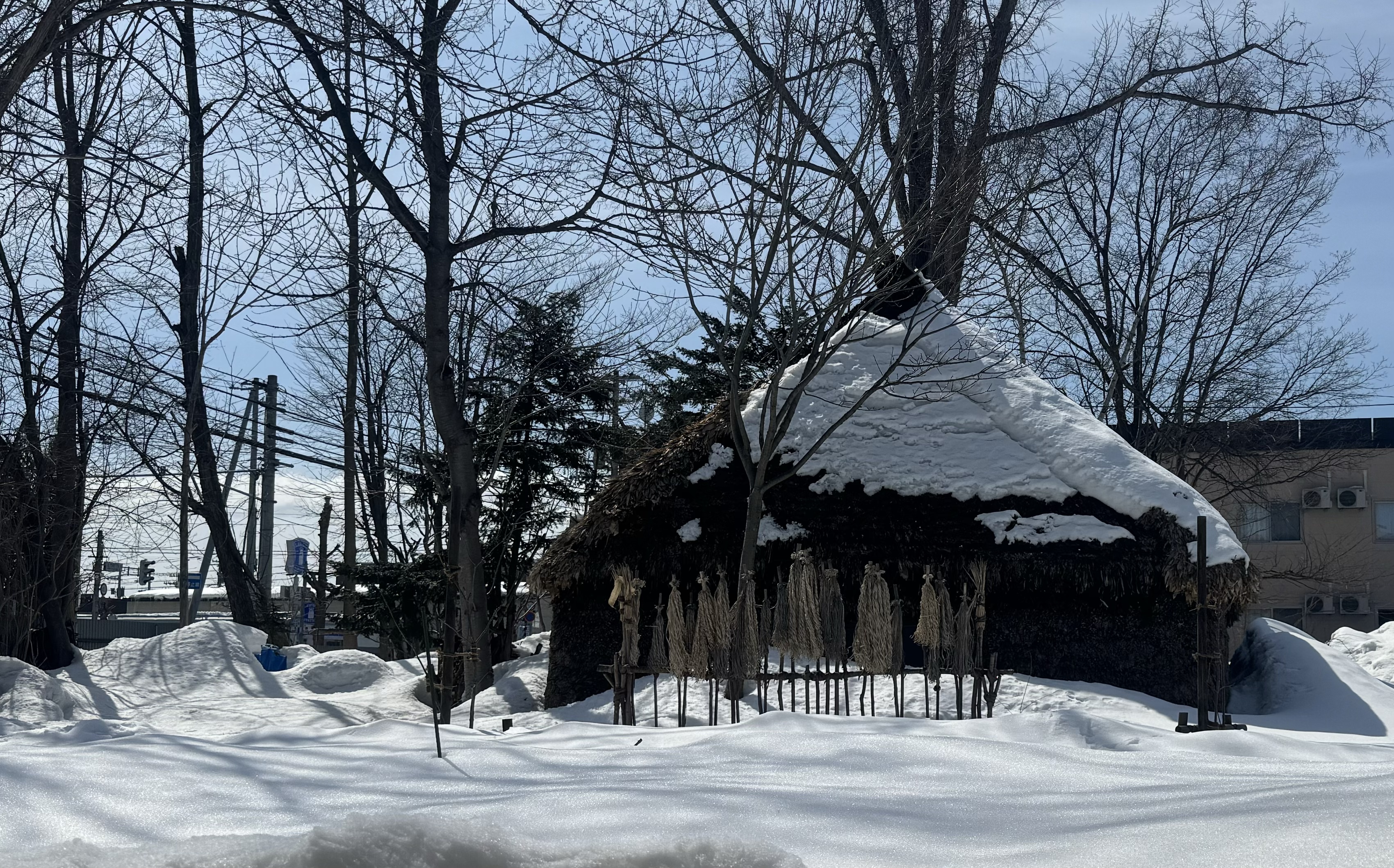
A traditional Ainu dwelling in the grounds of the Kawamura Kaneto Aynu Museum, Asahikawa.
Around the time that Hokkaido was annexed and the Seventh Division of the Japanese Army was established in Asahikawa, an influx of ethnic Japanese visitors came to Chikabumi Kotan, where the local Ainu people then lived. To help the newcomers understand Ainu heritage, their leader, Kawamura Itakishiroma, constructed a traditional Ainu dwelling separate from his own, which he used as a venue to explain the Ainu culture. And thus, the museum was born.
From this time, the role of director of the museum was passed down within the Kawamura family, and they are still strongly involved with preserving Ainu knowledge. Similar to Māori, although on a much smaller scale, the Ainu of Hokkaido, are gradually restoring their mana through the recreation and enactment of traditional ceremonies, and by sharing traditional customs and traditions. The museum as a living tribute to the Ainu way of life is integral to this process.
On the day we visited, we were the only visitors–in fact, the only other person I saw was the woman who collected my 800 yen entry fee. The modest collection of beautiful artefacts provided much food for thought. In many ways, the museum itself feels somewhat dispossessed, or perhaps, displaced, situated as it is, right in the middle of an impersonal cross-hatch of suburban streets. The imagery evoked by the exceptional carvings of bears, fish and birds suggests rugged mountains, fertile plains, thick forests and sparkling streams–memories trapped within the static forms.
I was hoping to see some photographs from the old days, especially of Ainu women with their traditional facial tattoos, or of the children of the times, but there were few on display. Some images can be found online, of course (and the ones I’ve used here are open domain images from Wikimedia Commons). We all know that the early anthropologists were naturally curious about the ways of life of indigenous people, and that they rarely took the feelings of their subjects into account. The brochure I picked up at the museum also had some interesting photographs.
Some more about traditional Ainu culture
The division of roles
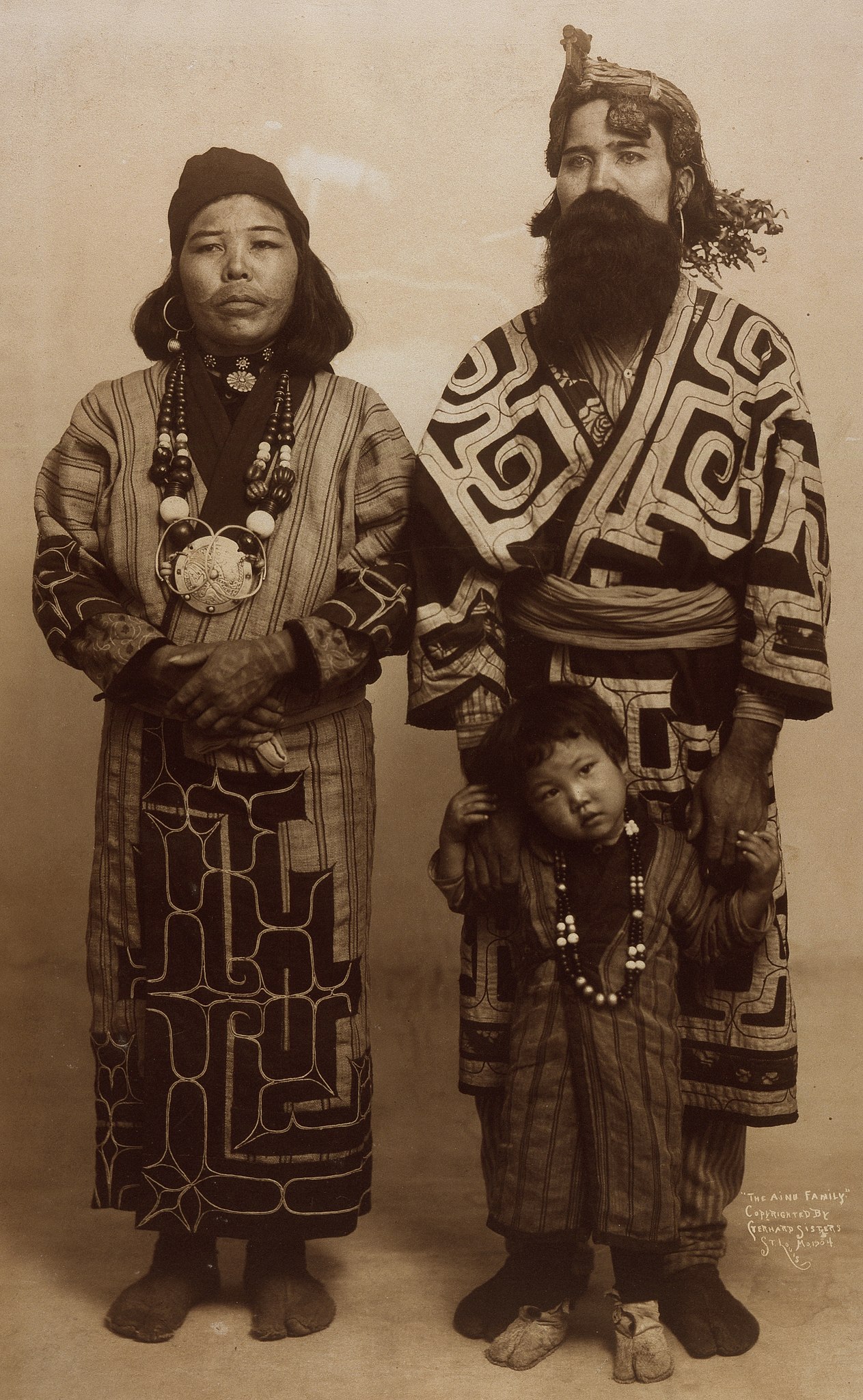
‘The Ainu Family’, a photograph taken during the 1904 World’s Fair, and currently held in the Missouri History Museum. (Wikimedia Commons)
Ainu women had a very hard life, or as the documentation in the Anyu museum puts it, their noses were kept to the grindstone. They gave birth to and raised their children, foraged for edible plants, produced everyday items, wove fabrics, gathered firewood, and occasionally, even carved wood. They didn’t waste a single material, and decorated everyday items with traditional patterns, which have been passed down from mother to daughter. These are often abstract designs that represent objects found in the natural world.
Ainu men engaged mainly in hunting, fishing, trading, and offering prayers to the deities. They were also required to protect their families and villages. The tradition for succession, was that eloquent orators who displayed courage and dignity, and excelled in dexterity, were selected by the people to be village chiefs; hereditary succession was forced on them after annexation.
Bears – Kamuy imoka, a gift from the gods
One of the many carvings of bears in the Kawamura Kaneto Aynu Museum, Asahikawa.
Hokkaido is home to the Ussuri Brown Bear, and these animals were (and are still) extremely important to the Ainu, for their fur, their meat and also because they are believed to be gods in human form–in fact, in the Ainu language there are over 80 words for bear. Kim-un kamuy (the god that is always in the mountains) is the word used most often. According to Ainu tradition, in the world of the gods, gods exist in the same form as humans, but when they visit the world of the humans, they take on the form of animals. People who had been visited by bears, therefore, were considered to be trusted by the gods.
In the older times, cubs born during hibernation were raised with care by human famililes. The mother of the household would breastfeed the bear cub and it would be raised until about two years old, as if it were their own child. Then on a cold winter’s day, when the temperature dropped to around -30 degrees, the little bear’s spirit would be ritually parted from its body, and the spirit would return to the world of the gods, where its ‘real, dear mother’ would be waiting for its return. The iyomante (ritual) would last for three days and three nights, during which the sad parting from the bear cub would be transformed into the power to overcome winter.
In the museum I think I saw more carvings of bears, than of any other creature.
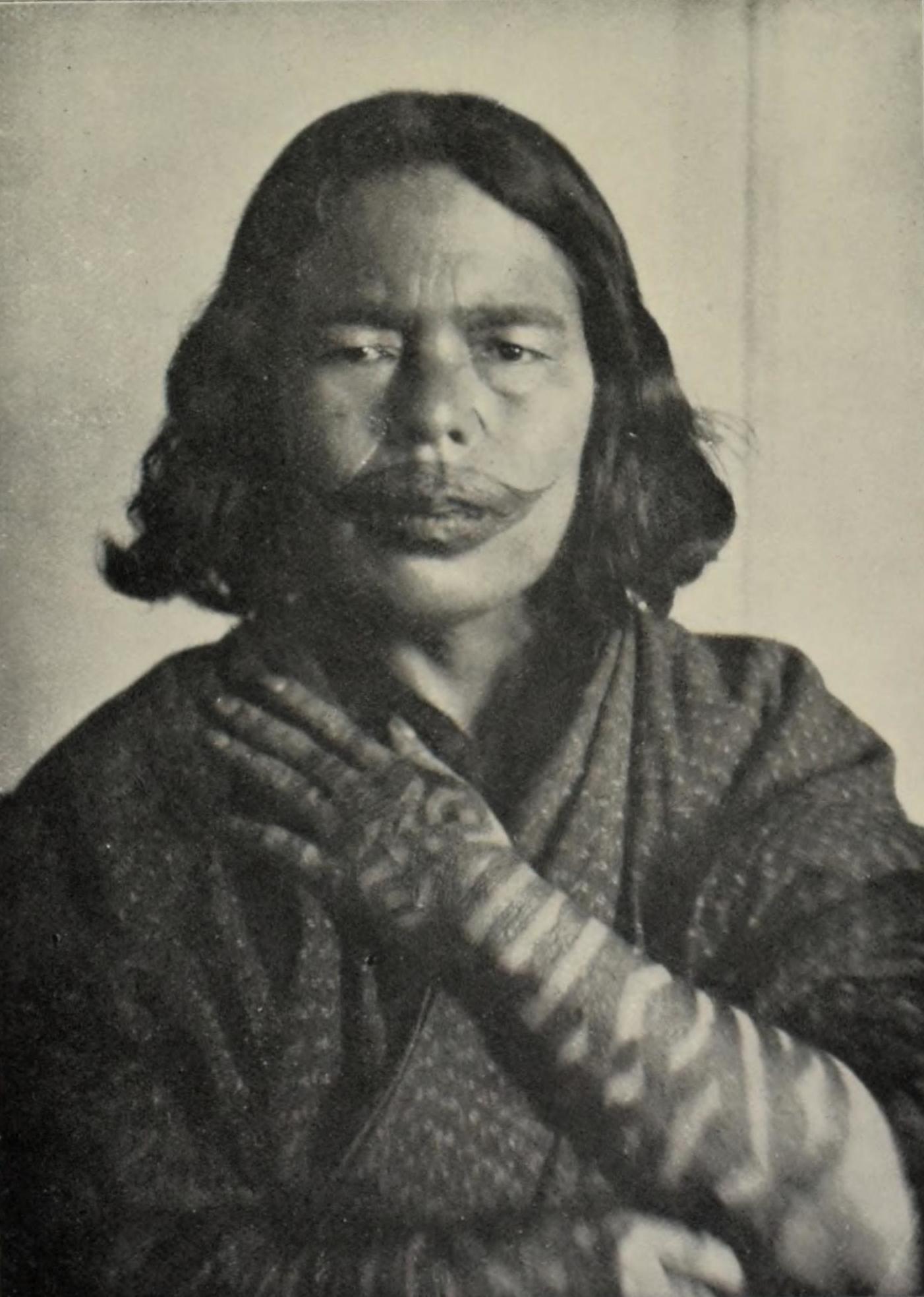
An Ainu woman displaying the traditional facial and forearm tattoos. Sourced from, “The Ainu and their Folkore”, (1901), page 21 (Wikimedia Commons)
Ainu women traditionally underwent facial tattooing, and to a lesser degree, arm and hand tattooing. Only women were tattooed, and only women were the tattooists, and this practice continued down the matrilineal line. Tattooing was prohibited by the Japanese at various times both before and after annexation, but it wasn’t until 1998 that the last fully tattooed Ainu women died. It is unsurprising that the practice took such a long time to fade out, as being tattooed was traditionally a prerequisite to marriage and to the afterlife.
When I first was shown photographs of an Ainu woman with the traditional tattoo around her lips I was fascinated. To my western, kiwi eyes, this looked so unusual–both alien, and yet, beautiful. If you are interested in reading more about the tradition, and also the different patterns and designs, Lars Krukak’s website, ‘Tattooing among Japan’s Ainu People’ is well worth a visit.
The past and what it means for the present
I suppose that life ‘goes on’; the sheer energy of birth and death has its own momentum. We can look back at the atrocities of the past and see how they are reflected in the terrible things that are still happening, right now, this very moment as I write.
I think about loss of culture and how this can impact future generations, and of the way that the history of Ainu is so very similar to the history of Māori in my own country of Aotearoa. I think about the Middle East and feel dread about how today’s actions are affecting countless children, countless women, countless future generations.
I also like to think (hope?) that for every terrible thing we hear about, there is somewhere, some positive thing occurring, no matter how small the scale, that might be the first tiny seed of change. I wonder how many people have hoped or prayed for the same thing, only to be disappointed.
It does seem to me, however, that the Ainu haven’t given up. They are not merely looking back and dwelling on what they cannot change; they are making their way forward and picking up the pieces of their history. Rebuilding and relearning.
Ainu women in the 1930s (Showa era). Kawamu Kawamura Kaneto Aynu Museum brochure.
Snow cloaking trees on the side of the road. On the bus from Asahikawa Airport to the Railway Station.
I’m back in Asahikawa (Yay!), and it feels really good. This is my eighth trip to Japan, and I’m not sure if I’ll make this trip again due to various external factors, so I intend to make the most of this visit.
Napier to Asahikawa
To get to Japan, I first took an afternoon flight from Napier. I had a front seat and was wedged in beside the guy in the above photo. I couldn’t resist capturing the view.
Flying between Napier and Auckland.
After flying in from Auckland to Narita Airport, Tokyo, I was able to take a direct flight to Asahikawa, rather than first having to transfer to Haneda Airport. This was thanks to a new route opened up by Jetstar Japan. Narita and Haneda airports are quite a distance apart and to travel from one to the other usually requires a couple of train trips, or catching the Limousine Bus. Having the option of a direct flight from Narita was too tempting to ignore. I was a little worried, however, about my timings. If my Air New Zealand flight ran late, and if Passport Control and Customs at Narita were especially busy, then I would be cutting it fine to get to Terminal 3 in time for my Jetstar flight. As it turned out, I had plenty of time as we arrived early, and the airport wasn’t busy.
The first view of the southern edge of Hokkaido, from the window of my plane.
The flight to Asahikawa took just under two hours and was uneventful. I had purchased a premium booking with a ‘meal’, luggage of up to 30 kg (way more than I needed), and the option to change flights at short notice. The ‘meal’ turned out to be a hot drink and a piece of apple-filled pastry in a celophane wrapper. If I had to rate it, I’d say it was ‘just okay’, but I didn’t really mind, I was just pleased to have connected successfully. The skies were clear and I was afforded a clear view of the spectacular mountainous scenery, especially as we drew closer to Asahikawa.
View of the mountainous terrain as we flew closer to Asahikawa.
Items that are hard to find at home
My main purpose for visiting Japan is to catch up with my daughter, her husband, and my two grandchildren. But I while I’m here I also intend to purchase some bits and pieces that I’ve come across on previous visits, and that I’ve wished I’d purchased at the time.
Mini vacuum cleaner – it’s only 6 cm in diameter!
Japan does particularly well at producing useful items that you didn’t know you wanted until you saw them. I’ve spent a great deal of time in New Zealand looking for exactly the right kitchen or bathroom item, to no avail, and often when I do find a suitable product, it’s either ‘not quite right’, or its seriously over-priced.
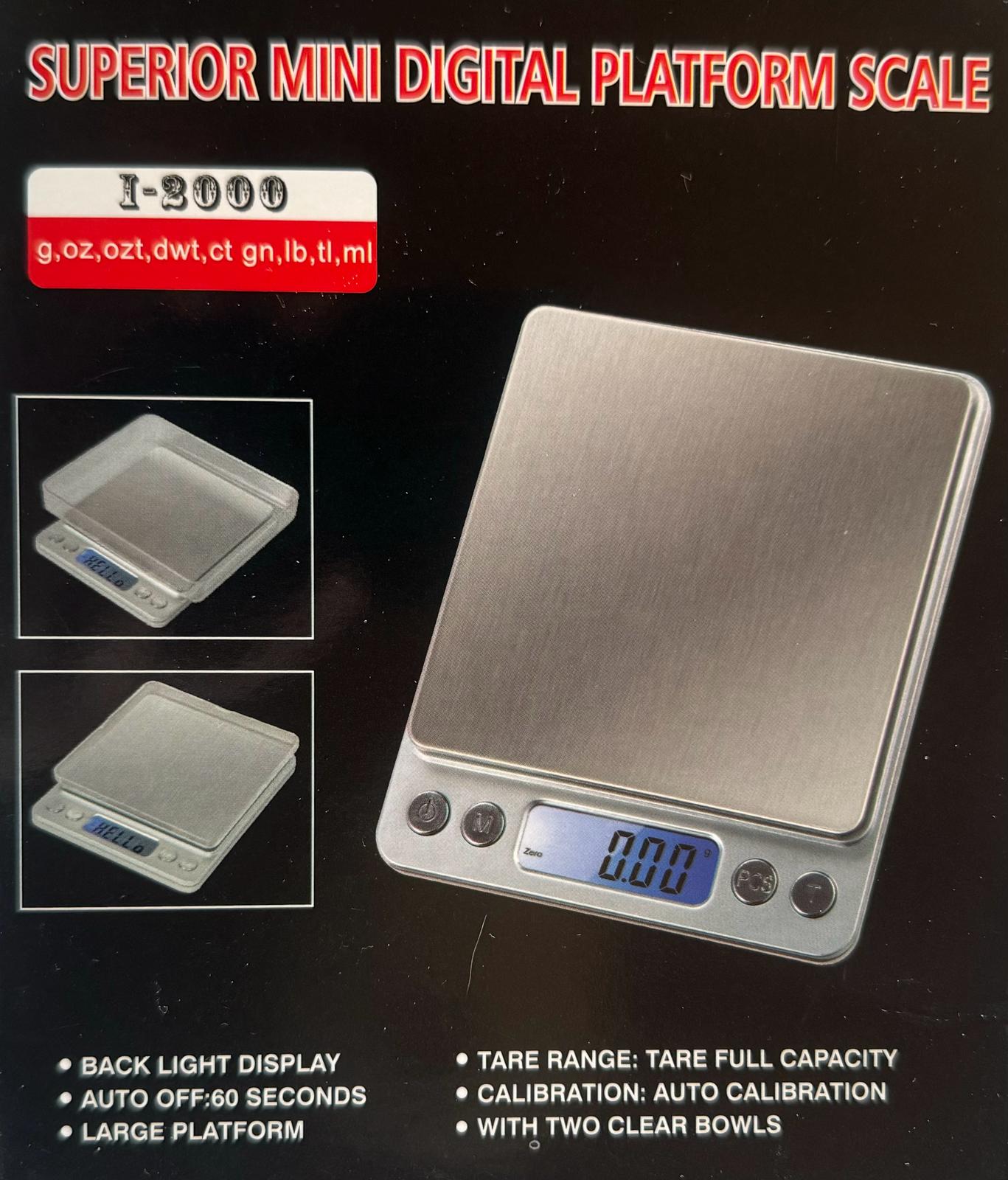
Tiny scales, approx 13 x 11 cm
If you were to look at my list, you’d see a bunch of trivial items: a very small digital kitchen scales (you’ll think I’m weird, but sometimes I’d like to know how much hot chips I’m eating, or just how heavy a date scone is); a cute little mini vacuum cleaner to clean up crumbs (or other small debris) off a table; a second super light-weight feather quilt for those summer nights in New Zealand that are too hot to be covered with anything, but when you just want ‘something’–I purchased one last year and it was perfect; a set or two of versatile shelving and/or containers that can either be stuck, or screwed to tiles or a wall, or attached to a magnetic surface.
These 100% cotton kitchen towels are not only beautifully made, they are very functional.
I always look for products that have been made in Japan, but many everyday items, while of Japanese design, are produced elsewhere, most commonly in China, or Korea. Japan produces its own premium items, of course, and for the visitor, these are definitely worth purchasing when you can, due to their superior quality and thoughtful design. Linen, paper products, writing materials, ceramic items, knives, glassware, cakes and candies, technological wares… the list goes on and on.
Snowy roads and pathways
Returning home after dinner at Jiji and Baba’s.
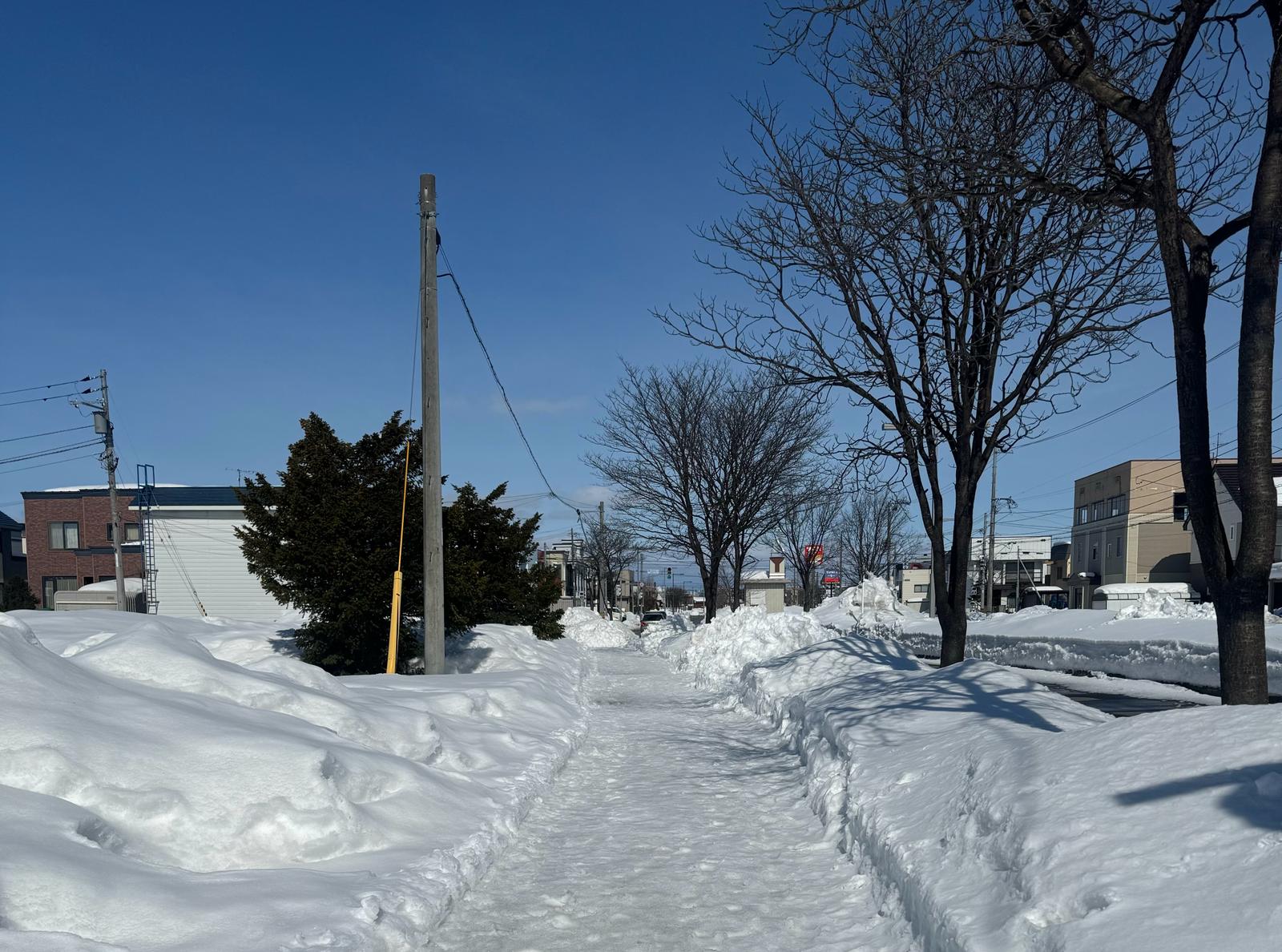
There’s a lot of snow lying around in Asahikawa compared with the last couple of years that I’ve visited. And it’s colder, according to the weather app. I’m glad. I would feel short-changed if there was no snow. It’s very beautiful, even with the heaps of snow discoloured by the muck on the sides of the road. I can ignore those and just focus on the pure white mountains piled up everywhere else.
Running in the snow. The banked up snow will reveal a flat, grass playing field, when melted.
I know that the snow will disappear quickly, with every day that climbs above zero degrees, but so far, the gardens are completely dormant, the plants still sleeping under their white blankets. Out of curiosity I visited the garden section of DCM Homac, a hardware / DIY chain, to see what they were selling, but as far as outside plants were concerned, all I saw were trees—flowering cherries, dogwoods and magnolias. No perennials yet. And not much else, either.
As I grow older, my body has begun to display issues associated with the wear and tear of a lifetime. I currently have a problem with my right knee (synovial chondromatosis); it isn’t such a big deal, but it does mean that my knee becomes quite painful when walking, or more so if I have to walk up or down stairs, or up or downhill, and this will affect how much I can get out and about. If you’ve followed my blogs in the past, you’ll be aware that I usually like to take long walks—this time I fear my walks will be much shorter, but I’m determined to get out as much as I can. I’m seriously looking forward to the first signs of Spring.
Spring, donuts and nostaglia
A few days ago it was Vernal Equinox Day 春分の日(Shunbun no Hi), a public holiday to mark the end of Winter and the beginning of Spring. This day was originally an event relating to the Shinto religion, but after WWII, and in line with Japan’s post-war constitution, it was repackaged to separate religion and state, becoming a public holiday in 1948. The main thing I noticed were the kids off school, and more people out and about.
Sakura ‘half bloom’ donut – a delicately flavoured delight.
Yesterday I went out to look for a birthday present and ended up visiting Mister Donut for lunch. I prefer not to eat too many sweet cakes, so chose a ホットドッグ (hottodoggu) to go with my Sakudo blooming donut (Yes, really healthy!) Japan loves seasonal themes when it comes to popular food, and sakura is the flavour for Spring. I couldn’t resist the donut as I was curious about the flavour. I wasn’t disappointed; it was lightly sweet with a delicate floral quality. Perhaps it did taste like the fragrance of sakura. I certainly remember as a child, the sweet smell of the snowy white blossom on our Mt Fuji cherry(Prunus serrultat ‘Shirotae’).
While I was munching away, Michael Jackson’s 1972 song, ‘Ben’, started playing in the background. I used to love that song. What a flashback! I would have been 15, and I still know the words off by heart. It reminded me of riding my bike with my neighbour Lynette, listening to pop songs and being the age where my whole life stretched out ahead of me.
Walking home last Wednesday.The same path, yesterday (4 days later). The snow isn’t in any hurry to melt.
South Head to Napier
Once I’m back in New Zealand, I will no longer be writing from South Head. In February, we made the move to Napier, in the Hawke’s Bay. So, I’ll be writing about quite different things and posting photographs of quite different scenery.
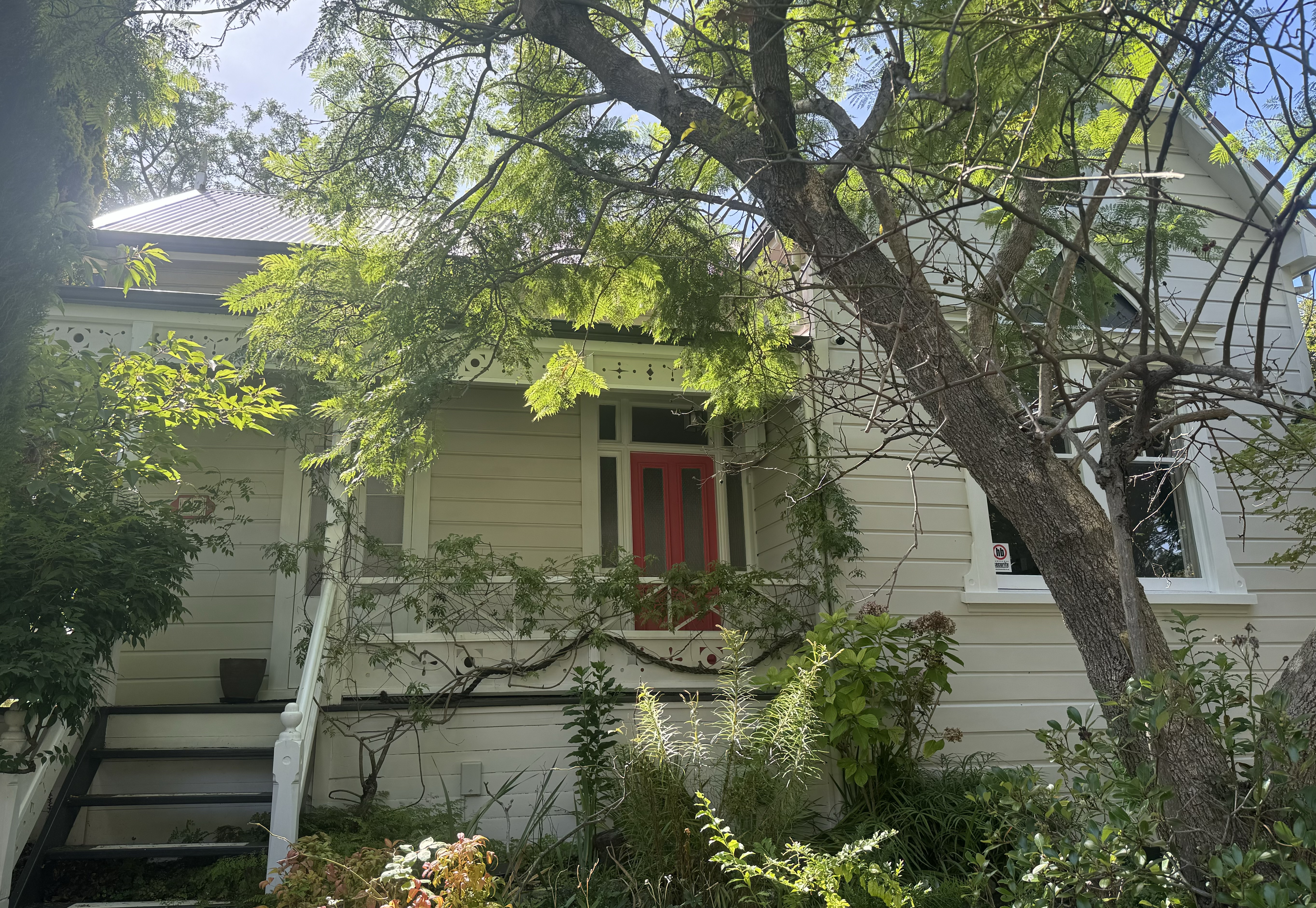
One of the reasons for the move was the amount of physical work on our South Head property. We have been finding it difficult to keep up. Our new house is a charming cottage, built in 1875. It is fashioned entirely from kauri(Agathis australis) a golden timber, native to New Zealand. The property has a much smaller land area and a much more manageable garden. We should also experience a few frosts, so I’ll be able to grow flowers that couldn’t cope with the heat of up north.
A completely different way of life. City dwelling versus country.
The joys of air travel
There’s not much privacy when you’re squashed into a small seat beside a larger person.
Waiting for the 12.22 am shuttle bus from Terminal 1 to Terminal 2, Haneda Airport, Tokyo.
In early March, Japan finally opened up its borders to a limited range of international visitors. I was fortunate that one of the categories was, ‘close family member’ which allowed me to at long last make my way back to Asahikawa.
I commenced my return journey on 17 March, which was a full two years since the trip I’d had to cancel in 2020. Prior to my flight I was required to be fully vaccinated, with two shots and a booster, and to take a Covid test within 72 hours of my departure.
You can imagine my trepidation as the day drew closer and I had very real fears that I might contract Omicron somehow in the last few days before my flight. Of course, this was somewhat unlikely as living in the country meant I wasn’t in contact with any potentially contagious people. But I did have to drive to Auckland to the Japanese Consulate to drop off my application papers and NZ passport, and later to collect my VISA, and I also had to undertake the pre-departure saliva test. For my trips I donned a P2 mask, to be on the safe side.
It’s usually impossible to find an empty chaise lounge in the Koru Club.
The Air New Zealand International Lounge at Auckland airport was busy, but not crowded. Everyone was wearing masks, except for in the dining area. I couple of guys sat really close to me, one older than me and one younger. It was annoying enough that the one who decided to sit beside me on the bench seat was close enough to almost touch shoulders, but he started coughing and snuffling a lot. And then his fellow-traveler began a long-winded story about a mutual friend (I could hear every word) and began to swear with just about every other word. I moved away and found that all the lying-down type seats were empty! So I was able to settle down in a quiet corner.
The Flight
If I expected Auckland Airport to be quieter than usual, I wasn’t proven wrong, but even so I wasn’t prepared for the lack of passengers on the flight itself. While I sat and waited to board, I noticed that most of my fellow passengers were Japanese, and that I was most likely one of only three gaijin. I had chosen an aisle seat, but was the only person seated in the entire row.
All quiet on the flight to Narita.
I was tired. The previous two weeks between when I discovered I could apply for a visa and when I actually held the stamped passport in my hand, had worn me out. It wasn’t just the fear of being turned down, despite all the work that my daughter and her husband had done to get the paperwork sorted, it was the fear that my visa wouldn’t arrive in time, or that I’d get sick, or that something else would change, the rules would change, the troubles in the Ukraine would develop into full scale war, a new mutant of the virus would cause borders to close, that kind of thing. So when I was finally on the aeroplane and was in the air, it was hard to believe that I was actually on my way.
Waiting at the Airport
I was already aware that when I touched down in Japan that afternoon, I’d be required to undertake a Covid test, and that I would have to wait at Narita airport until my results came through. If I tested positive I’d be required to go into quarantine in Tokyo, but if I was negative, I’d be free to travel to Hokkaido, as long as I reached Asahikawa within 48 hours.
I was a little worried about the timing of everything. My flight would land at Narita around 5 pm, but the connecting flight to Sapporo departed from Tokyo’s second airport, Haneda, at 9.30 pm, and I was booked onto the Limousine bus (the shuttle to Haneda) for 6.35 pm. Surely it would all work out. But as soon as I walked off the plane and turned a couple of corners into the arrivals corridor, my heart sank. Ahead were two extremely long rows of single seats. Each seat had a large number attached to the back and the one I was to sit on was numbered ’75’.
The line was long, and it wasn’t moving.
For the first hour, not one person on any chair moved forward. It was hot and crowded, I had with me my 23 kg tightly packed suitcase and my 7 kg backpack. There were people around me with children and babies. There were elderly people. There were constant announcements being conveyed through speakers, but I could understand nothing. The time ticked by and when I finally managed to attract the attention of a young staff member, and to explain my predicament, i.e., how likely was it that I’d be able to catch the 6.35 pm shuttle, she apologetically gestured in such a way that I had no doubt that it would be impossible. Little did I know that I wouldn’t be finished with the whole process for another five hours. In that time, the limousine bus, my connecting flight and my hotel in Sapporo had to be cancelled.
Fortunately I was able to connect to the airport wifi and contact my family in Asahikawa, and thanks to them, my flight was changed to one the following day, and I was booked in to the First Cabin hotel at Haneda Airport for the night. For anyone who was reading my blog in 2018, you’ll possibly remember that I stayed there then. I was extremely relieved.
Three Trains Late at Night
At around 10.30 pm I was finally through Customs and baggage control and had ahead of me the task of purchasing tickets for, and negotiating three different trains, to get to Haneda airport before the last train, the Tokyo Monorail, ran its final trip for the night.
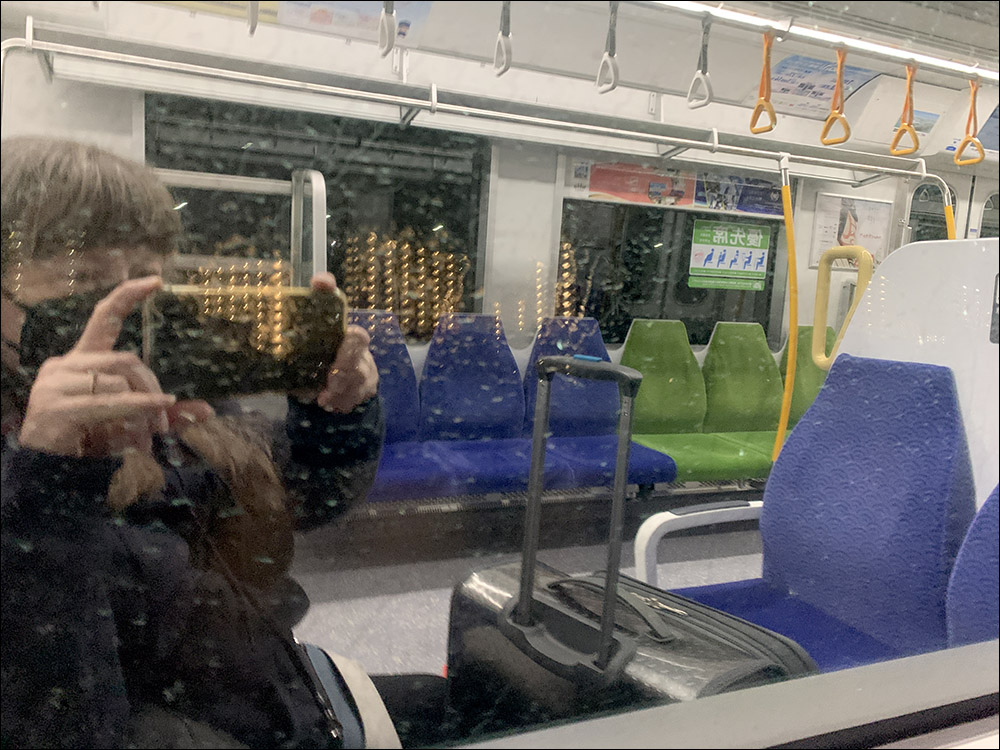
This is me on the train to Nippori trying to take a photo through the train window of the lights of Tokyo. All I managed to get was my own reflection!
My Asahikawa family had sent through been instructions on the route I should take, so I made my way to the railway station, dragging my luggage up and down the escalators. I was particularly grateful to the young woman in the ticket booth for the Skyliner. Despite having very limited English, she gave me clear instructions and walked me to within sight of the exit to the first platform. I was also grateful that after the first leg of my train escapade (Haneda Airport to Nippori Station) that the platform there also had an escalator. I was so weary by this time that if I’d had to somehow lift my large suitcase up a huge flight of stairs, I don’t think I’d have managed it. Not that I can actually lift it far off the ground. Being short, I can only just raise my suitcase high enough to get on and off a train–thank goodness it has wheels!
Haneda Airport, Terminal 1. All alone by myself. Luckily there was one more shuttle bus to Terminal 2, scheduled for 12.27 am.
The triple train trip is something of a blur. And to top it off, when I got to my final stop, Haneda Airport Terminal 1, I went to the wrong side of the carriage and stood there waiting for the door to open, which of course it didn’t. By the time I realised my mistake, and hurriedly turned to the other side, the door shut in my face and we were moving again. Exiting at Terminal 2, all the shops and counters were closed and the airport was completely empty, except for some security personnel wandering around. They kindly showed me the way to the Free Shuttle Bus stand and I was relieved to see that the last bus was scheduled for 12.27 am. I had only eight minutes to wait. And it did arrive. Thank goodness.
Sleep at Last
At Terminal 1, it was much the same. I was met at the bus by a couple of security personnel who escorted me to the hotel. There I was, trundling along, dragging my sodding heavy suitcase, shoulders drooping after five hours of wearing my backpack, hot and sticky. With a tiny pod type room awaiting me. Barely enough room to swing a cat. But when I slid the screen closed, I was just pleased to be somewhere with no-one else. Just me. A clean bed with a puffy duvet. And to be at Haneda, rather than still at Narita, with only the morning’s flight to Sapporo ahead of me in the morning, before I could connect with my midday bus to Asahikawa.
Walking along the bank above the grey green waters of the Ishikari, running full and fast due to snow melt, I disturbed a fox. It was up ahead, sniffing by a wooden post, tawny-coated below the silver-gold sky of a setting sun. It turned my way then ran down towards the water, a dark blur against the snow, brush tail flouncing.
There it rested beneath a bare branched willow and I saw that there were two. They were larger than I expected and I later read that they were most likely Kitakitsune. I tried to capture them with my iPhone but it was twilight, they were far away and on the move, and after three attempts my phone’s batteries expired and it shut down.
Two foxes in the distance, bounding over the snow.
I walked on a little then turned and looked back. They’d stopped running and were standing immobile, heads raised, watching. I resumed my walk with a feeling of loss. It’s unlikely I’ll see those two again. Ahead, the sun dropped below the clouds and a sharp wind picked up dry leaves from the snow at my feet. A solitary Tobi circled high in the sky above.
The Kitakitsune, the Tobi, the fluttering leaves, the roiling river, and me. Nothing else moved in the silent landscape. To my left, the Ishikari flowed swiftly to the north, banks stacked with dirty piles of snow sculpted into strange shapes by wind and sun. To my right, rows of pastel houses, shabby-seeming in the twilight, displayed yellow-glowing windows.
You can walk in a foreign country and forget to see the differences while you tread the unfamiliar city footpaths and unexplored tracks by the river. You can investigate routes through powdery snow or earthy tree litter, while disregarding the strange smells and ignoring the different angle of the sun. You can choose to be in the moment or to let your mind drift away.
The flight from Auckland to Narita takes about 10 hours. I’m not particularly fond of flying. But perhaps nobody is. It’s not so much the thought of being up in the air in a huge metal machine, it’s more about the claustrophobic aspect of being crammed into such a small space for several hours, sharing the stale air with a few hundred people you’ve never met.
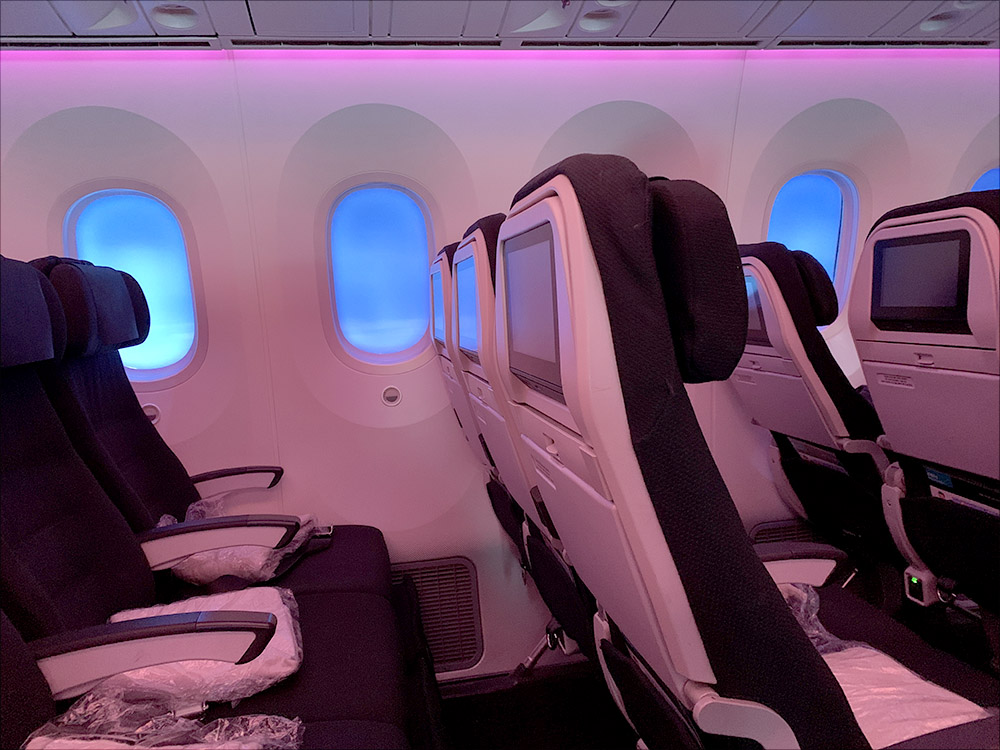
The new aeroplanes, while comparatively roomy and equipped with all the mod cons, are not designed for short people, (just as they aren’t designed for tall people, or large people). The position of the head rest isn’t quite right, the flow of fresh air completely misses my face, that kind of thing. To distract us we’re provided with movies or TV programmes, music and refreshments, and these just about do the trick, especially if you’re traveling alone and don’t have to entertain a child or comfort a baby.
We were served ‘lunch’ a couple of hours after departure. I chose the salmon, which was accompanied by a small egg roll, some green beans and rice. The other option was scrambled eggs and chicken sausage – definitely unappealing, even mentioning it here makes me a little squeamish. Then a couple of hours out from Narita we were served dinner. The choices were either a chicken dish, or a beef casserole with peas and roasted potatoes. I chose the latter and polished it off at a speed that surprised me.
My seat was situated on the left-hand aisle, adjacent to a guy aged around late-40s and his son (about 10). They didn’t bother me on the trip, but nor did we communicate, except for when they needed to squeeze past me for some reason. At one point I became aware that several babies were crying inconsolably. It was a somewhat bizarre situation – playing out on the screen in front of me was a sex scene in the movie ‘The Shape of Water’. A very wet scene with water dripping and flowing everywhere, and then there was the sound of babies howling from several sides. I felt sorry for them, and for their caregivers. A long trip is difficult when you have little ones in tow. I was also glad they weren’t my babies.
Thanks to a tail wind, we landed a little early at Narita, just before 5 pm, with a reported outside temperature of 28 C. Looking out the plane windows it appeared overcast and smoggy. I’d packed some of our own honey as gifts and was half expecting the contents of my luggage to be queried, but I passed through Customs and the security check speedily. My first task was to purchase a ticket for the Limousine Bus that would take me from Narita to Haneda airport, a trip of about an hour, across the city.
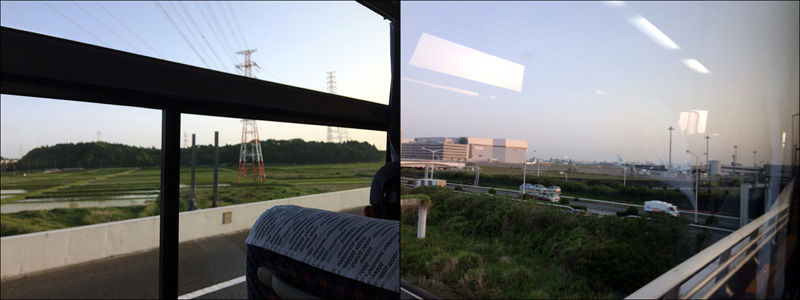
From the Limousine Bus I caught glimpses of rural scenes and cityscapes.
The bus was only about half full, but every window seat was taken so I couldn’t see much of Tokyo or the surrounding area. I did, however, catch glimpses of rice fields and greenery, along with grey industrial buildings and motorways.
Sitting on the Limousine Bus.
Nearer to Haneda we drew close to the ocean, which looked dark and choppy in the late afternoon light – visibility restricted by the smoggy atmosphere. By the time our bus reached its destination, the sun had dipped to a position only a little above the horizon. The sky was a dirty gold changing to smoky apricot with the buildings standing out starkly and I was feeling very tired.
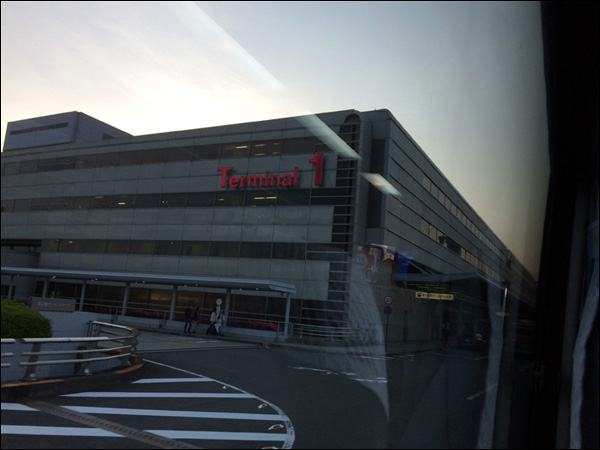
My first glimpse of Terminal 1, Haneda Airport, Tokyo.
I’d booked a first class capsule at First Cabin hotel, situated in Haneda Airport’s Terminal 1. I located the hotel without too much difficulty and checked in at around 6.40 pm. I had to wait twenty minutes for the room to become available and then curiously walked through the narrow corridors to find my ‘home away from home’ for the night.
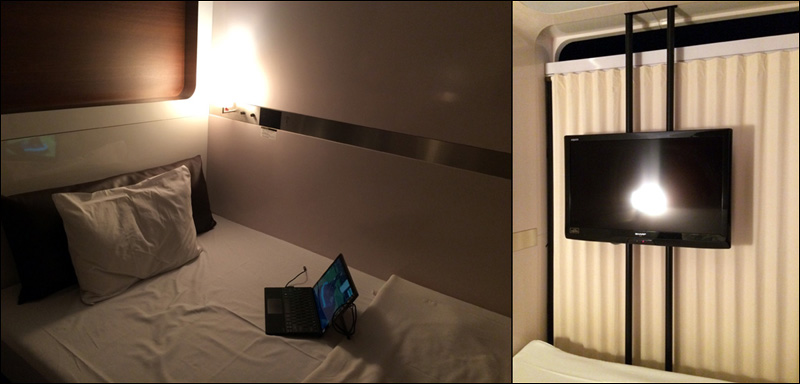
Left: My bed in the first class capsule – I was glad there was free WiFi; Right: The TV was at the foot of the bed, and behind this, the curtain that closed off the capsule.
The room was adequate and I wish that I’d taken a photo when I first slid the curtain open and hadn’t disturbed anything. For about NZ $60 I was provided with a clean room with a bed, a TV (which I didn’t use), a small side table, a lockable drawer, a towel, wash-cloth, pair of disposable slippers, and a set of cabin wear consisting of a simple top and trousers, made of a thick, brown fabric.
Onigiri – something I LOVE but can’t find in New Zealand.
By this time I was so exhausted I was almost dead on my feet. But I was also terribly thirsty, so once I’d undertaken a very basic ‘unpack’, I left my gear in the capsule (trusting that it would be secure) and roamed the airport in search of something to drink and eat. I walked back and forth a few times unable to make a decision then settled on a bottle of Mirin brand Sparkling Lemon (which I guzzled as quickly as the coldness of the liquid would allow) and a Convenience Store-style Onigiri of some kind. It was time to retire for the night.
Next stage of the trip: My night as a guest of First Cabin.
At 7.45 am on Tuesday 15 May I was sitting in the Koru Lounge of Auckland International Airport, struggling to keep my eyes open. It had been an early start, made a little more complicated by having to jettison a couple of items at the last minute (my Kindle, a bottle of shampoo and my pillow), in order to get the weight of my bag closer to the 23 kg limit.
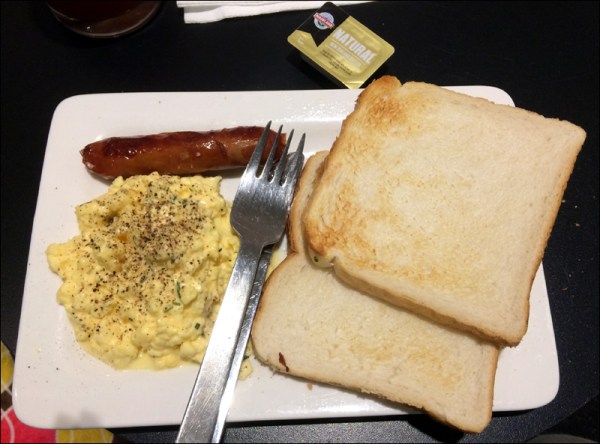
Scrambled eggs, kransky sausage and toast, a la Koru Lounge
The day had begun with my Apple Watch vibrating me into awakedness at 3.45 am. In theory, I should have been ready to go, having packed and separated out the items I might need with me on the journey, the previous day. The trip itself, would be a little different from that of the previous year; on this occasion it would be undertaken in two legs: Auckland to Tokyo (Narita airport) and Tokyo (Haneda airport) to Asahikawa. Last year I’d flown directly to Sapporo, before traveling by rail (the Kamui) to my final destination. Another difference was that it would involve an overnight stay in Tokyo, as my Asahikawa flight wouldn’t depart until mid-morning on the Wednesday.
The drive from home to the airport was uneventful. It was a clear, calm morning and South Head Road was dry, only broken by puddles of fog whenever the road dipped into a hollow. There was little traffic through Parakai, Waimauku and even at Kumeu, which an hour or so later would be bisected by a long snake of commuters. We tanked the car at the Gull station there, and leaving the last of the fog behind, hit the northern end of the South Western motorway. Even the road works leading down to the Lincoln Road off ramp didn’t hold us up and before long we were driving through the Waterview Tunnel, and out the other side where I was surprised to read on an electronic sign that it was 18 C.
Ben dropped me off at the international terminal at around 6.00 am and headed back to wrestle his way to the city centre through the early morning traffic. My bag weighed in at 23.4 kg but the attendants let it through; fortunately I didn’t have to implement my backup plan of transferring various items (such as computer cables) from bag to back pack. After clearing Customs and the security check I wandered a couple of times around the duty-free shops, then headed to the Koru Lounge. I had a long wait ahead of me.
The lounge was full with the best seats taken. There are always plenty of comfy chairs but they are the wrong dimensions for a person of my height. They force me to either sit forward awkwardly on the edge, or to sit back with my feet barely touching the floor, so the best chairs for me are the regular ones beside the dining tables. I plonked myself down into the best of the worst and opened my laptop. My intention was to get some writing done and to avoid alcohol – it was, after all, still very early, but after 30 minutes of listening to a nearby group of women talking firstly (and at length) about who they did and didn’t like in ‘Dancing with the Stars’ (a new series is apparently running on TV3), and secondly, about how irritating Winston Peters is and how lovely Jacinda Ardern is, and then having another woman beside me coughing and sniffling, I decided I needed something. And there’s nothing like a glass of bubbly at 7.32 am.
Looking around, I observed that the area was mostly populated with grey-haired, or no-haired individuals, most of them, paired off. Yes, there were a few younger couples and singles, and I did observe one child aged around eight, but I was definitely on the younger side of the majority. Most of us were tapping away at laptop keyboards, or peering closely at mobile phones. Reading glasses were ‘de rigueur’. I thought this somewhat odd. Perhaps it was to do with it being the international lounge – I knew from experience that at that time of the morning on a week day, the domestic lounge would be filled with business types, all suited up.
The noise level was high, too. Across from where I was sitting, the barista gal was regularly bashing the coffee grounds out of the portafilter, plates were being clattered by the breakfast bar, glasses were clinking on a trolley being wheeled past, the buzz of many conversations was reaching a crescendo – the cacophony peppered with abrupt peels of laughter and muffled coughs. I could catch the odd phrase of a conversation, but it was mostly just noise, the kind that makes your eyelids grow heavy until suddenly you realise that you almost fell asleep. Or perhaps it was the one small glass of wine that was beginning to affect me. It was time to zone out.
Next stage of the trip: The flight from Auckland to Narita airport, Tokyo, and the subsequent journey between Narita and Haneda airports, and my experience as a guest of First Cabin.
My flight to Japan was scheduled for the ungodly time of 1.15 on a Thursday morning. I arrived at the airport well in advance of this and after a less than enthusiastic circuit of the duty free stores, settled myself into the Koru Lounge for a long wait. I was barely hungry and not in the mood to drink more than a 1/2 glass of chardonnay at such an early hour, so I spent most of the time writing notes in a diary and contemplating the six weeks ahead of me.
Asahikawa is the second-largest city in Hokkaido (the northern-most island of Japan) with a population of around 350,000. To get there from Auckland you have to first fly to Tokyo, and then on to Sapporo, leaving the island of Honshu behind. After that, you can either take a train or a bus for the remaining 138 km. Asahikawa‘s latitude is around 43.77N and if you were to head roughly due west for 850 km (over the Sea of Japan), you’d end up in Vladivostock, Russia – that’s how far north it is.
During my flights from Auckland to Sapporo, and on the train journey from Sapporo to Asahikawa, the reality that I was travelling to an entirely foreign country with a completely different season only became apparent in stages. The first indications emerged while I was waiting in the boarding lounge at Auckland airport, where I metamorphosised into a member of the minority culture. But it was just something I noticed – the situation didn’t feel that different. I could’ve just as easily been on the AUT campus during Orientation Week.
Then there were the suppers and breakfasts served on the Air NZ flight. On both occasions, the ‘Japanese’ option sounded more appetising, which is not to say it actually was appetising (although I have the feeling that it was better than the alternative. ‘Chicken Sausage’ never sounds appealing as a breakfast choice).
Then there was the fact that for every interruption to the films I was watching (and there were announcements at regular intervals) there was a follow-up broadcast in Japanese, timed for about a minute later, just when I’d manage to re-acquaint myself with the plot. (If anyone’s interested, I watched ‘Lion‘ and ‘Manchester by the Sea‘ and enjoyed both.) The Japanese explanations seemed to take a lot longer, and I couldn’t help wondering if I was missing something.
Auckland to Tokyo
The flight from Auckland to Tokyo takes about 10 hours. I expected to notice differences when disembarking and entering Narita airport, but there were English translations everywhere, and announcements in both Japanese and English, and it was a nice surprise to not feel vertically challenged for once. Customs control and baggage checking went smoothly and before I knew it I was free to do my own thing. I made my way from International to Domestic to board my flight to Sapporo. I had a couple of hours to wait but had already gone through the ‘point of no return’ before this dawned on me. So I was stranded in another waiting room, with not much to keep me occupied. I made a note to make sure I picked up some cash before catching the train from Sapporo.
The lounge at Narita airport.
Probably the worst aspect of the trip was the size of my suitcase. The large dimensions meant that I couldn’t use the escalators in the airports and railway stations and had to drag it behind me while I hunted around for elevators. I couldn’t even lift it higher than about 15 cm off the ground.
Tokyo to Sapporo
My first view of Sapporo – steam rising from the heated tarmac.
The flight from Narita to Sapporo took an addional 2.5 hours, but thank goodness it was an older style airbus. The cabin was much less stuffy than on the long-distance flight, and I had a window seat so could look out at the snowy terrain unfolding below. The land started out flat then became more hilly, then mountainous. When we flew over the Tsugaru Strait I saw many container vessels and it must’ve been windy as the charcoal-grey water was dotted with the white crests of waves. Then we were on the way down. And as we taxi’ed along the runway at Sapporo, it looked COLD, with grey skies, bleak buildings, and small piles of snow here and there.
Sapporo to Asahikawa
I’d been given detailed instructions on how to get from Sapporo to Asahikawa, including the purchasing of the train tickets, and finding the correct platforms and lines, so the actual ‘finding my way’ part was reasonably straight-forward. But it had been a long, tiring trip and by the time I was safely seated on the ‘Kamui‘, with my huge bag tucked tightly beside me, I was both tired and hungry.
A fleeting view of houses – I’d only just focus on a group, and then they’d be gone.
The Kamui is a fast train and soon it was whoosing along, out of Sapporo and through the countryside. For most of the journey the terrain was flat, with almost everything covered with a blanket of snow. The houses in the small settlements we passed looked very different from those in New Zealand – they were boxy or angular, coloured with plain earthy tones, or shades of white, or in bright pastels.
Similarly, the trees seemed to rush by.
And as we travelled further north, the views reminded me of Finland, with forests of bare tree trunks crowded closely together on low, mounded hills. Unlike Finland, there were occasional glimpses of snowy peaks in the distance, but this was my first impression.





















 Heni Irihapeti's Blog