The piece of flash fiction I submitted for consideration didn’t make the cut, but that’s how it goes with writing. The actual task of working towards something and fine-tuning your work, is an ongoing process, and it’s one that I do enjoy, even though I don’t have high expectations.
And when you do have a story accepted, no matter how small, it’s as exciting as winning a lottery.
This year, as part of the lead-up to National Flash Fiction, there has been a parallel celebration of micro fiction. Writers were asked to submit works of 100 words or less, and one story has been featured each day since June 1st.
Members of my family will recognise that part of the story is drawn from my father’s experience as a child. That’s what I tend to do… write about things that have happened to me, or that I know about from friends or family.
If you are interested in hearing more about Micro Madness, National Radio’s Standing Room Only programme featured the following interview, yesterday at 1.00 pm.
The pomegranates we hoped to sample have burst.
Firmly secured to their bare branches,
they are still too high for us to reach.
Corpulent macadamia pods fatten ‘on the vine’.
Smooth brown nuts in moss green shells,
each day I gather them from the ground.
The last feijoas lie scattered, rotting away on the soggy earth.
More than one hundred have passed my lips this year.
They still taste sweet.
Across the road, black and white cows munch away on green grass;
One or two have lain down in the sun.
Beyond, the Kaipara is soft in shades of blue and grey.
Yesterday at dusk I heard the chirping of a cricket,
then a cold wind chased me indoors.
Surely June is too late for a cricket’s cry.
For some reason I was thinking this morning about my Roman Catholic childhood. I was thinking about the National Party’s blatant lack of good faith regarding Crown Land up here in Auckland. It might be the kind of thing they’d take to the confessional… dunno.
If they did, it might go something like this…
Forgive me Lord for we have sinned.
It is quite a few days since our last confession.
Since then, we have gone back on our word (again).
So, there was this agreement we had with Ngati Whatua. Part of the Treaty of Waitangi settlement. Basically we agreed that we’d give the iwi first dibs on purchasing any Crown land we were going to dispose of.
Sure, this is land that was theirs to begin with – acquired by nefarious means. BUT, really, in this day and age, and with the value of land and the need for HOUSING, we think that someone OTHER THAN Ngati Whatua should be able to buy the land and make money from it. A big multinational company. It doesn’t even need to be NZ-owned. We like to share our land around. An Aussie company would be good.
So, I don’t think this is REALLY going back on our word.
Is it?
What do you think?
I’d appreciate any comments.
More information can be found here (thanks to TV3)
Kites flying at Bastion Point. Celebrating Waitangi Day, February 2015
Perky chicken bare of feather Looks out at the murky weather Not for her the field next door Nor sunny nooks on forest floor
Perky looking out towards where the other hens are scratching.
Attempt 1: The Knitted Jumper
The idea of knitting a little outfit for Perky didn’t work out as we’d planned. And I suspect that Perky wasn’t impressed with the whole process, either.
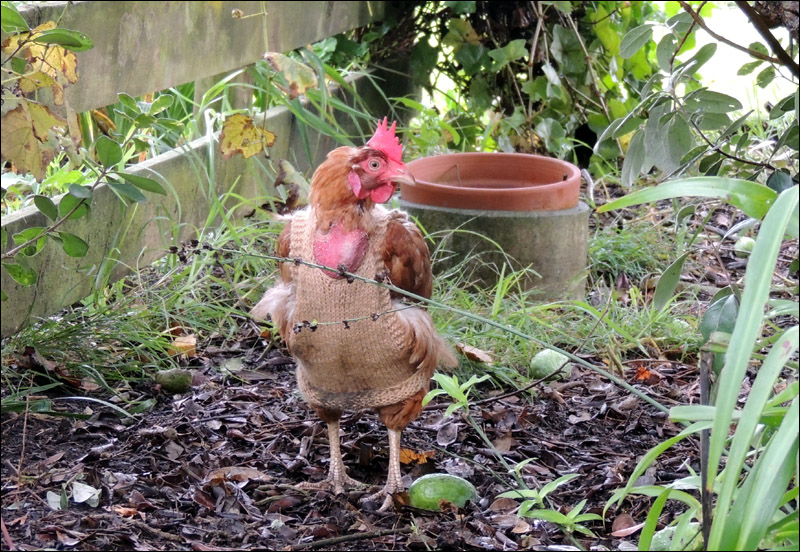
Ben found a jumper pattern online, as well as comments indicating that dressing Perky in such an item would be a workable idea, and would help protect her and keep her warm until the feathers around her neck, chest and crop grow back. I duly knitted away and produced the outfit below: –
The completed hen tunic.
That night, we crept up to the hen house under the cover of darkness, grabbed Perky (who was sound asleep) and while Ben held her snugly, I put the tunic over her head, fastened the two buttons, freed her wings and adjusted it as best I could. Perky wasn’t that impressed but didn’t wriggle much.
Ben went out later on to see if she was still okay, and she was sleeping peacefully with the woolly jumper on. So far so good.
A disgruntled Perky, wearing her new ‘jumper’.
The next day I went out first thing to check and was dismayed to discover that Perky had become entangled in the little outfit. She’d somehow managed to lift one of her legs through the ‘armholes’, where usually only her wings would go. So part of the garment was now under her body and the bottom edge of the garment was wet and muddy and dragging on the ground – of course to make matters worse, it was raining.
Dismayed, I managed to corner Perky and pick her up. I stroked her for a bit to soothe her, and then re-adjusted the tunic, ensuring it was sitting correctly and that her wings and legs (and head, of course!) were free. I pulled it up so that it sat nicely below her neckline and set her back on the ground.
Even after adjusting the tunic, I could see that it was too loose.
Thirty minutes later when I went back to check, I could see that the tunic was actually too large for her – she’s such a tiny scrap of feathers. The hem was down to her ‘knees’ (not sure if hens have knees) and it was clearly annoying her – she kept trying to lift her legs to scratch it away with one or other of her feet.
Sadly I had to catch her again – Poor Perky, I hate chasing her to catch her when she’s not really tame enough. I gave her some cuddles and removed the offending item.
Attempt 2: Stockholm Tar
The other three saved hens were still pecking at her bare skin, so on Saturday we applied some Stockholm Tar to the exposed flesh, thinking this would be a good solution.
Wrong again. The other hens just pecked it off – we could see who the main culprit was (Crinkle) by the tar on her beak.
Attempt 3: Isolation
It doesn’t seem fair that Perky has to be the one kept away from the outside world.
Perky is now all by herself in the rescued hen section of our fenced off area. The other three saved hens have been integrated into our main flock and are doing fine.
One amusing thing though… while chasing Perky on Saturday to apply the Stockholm Tar, Ben found a pile of more than 30 eggs, all nicely piled up under some long grass.
The secret nest area. We’ve left a fake egg there so that Perky has something to lay her own egg beside.
We checked them all using the ‘will they float in water?’ test, and ended up only discarding about 10. We had visitors over the weekend so have eaten the remainder already. It would appear that all the rescued hens have been laying since we’ve had them. I think that’s ironic considering that the battery farms cull them for going off the lay.
The short poem to Perky at the top of the page is a quatrain.
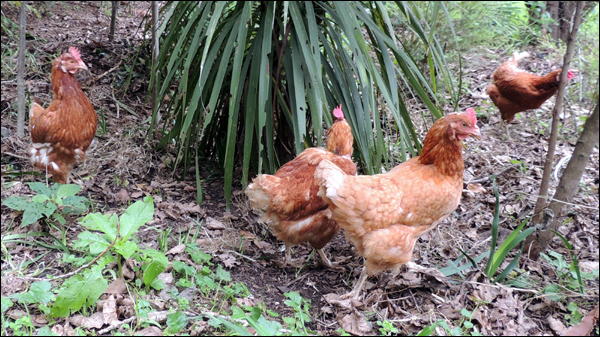
The four rescued hens, scratching around in the leaf litter.
Our four new girls have settled in well. They picked up the business of being free range surprisingly quickly and are now integrated into the main flock. We have 11 hens altogether; our 3 original Red Shavers (Lottie, Lulu and Leila), our 4 Black and White Orpingtons (Francesca, Pearl, Fatima and Hannah) and our 4 new rescued hens (Perky, Pompom, Crinkle and Honey).
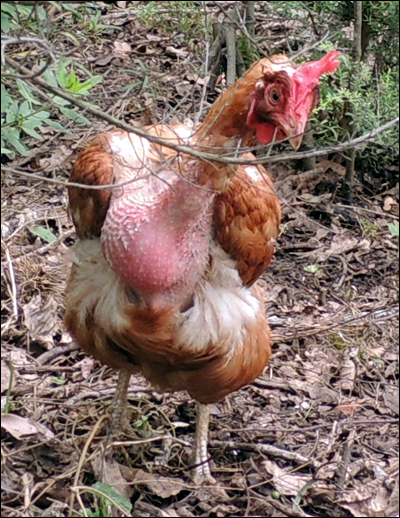
Poor little Perky of the Bare Crop.
Pompom, Crinkle and Honey have almost all their feathers now, but Perky is still being picked on. And pecked on. When she arrived she had hardly any feathers around her crop and even though new quills start to form, they get pulled out by (we think) Crinkle. I guess she’s at the bottom of the pecking order.
To solve this problem, I’m knitting a little outfit for her to wear. I should have it finished this evening and we can dress her in it tonight when she’s half asleep.
All the new hens are becoming quite tame, but I haven’t yet felt like trying to pick any of them up, for fear of scaring them. It’s been a lot for them to take in over the past few weeks. Going from being squashed into a small cage with their days governed by artificial lighting, to being free to come and go, feeling dirt and grass under their feet, able to flap their wings, build hollows in the dirt to bathe in, etc., etc. I think they are doing remarkably well, considering.
They still haven’t mastered perching for sleep, however. At the moment they are still in their own little house at night so it doesn’t matter if they hunker down on the floor, but at some point we’ll have to try to teach them how to use the perches.
Fruit and Funghi
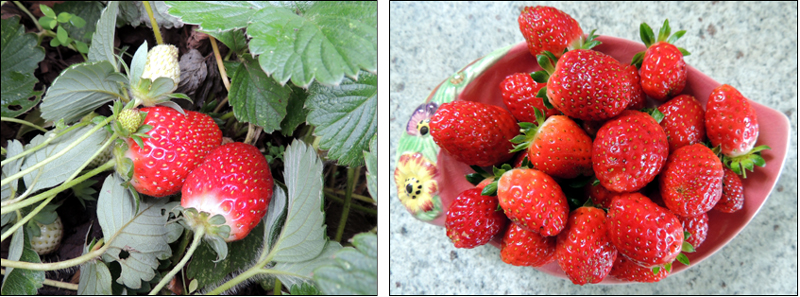
Juicy strawberries growing at the end of Autumn
It seems an odd time of the year to be picking strawberries, nevertheless, that’s exactly what I was doing earlier today. I’d noticed the odd berry amongst the leaves over the past week or so, and had been eating them when I spotted them, but today I’ve picked enough for dessert this evening. Yummy.
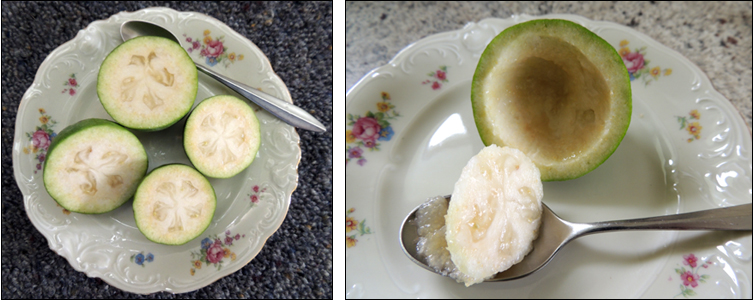
Exquisitely-delicate tasting Feijoa.
Our feijoas have been phenomenal. If there ever was an amazing feijoa season, this has been it. Numerous fruit are still falling on a daily basis and whether they are tiny or large, they taste exquisite. I know some people can’t abide the flavour, but ours are so JUICY and not at all dry. We have two trees and the fruit from each tastes different.
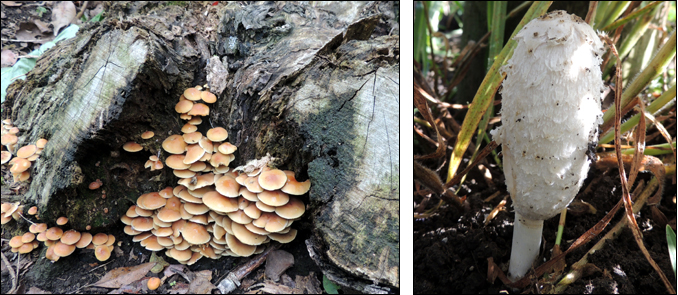
Left to Right: Hypholoma acutum, Coprinus comatus.
It’s also the right time of year for funghi. Today I found a spectacular crop of Hypholoma acutum on an old tree stump in the native area, and in the weekend we found a couple of Shaggy Ink Caps when we were pulling out some Kikuyu grass from by the fence line.
Sadly I think the season for Shaggy Ink Caps is mostly over, as I’ve seen dissolving black patches of black goop around the edges of the property. Now that I know what they are and that these funghi are edible (they taste really good) I’ll be on the lookout for them a year from now.
Tropical Plants
A couple of interesting plants we put in recently are thriving: –
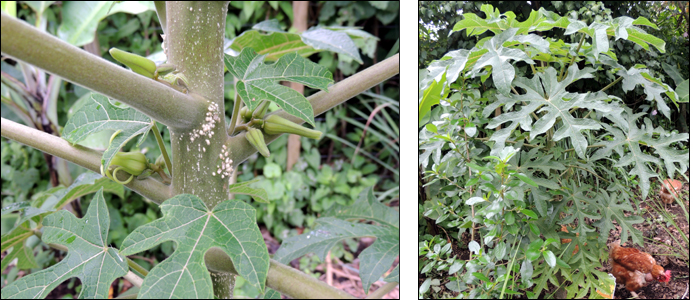
Mountain Pawpaw (Carica Pubescens)
Our Mountain Pawpaw has flower buds and has put on a heap of growth. We planted it in our ‘native’ area where it’s sheltered and the soil is very good. Also, I gather they are happy in partial shade so it should suit the plant perfectly as it grows.
Sweet Grenadilla (Passiflora ligularis)
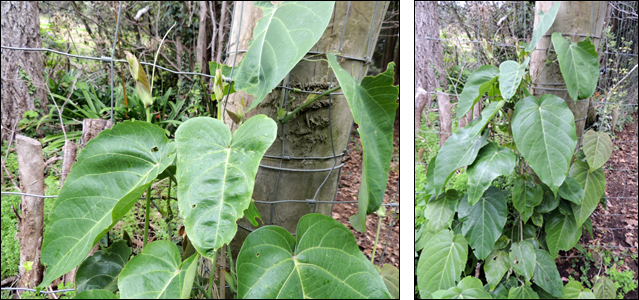
We also planted the passion fruit variety, Sweet Grenadilla, to make up for the fact that we took out our old regular passion fruit vine. I’m very hopeful that this won’t succumb to the same disease as the other did. It certainly looks completely different, leaf-wise and it’s eagerly sending off tendrils this way and that. We’ve chosen a very sheltered corner for it.
So… watch this space. I’ll take some photos of Perky wearing the little outfit and post some in the next day or so.
I was enjoying reading I. K. Paterson-Harkness’s recent blog on Haiku and thought I’d post something of my own. My interest in poetry and the actual writing of poetry has been rekindled lately, to the extent that I’ve purchased a couple of books to get me back in the mode (or is it in the mood?).
One was Six Centuries of English Poetry Tennyson to Chaucer: Typical Selections from the Great Poets, (1892) by James Baldwin, and the other, Above the River: The Complete Poems, by (author) Professor James Wright.
I chose the first book to reacquaint myself with some of the works and the styles of the classic poets, some of whom I read decades ago, and others of whom I’m sorely ignorant. And as is often the way for me, I heard one of James Wright’s poems being read last week on National Radio and liked it so much that it spurred me to purchase more of his work.
Lying in a Hammock at William Duffy’s Farm in
Pine Island, Minnesota
Over my head, I see the bronze butterfly,
Asleep on the black trunk,
Blowing like a leaf in green shadow.
Down the ravine behind the empty house,
The cowbells follow one another
Into the distances of the afternoon.
To my right,
In a field of sunlight between two pines,
The droppings of last year’s horses
Blaze up into golden stones.
I lean back, as the evening darkens and comes on.
A chicken hawk floats over, looking for home.
I have wasted my life.
(James Wright)
Poetic Forms
Paul B. Janeczko, A Kick in the Head
Another book I’ve loved for years is Paul B. Janeczko’s, A Kick in the Head: An Everyday Guide to Poetic Forms (2005). This book lists 29 different poetic forms and provides examples for each. I’d recommend it if you are interested in the challenge of some of the more complex styles. The illustrations are neat, too.
Haiku from a Distant Summer
Here’s my Haiku offering… something I wrote way back in 1995 when I was living in St Leonards, Dunedin.
Dry parched hills
reflected
in the eyes of our cats
amber, gold and brown.
Cicadas
rapid fluting melody
I catch my breath
as they fly
Flax seeds
ripening broom pods
exploding
thistledown
caught on the breeze
Arid creek
quiet noise
sunlight dulled by
brackish pool
eucalyptus
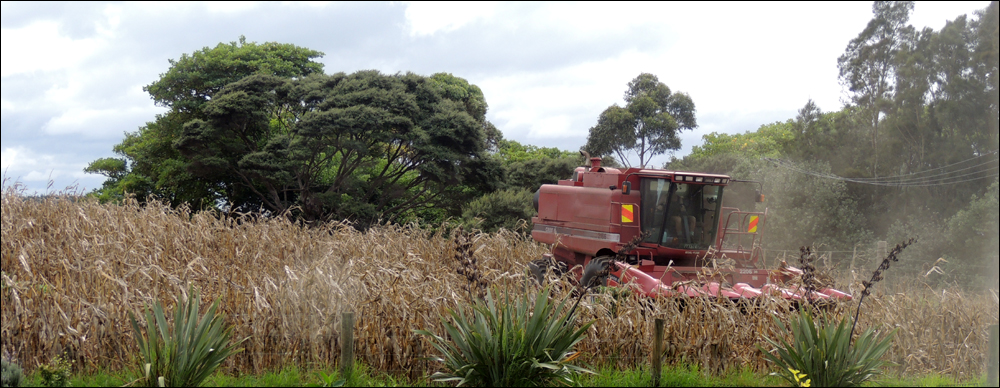
It’s definitely Autumn. As I sit at my computer I can hear the rumble and whirr of the combined maize harvester driving along the paddock adjacent to our property. As it moves down the rows, capturing everything in its path and discarding all but the individual maize kernels, great clouds of dust rise around it.
The wind has picked up this afternoon and is blowing in from the north… It was supposed to rain, and perhaps it still will, but right now it’s a mixture of bright sunlight and racing clouds.
The Garden
This beautiful squash, ‘Burgess Buttercup’ weighed 3.189 kg.
Clean Up Tasks
It’s the time of year for clean-up and maintenance tasks in the garden. The squash and pumpkins are ready to be cut from their vines and stored in a dry and airy place.
The twisted brown tomato stalks need to be pulled out and burned, along with the remains of our former passion fruit vine.
I made the decision to remove the vine after it had finished cropping, due to it being afflicted with disease. It has been incredibly productive this year, and I’m sure we have eaten more than 200 individual passion fruit. So, it was with a heavy heart that I cut it away from the fence yesterday. All that is left is to dig the roots out of the soil.
Fruit
A scattering of fruit; Feijoa and Guava.
Plump feijoa and red and yellow guava are strewn on the grass outside our kitchen window; an array of yellow, green and red baubles.
While the guava are quite definitely edible, now that the feijoa are ready they won’t get a look in with me. Back in Spring when the blackbirds were stripping the petals from the flowers, I could not have imagined that the trees would be so heavily-laden.
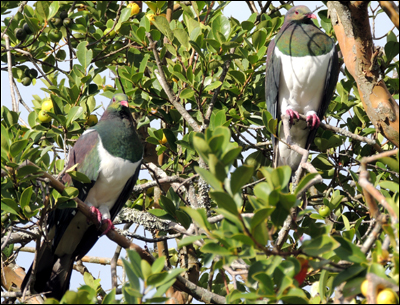
A pair of kereru in the yellow guava.
For several days we’ve had two plump kereru camped out in the fruit trees. At night they seem to seek refuge in the golden totara, but by day they stay in the yellow guava, gorging on the fruit (they can swallow the guava whole!) or just sitting still in the sun.
Juicy pears.
We’ve also had many pears. The only problem is getting to them before the blackbirds! But if we go out early in the day we can usually rescue most of them.
Vegetables
Capsicum, Eggplant and Chillies.
For the first time, we’ve had eggplants that have grown to maturity and we’ve had an amazing crop of capsicum. I’m hoping that these will keep cropping until May or June. We also have abundant habanero and one other (unidentified) chilli pepper. This latter plant came from a packet of chilli ‘Caribbean Blend’ so I’m not really sure what it is. We sampled it (with trepidation), and although it was hot, it didn’t seem as hot as a habanero, nor did it have the beautiful floral flavour that a habanero has.
Our new seasons’ chilli peppers strung up in the barn.
As you can see from the photo above, I’m going to dry the chillies this year. We have such a huge chest freezer, that even with the baskets at the top, we tend to lose track of small things. It will be interesting to see if I’m successful or not. I thought it would be great to grind them up and use them with a pepper shaker.
This morning I took a bucket to the farm across the road and collected some field mushrooms. Yum!!! These are my favourite funghi. They have such a rich taste in comparison with button mushrooms purchased from the supermarket.
Field mushrooms, freshly-picked this morning.
They’ll be great sauteed in butter and stirred through some freshly made pasta.
After the Harvest
What’s left after the harvester has done its job.
The harvester has finished in the field. All that is left behind are the husks and a few dried leaves. It’ll be tough for the small shrubs we have on the fence-line, especially now that the wind is coming from the north. For a good six months they’ve been sheltered by the maize!
We are now the proud ‘parents’ of four former battery farm hens. We adopted these from The Animal Sanctuary and drove across to Dairy Flats last Wednesday to collect them.
They were part of a group of several hundred hens saved from being killed after reaching the end of their very first egg-laying cycle. This is usual practice for battery farms – they don’t wish to feed the hens when they go off the lay (the latter state being a natural part of a hen’s yearly cycle). Hens can’t keep laying eggs non-stop without a rest and usually go ‘off the lay’ for a few weeks when the days start to get a little shorter.
We’re waiting to get to know them a little better before we name them.
Our four new girls are in their own separate area, in their own house and sheltered amongst native vegetation.
For the very first time in their lives they can walk about freely, feeling the dirt under their feet and waking and sleeping by the natural day.
One of the hens enjoying a soothing dirt bath.
They don’t yet know how to perch, but have already figured out how to take a dust bath. We think this is pretty cool.
We’ll keep them apart from our other hens until their feathers have grown back some, and they are more confident in their surroundings. Then we’ll gradually introduce them to the flock and … in time, allow them to roam freely with their sisters.













 Heni Irihapeti's Blog