Quinn’s Post Hotel, Upper Hutt, c. 1975. Negatives of the Evening Post newspaper. Ref: 1/4-022569-F. Alexander Turnbull Library, Wellington, New Zealand. http://natlib.govt.nz/records/22424141
It’s been a busy week as far as having stories published is concerned. Of course, I’m delighted, but there is the problem that I need to knuckle down and write some more, get them sent off, etc. I don’t want to run out of any momentum I may have generated.
My latest offering has been published online by Crab Fat Magazine and you can read it here.
Moonshine Road
As I explained in my blog on June 25 of this year, Moonshine Road is a fictional story.
It concerns one particular night in the winter of… shall we say 1976? And thinking back, it would have probably been around June/July.
Outside it was clear and frosty, while inside the Quinn’s Post Tavern, music was pumping.
The scene was set for romance. What could go wrong?
To celebrate this fortuitous collision, Speculative Fiction NZ challenged its members to write a short story that combined the two. Imagine my delight when I heard that my submission, The Bookshop, had been placed second!
The Bookshop is about a woman, Charlotte, who returns to the home of her earliest memories, to try and make sense of her past. Once there, she must overcome her fears and fulfill her destiny.
When I started writing this story, I had a very clear picture of the bookshop itself. I knew that it was old and no longer occupied – it was spooky, after all. I pictured it as a smallish, stand-alone, two-storey, weatherboard building – run down and neglected. It had been empty for decades, and yet, there were still stacks of old books inside, along with the memories.
I tried to think about why the bookshop had been vacant for so many years… What (if anything) had happened, and when? It was a fun challenge!
The process of writing can be very much like a jigsaw puzzle. The pieces are all the ideas battling for favour inside my head, waiting to be selected and placed within the frame that is the story itself.
My short story, The Mysterious Mr Montague has been published in the Ticonderoga Press publication Bloodlines.
Bloodlines hasn’t yet been launched officially, but a pre-launch party was held at the recent Conflux 11 speculative fiction convention in Canberra, Australia. It would have been wonderful to have been able to attend in person!
The great news is that Bloodlines is now available for purchase either from Amazon or directly from Ticonderoga Press (the latter in either soft or hard cover). click here
Needless to say (but I’ll say it anyway!) I’m very excited to have my story published in an actual book (rather than an e-copy) and grateful to Ticonderoga Press for accepting The Mysterious Mr Montague for their anthology of stories about blood.
The tale itself is set in Kilbirnie (Wellington, NZ) in the 1970s. At various times back then I lived in the nearby suburbs of Hataitai and Lyall Bay. I walked the streets of Kilbirnie and Evans Bay, frequently. My identical twin uncles owned a butcher shop in Kilbirnie.
It was fun to write and I particularly liked adding reference to ‘The Larch’. Back in the 70s in Wellington, you would see ‘The Larch’ scrawled as graffiti on many walls and previously blank spaces. It was in reference to the Monty Python’s sketch of the same name. The Larch
My story, of course, is complete fiction, but I did enjoy drawing from my memories of the area and the time.
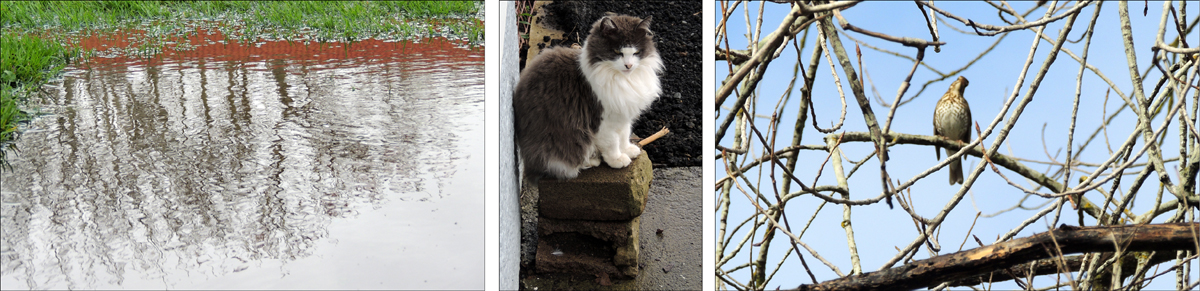
Three days of rain have drenched the land
forming rippling mirrors in the grass
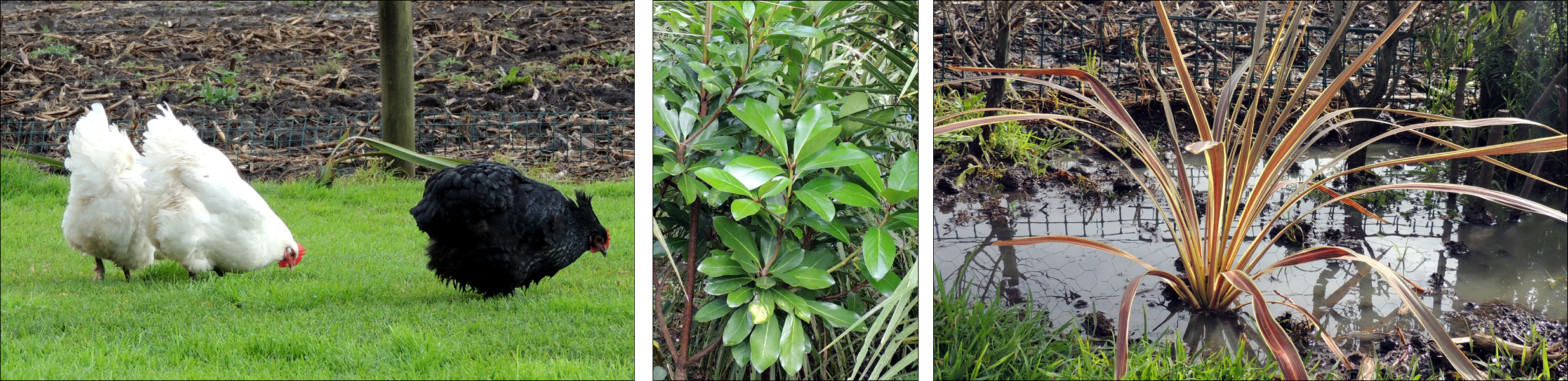
and a flock of dishevelled, wet hens.
A river of caramel water
runs at the edge of the gravel road
then ducks beneath the concrete pipe
at the end of our driveway.
Bright green leaves are freshly washed.
A song thrush calls from high up in the silver poplar
and Molly is perched on a chunk of concrete,
keeping her paws dry.
This morning I stomped around in my gumboots
hoping to capture memories of the water
but the thirsty earth had already swallowed
most of them.
The land at South Head imitates a sponge.
Formed from ancient dunes
it doesn’t allow water to rest here for long.
This year, Halloween falls on NZ Bookshop Day. To celebrate this fortuitous collision, they are challenging members of SpecFicNZ to write short stories that combine the two.
Send them your stories of spooky bookshops, booky spooks, or spooked books and be in to win $100!
Details
Length: 1000 – 2000 words Deadline: 30 September 2015
Theme/genre: Stories should feature both bookshops and Halloween/general spookiness.
Additional information about the challenge is available here.
About SpecFicNZ / How to join
Information about SpecFicNZ and how you can become a member is posted on their website.
or… how to wile away an afternoon instead of working on your current writing project.
The finished product
This week is Te Wiki o Te Reo Maaori, hence my attempt at dual headings. The macrons don’t seem to always display that well, so in same cases I’ve reverted to double vowels.
My Road to Chiles
Tāku Ara ki Ngā Hirikakā
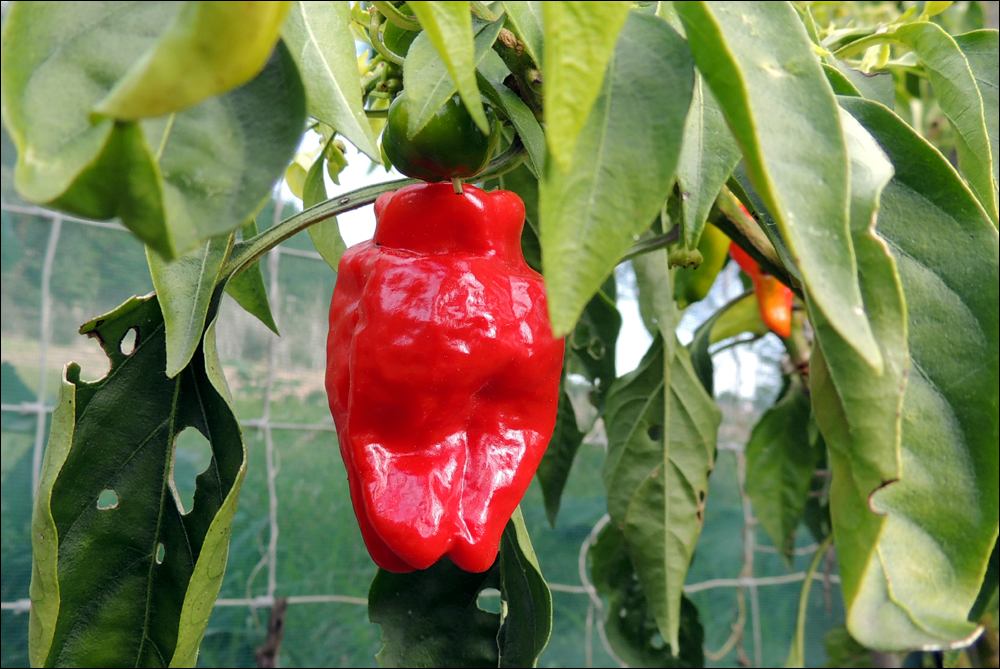
From the day I first tasted a pickled jalapeno on a pizza, I’ve always loved chiles. Very early on I was a member of a chile pepper Usenet newsgroup – this was back in 1994/1995, and a time when the internet as we know it now, was still in its infancy. You weren’t able to browse gazillions of web pages then, nor purchase unusual chile seeds online. A friend sent me some Habanero seeds by snail mail, all the way from the US. Of course, it was probably illegal to do this, but I didn’t think about such things back then, I was just so keen to try them. I nurtured the precious plants under plastic in my (then) Dunedin garden.
Habanero
Ngā Hirikakā Tino Kakā
The Habanero is still my absolute favourite pepper. In my opinion, it is the most floral and fragrant of them all and I love the heat. I use Habanero everywhere; in curries and pickles, sauces and pastes, even in a Hot Martini! 🙂
A chile plant in July at South Head.
I have grown Habanero, Jalapeno, Serrano and other assorted peppers continuously, since moving to South Head. In fact, my plants are still bearing chiles, out there in the cold, wintry conditions… They are so prolific that by the end of a season, I get somewhat lazy about harvesting them.
Keeping Chiles for Later Use
Hei Rokiroki ngā Hirikakā
My usual practice has been to pick the chiles when they are fully ripe, wash and dry them thoroughly, then freeze them whole. This is an excellent way to store these jewel-like fruit as you can just take one out and slice off a chunk when you need it. The problem is, we can never keep up with eating them and there are bags of them in the freezer – some going back a couple of years. They don’t seem to deteriorate.
This year I thought I’d try preserving some by drying. I’ve seen those neat little jars in home ware shops – the ones with a glass body and a stainless steel screw-top lid with holes. Dried chile is such a beautiful colour, how nice it would be to have our very own flakes or powder, to use as a condiment.
Drying Chiles
Hei Whakamaroke ngā Hirikakā
Chile peppers strung up in the barn.
I wouldn’t say that my technique was completely successful. I diligently harvested a mixture of Habanero and Caribbean Red Habanero, threaded them on strings, and strung them up in both the barn and the hot water cupboard. I kept a few back to use fresh – they were in a rourou on the bench, then forgot about them. Amusingly, a few weeks later, I noticed that these were starting to dry quite well, so I put the rourou into the hot water cupboard as well.
Today I decided it was high time to do something with these peppers. Every time I went to put some linen in the cupboard, I had to push it behind the chiles rattling on their strings. Interestingly, I discovered that the peppers that had dried the best, i.e., had no mouldy-looking discolouration, were actually the ones in the rourou.
The End Product
Te Mea Whakamutunga
I discarded any that didn’t look good enough for my high standards (!) This reduced my stock by at least 50%. I then trimmed the stalks off the others and nuked them in my blender/grinder.
The result is a lovely HOT product – a chili powder/flake, which will be ideal to sprinkle on foods, or to add at the cooking stage – IF YOU DARE. I was using a pastry brush to sweep out the last powdery residue from the grinder – didn’t want to waste any – and inhaled some. Yowsa it was hot, and I coughed for about five minutes.
Recipes
Ngā Tohutaka
Hot Martini
This is the recipe that we use, but I can’t find where I sourced it, unfortunately.
I also found this recipe on the net. It sounds much hotter – perhaps we’ll check it out tonight.
Ingredients
½ habanero pepper
60 mls agave tequila
15 mls dry vermouth
Ice
Instructions
In a cocktail glass muddle the habanero to release some juices. Do not pulverise. Keep the pepper in the glass, or remove it for a (slightly) lesser heat.
Combine over ice the tequila and vermouth. Shake well. Then pour the mix over the muddled habanero.
It was foggy when I awoke this morning, and a rather chilly 7 degrees Celsius.
The paddock next door glowed a mellow brown against the leaden sky. It had been freshly-plowed a couple of days ago and the rich earth bristling with broken maize stalks reminded me of a rough slice of dark rye bread.
I walked a circuit of the property several times (my usual practice). This combines exercise with the chance to see the myriad changes in the garden from the previous day.
Spider Webs
What captured my attention today was the texture of the light through the mist and the way it picked out the delicacy of the tiny things it touched.
For example, I saw the work of countless orb-web spiders. Their intricate webs are strung from fence wires, dangling from branches and woven between the leaves of the harakeke and other native shrubs.
This morning, each web was heavily laden with tiny drops of water.
The Colours of a Misty Day
At first glance, the garden appeared to be clothed in muted greys and pastels.
Paradoxically, as I drew close to them, trees and shrubs seemed somehow fresher. They appeared to loom up out of the grey and stood out with greater clarity than I’d noticed on days where there is no mist.
All the while, the sun was trying to break through the moisture-laden air.
Tahou
Zosterops lateralis lateralis (Waxeye or Silvereye)
A tiny Tahou fed on small insects on the lichened branch of the old plum tree.
I was interested to read in Lynette Moon’s Know Your New Zealand Birds that this pretty little bird is protected.
Waxeyes are classified as native, which means they are either naturally found here, or self-introduced; large numbers migrated to New Zealand from Australia in the 1850s.
Who is the specimen here?
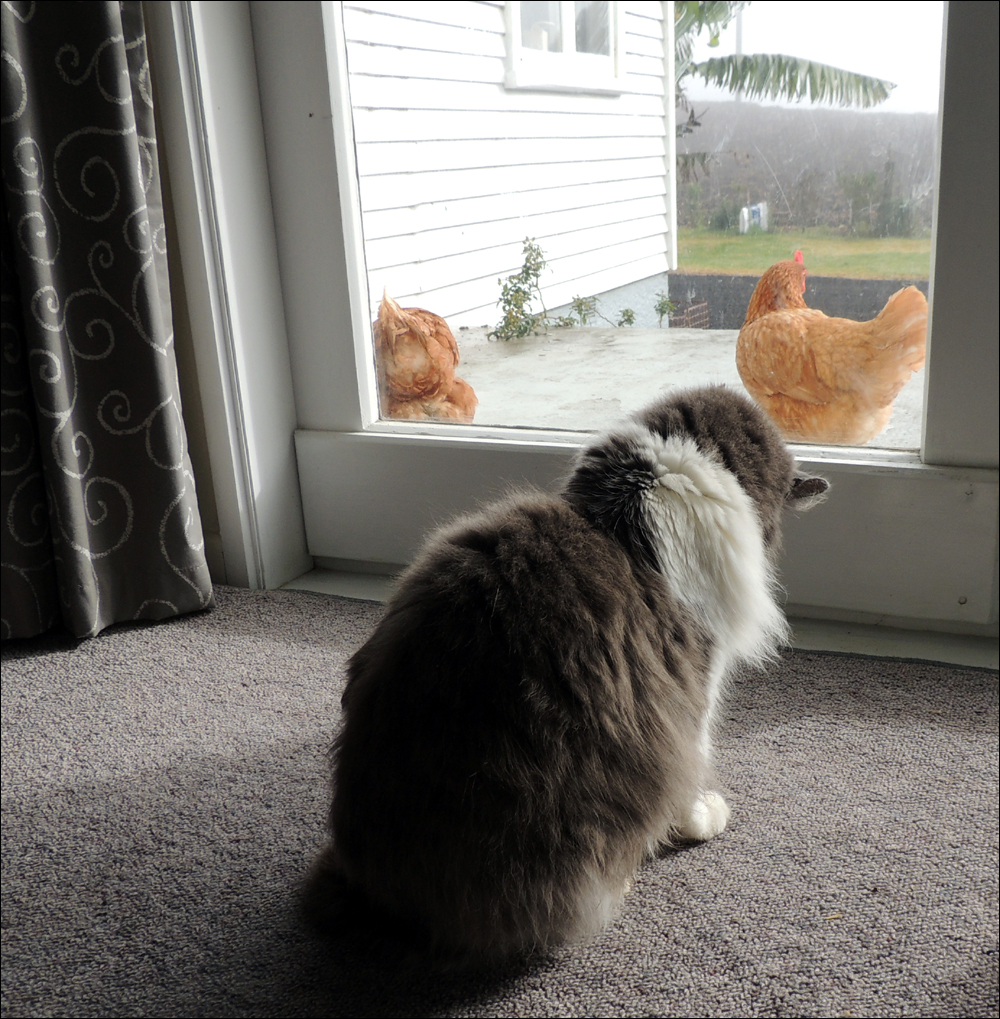
When I came back indoors, several of the hens were on the terrace, looking in at me through the living room window. Sometimes I have the distinct impression that I’m a specimen in a zoo.
Molly joined me. She looked at the hens, the hens looked back. Then they walked away. Slowly.
This always amuses me. Had she stared them down? What is the pecking order here?
On rainy days when the hens are sheltering near the window, Molly often looks out at them. Sometimes she goes right up to the window and just looks. I’d like to be able to read her mind.
Reference:
Moon, Lynette (2006) Know Your New Zealand Birds New Holland Publishers (NZ) Limited, Auckland.
My Flash Fiction piece, Moonshine Road, has been accepted for publication by Crab Fat Literary Magazine.
The story goes back to my past – there are some elements of truth and some of fiction. This made it easier for me to write as I still have vivid memories of Moonshine Bridge and Moonshine Road. As kids we knew the area inside out.
My friend Sue and I spent hours and hours, especially as young teenagers, exploring the river, the bridge, and the ruins and wild gardens of a dwelling that had been derelict for years. We’d walk across the river to the ruins of McCurdy’s Castle and swim at Whakamoonie. All amazing memories.
So… writing about the area was easier – my memories are still vivid.
Moonshine Road, the story, is about something different. And it’s set a few years later. But you’ll have to read it to find out what it is.
I’ll post something here when it’s published.
Moonshine Bridge was demolished in 1987 to make way for the redirection of State Highway 2 along the River Road.










 Heni Irihapeti's Blog