Category Archives: South Head

Chile Dreams / Ngaa Moemoeaa Hirikakaa

or… how to wile away an afternoon instead of working on your current writing project.

The finished product

This week is Te Wiki o Te Reo Maaori, hence my attempt at dual headings.  The macrons don’t seem to always display that well, so in same cases I’ve reverted to double vowels.

My Road to Chiles
Tāku Ara ki Ngā Hirikakā

From the day I first tasted a pickled jalapeno on a pizza, I’ve always loved chiles. Very early on I was a member of a chile pepper Usenet newsgroup – this was back in 1994/1995, and a time when the internet as we know it now, was still in its infancy.   You weren’t able to browse gazillions of web pages then, nor purchase unusual chile seeds online.  A friend sent me some Habanero seeds by snail mail, all the way from the US.  Of course, it was probably illegal to do this, but I didn’t think about such things back then, I was just so keen to try them.  I nurtured the precious plants under plastic in my (then) Dunedin garden.

Habanero
Ngā Hirikakā Tino Kakā

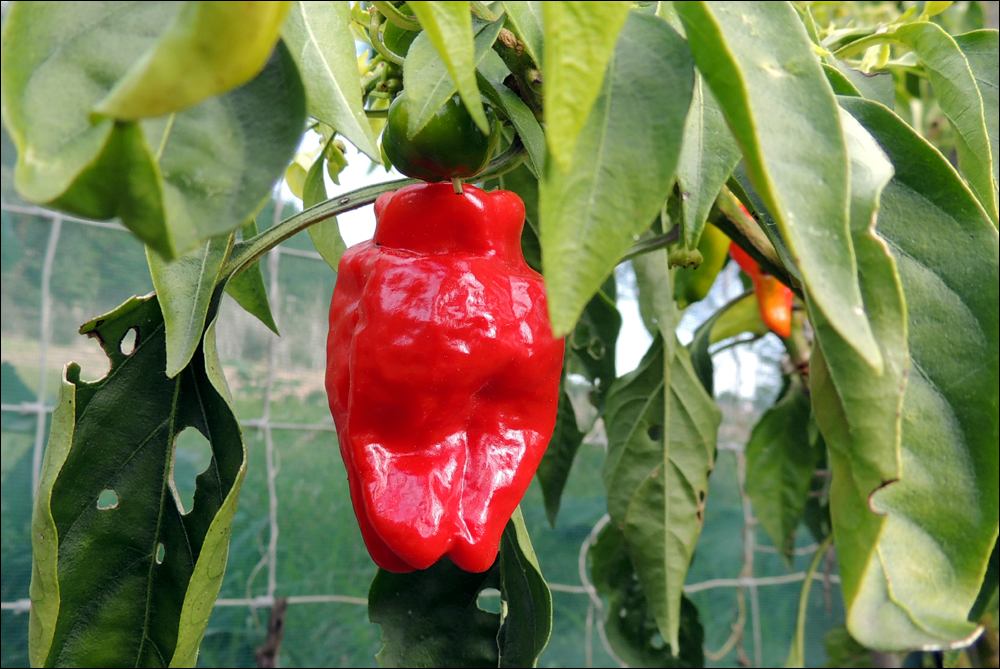
The Habanero is still my absolute favourite pepper.  In my opinion, it is the most floral and fragrant of them all and I love the heat.  I use Habanero everywhere; in curries and pickles, sauces and pastes, even in a Hot Martini! 🙂
A chile plant in July at South Head.

I have grown Habanero, Jalapeno, Serrano and other assorted peppers continuously, since moving to South Head. In fact, my plants are still bearing chiles, out there in the cold, wintry conditions… They are so prolific that by the end of a season, I get somewhat lazy about harvesting them.

Keeping Chiles for Later Use
Hei Rokiroki ngā Hirikakā

My usual practice has been to pick the chiles when they are fully ripe, wash and dry them thoroughly, then freeze them whole.  This is an excellent way to store these jewel-like fruit as you can just take one out and slice off a chunk when you need it.  The problem is, we can never keep up with eating them and there are bags of them in the freezer – some going back a couple of years.  They don’t seem to deteriorate.

This year I thought I’d try preserving some by drying. I’ve seen those neat little jars in home ware shops – the ones with a glass body and a stainless steel screw-top lid with holes. Dried chile is such a beautiful colour, how nice it would be to have our very own flakes or powder, to use as a condiment.

Drying Chiles
Hei Whakamaroke ngā Hirikakā

Chilli peppers strung up in the barn.
Chile peppers strung up in the barn.

I wouldn’t say that my technique was completely successful.  I diligently harvested a mixture of Habanero and Caribbean Red Habanero, threaded them on strings, and strung them up in both the barn and the hot water cupboard. I kept a few back to use fresh – they were in a rourou on the bench, then forgot about them.  Amusingly, a few weeks later, I noticed that these were starting to dry quite well, so I put the rourou into the hot water cupboard as well.

dried chiles

Today I decided it was high time to do something with these peppers. Every time I went to put some linen in the cupboard, I had to push it behind the chiles rattling on their strings.  Interestingly, I discovered that the peppers that had dried the best, i.e., had no mouldy-looking discolouration, were actually the ones in the rourou.

The End Product
Te Mea Whakamutunga

flakes

I discarded any that didn’t look good enough for my high standards (!)  This reduced my stock by at least 50%.  I then trimmed the stalks off the others and nuked them in my blender/grinder.

The result is a lovely HOT product – a chili powder/flake, which will be ideal to sprinkle on foods, or to add at the cooking stage – IF YOU DARE.  I was using a pastry brush to sweep out the last powdery residue from the grinder – didn’t want to waste any – and inhaled some. Yowsa it was hot, and I coughed for about five minutes.


Recipes
Ngā Tohutaka

Hot Martini

This is the recipe that we use, but I can’t find where I sourced it, unfortunately.

  • 60 mls gin
  • 7.5 mls Dry Vermouth
  • Splash of aromatic bitters
  • Slice of Habanero chile to taste
  • 3 green olives

Habanero Martini

I also found this recipe on the net. It sounds much hotter – perhaps we’ll check it out tonight.

Ingredients

  • ½ habanero pepper
  • 60 mls agave tequila
  • 15 mls dry vermouth
  • Ice

Instructions

  1. In a cocktail glass muddle the habanero to release some juices. Do not pulverise. Keep the pepper in the glass, or remove it for a (slightly) lesser heat.
  2. Combine over ice the tequila and vermouth. Shake well. Then pour the mix over the muddled habanero.

If you are interested in chiles, here is a useful link Chile Pepper Varieties

The Habanero Martini recipe is borrowed from PepperScale’s site – lots of neat recipes there.

Kō tēnei Te Wiki o Te Reo Maaori!

All is Quiet

misty


Kaipara Winter’s Morning

All is quiet when the mist seeps in
to hold the land close in its selfish embrace.

The twiggy branches of the gingko are decked
with the clever webs of orb-web spiders.
They shimmer in the slightest breeze.

The bright green grass glistens with dew
and my steps form wet hollows.

In the orchard, a tahou hops and flits
on lichen-encrusted bough.
His breakfast a selection of tiny insects.

Jane Percival, July 2015

Anyone for German Rye?

Foggy Morning

mist

It was foggy when I awoke this morning, and a rather chilly 7 degrees Celsius.

The paddock next door glowed a mellow brown against the leaden sky. It had been freshly-plowed a couple of days ago and the rich earth bristling with broken maize stalks reminded me of a rough slice of dark rye bread.

I walked a circuit of the property several times (my usual practice). This combines exercise with the chance to see the myriad changes in the garden from the previous day.

Spider Webs

orbweb

What captured my attention today was the texture of the light through the mist and the way it picked out the delicacy of the tiny things it touched.

For example, I saw  the work of countless orb-web spiders.  Their intricate webs are strung from fence wires, dangling from branches and woven between the leaves of the harakeke and other native shrubs.

This morning, each web was heavily laden with tiny drops of water.

The Colours of a Misty Day

mist 03

At first glance, the garden appeared to be clothed in muted greys and pastels.

Paradoxically, as I drew close to them, trees and shrubs seemed somehow fresher.  They appeared to loom up out of the grey and stood out with greater clarity than I’d noticed on days where there is no mist.

All the while, the sun was trying to break through the moisture-laden air.

Tahou

Zosterops lateralis lateralis (Waxeye or Silvereye)

A tiny Tahou fed on small insects on the lichened branch of the old plum tree.

I was interested to read in Lynette Moon’s Know Your New Zealand Birds that this pretty little bird is protected.

Waxeyes are classified as native, which means they are either naturally found here, or self-introduced; large numbers migrated to New Zealand from Australia in the 1850s.

Who is the specimen here?

hens

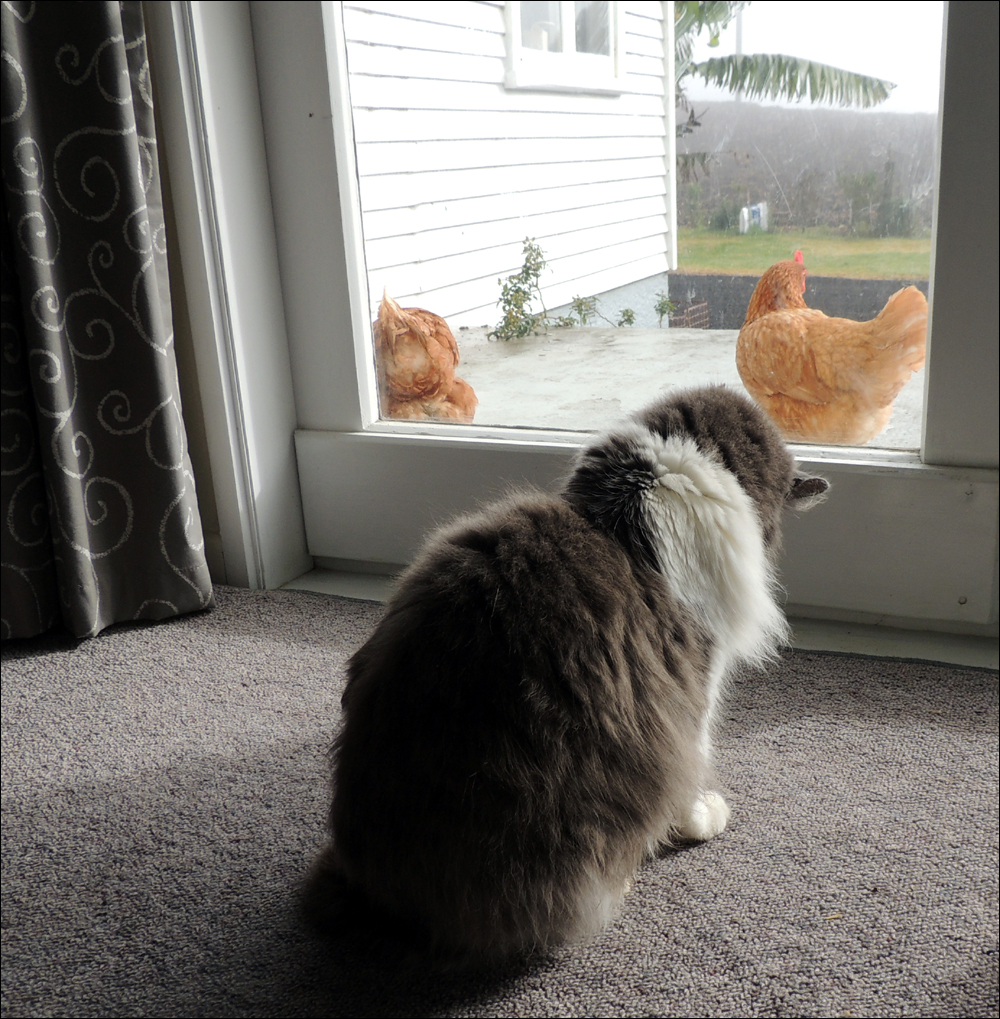
When I came back indoors, several of the hens were on the terrace, looking in at me through the living room window. Sometimes I have the distinct impression that I’m a specimen in a zoo.

molly

Molly joined me. She looked at the hens, the hens looked back. Then they walked away. Slowly.

This always amuses me. Had she stared them down? What is the pecking order here?

On rainy days when the hens are sheltering near the window, Molly often looks out at them. Sometimes she goes right up to the window and just looks. I’d like to be able to read her mind.


 Reference:

Moon, Lynette (2006) Know Your New Zealand Birds New Holland Publishers (NZ) Limited, Auckland.

Flash Fiction

Moonshine Road

Moonshine Bridge & siblings, c. 1974.

I received some excellent news today.

My Flash Fiction piece, Moonshine Road, has been accepted for publication by Crab Fat Literary Magazine.

The story goes back to my past – there are some elements of truth and some of fiction. This made it easier for me to write as I still have vivid memories of Moonshine Bridge and Moonshine Road. As kids we knew the area inside out.

My friend Sue and I spent hours and hours, especially as young teenagers, exploring the river, the bridge, and the ruins and wild gardens of a dwelling that had been derelict for years. We’d walk across the river to the ruins of McCurdy’s Castle and swim at Whakamoonie. All amazing memories.

So… writing about the area was easier – my memories are still vivid.

Moonshine Road, the story, is about something different. And it’s set a few years later.  But you’ll have to read it to find out what it is.

I’ll post something here when it’s published.

Moonshine Bridge was demolished in 1987 to make way for the redirection of

Image of the partial demolition of Moonshine Bridge

Winter Solstice One Day On

moon

Cold Night

It’s cold outside tonight. 6.9 Celsius is not usual for South Head at 11.00 pm, even in June.

Curious, I look out the wash-house window to the west and see a crescent moon, low in the sky. It is deeply golden.

(Alas my photo does not show this well
but I promise you it was golden.)

And this crescent moon is lying supine, lightly resting on the very tops of the pines in Redhill Forest.

A mischievous wind blows hair across my face as I walk to the fence, intent on resting my Nikon on a post to steady my shaky hands.

The long grass paints my ankles with wet stripes and the cool breeze is particularly interested in the end of my nose.

Overhead The Milky Way is too much for me tonight. The single moon-shape is what draws me, reclining there just above the horizon.

My app tells me it’s a waxing crescent moon and the wind is 13 kph SSE.

I could have sworn it was a Northwesterly.

Jane Percival 2015

Winter

pomegranate

June

The pomegranates we hoped to sample have burst.
Firmly secured to their bare branches,
they are still too high for us to reach.

Corpulent macadamia pods fatten ‘on the vine’.
Smooth brown nuts in moss green shells,
each day I gather them from the ground.

The last feijoas lie scattered, rotting away on the soggy earth.
More than one hundred have passed my lips this year.
They still taste sweet.

Across the road, black and white cows munch away on green grass;
One or two have lain down in the sun.
Beyond, the Kaipara is soft in shades of blue and grey.

Yesterday at dusk I heard the chirping of a cricket,
then a cold wind chased me indoors.
Surely June is too late for a cricket’s cry.

Jane Percival, 2015

Woolly Hen

Strategies to Counteract Hen-Pecking

Perky chicken bare of feather
Looks out at the murky weather
Not for her the field next door
Nor sunny nooks on forest floor

Perky looking out towards where the other hens are scratching.

Attempt 1: The Knitted Jumper

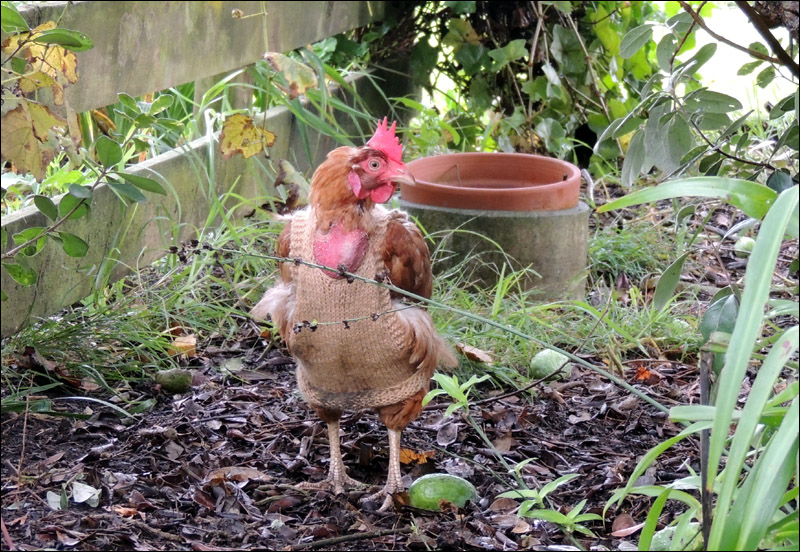
The idea of knitting a little outfit for Perky didn’t work out as we’d planned. And I suspect that Perky wasn’t impressed with the whole process, either.

Ben found a jumper pattern online, as well as comments indicating that dressing Perky in such an item would be a workable idea, and would help protect her and keep her warm until the feathers around her neck, chest and crop grow back.  I duly knitted away and produced the outfit below: –

The completed hen tunic.

That night, we crept up to the hen house under the cover of darkness, grabbed Perky (who was sound asleep) and while Ben held her snugly, I put the tunic over her head, fastened the two buttons, freed her wings and adjusted it as best I could.  Perky wasn’t that impressed but didn’t wriggle much.

Ben went out later on to see if she was still okay, and she was sleeping peacefully with the woolly jumper on. So far so good.

A disgruntled Perky, wearing her new 'jumper'.
A disgruntled Perky, wearing her new ‘jumper’.

The next day I went out first thing to check and was dismayed to discover that Perky had become entangled in the little outfit. She’d somehow managed to lift one of her legs through the ‘armholes’, where usually only her wings would go. So part of the garment was now under her body and the bottom edge of the garment was wet and muddy and dragging on the ground – of course to make matters worse, it was raining.

p_front

Dismayed, I managed to corner Perky and pick her up.  I stroked her for a bit to soothe her, and then re-adjusted the tunic, ensuring it was sitting correctly and that her wings and legs (and head, of course!) were free. I pulled it up so that it sat nicely below her neckline and set her back on the ground.

Even after adjusting the tunic, I could see that it was too loose.

Thirty minutes later when I went back to check, I could see that the tunic was actually too large for her – she’s such a tiny scrap of feathers.  The hem was down to her ‘knees’ (not sure if hens have knees) and it was clearly annoying her – she kept trying to lift her legs to scratch it away with one or other of her feet.

Sadly I had to catch her again – Poor Perky, I hate chasing her to catch her when she’s not really tame enough.  I gave her some cuddles and removed the offending item.

Attempt 2: Stockholm Tar

The other three saved hens were still pecking at her bare skin, so on Saturday we applied some Stockholm Tar to the exposed flesh, thinking this would be a good solution.

Wrong again. The other hens just pecked it off – we could see who the main culprit was (Crinkle) by the tar on her beak.

Attempt 3: Isolation

It doesn't seem fair that Perky has to be the one kept away from the outside world.
It doesn’t seem fair that Perky has to be the one kept away from the outside world.

Perky is now all by herself in the rescued hen section of our fenced off area.  The other three saved hens have been integrated into our main flock and are doing fine.

One amusing thing though… while chasing Perky on Saturday to apply the Stockholm Tar, Ben found a pile of more than 30 eggs, all nicely piled up under some long grass.

The secret nest area.  We've left a fake egg there so that Perky has something to lay her own egg beside.
The secret nest area. We’ve left a fake egg there so that Perky has something to lay her own egg beside.

We checked them all using the ‘will they float in water?’ test, and ended up only discarding about 10. We had visitors over the weekend so have eaten the remainder already.  It would appear that all the rescued hens have been laying since we’ve had them.  I think that’s ironic considering that the battery farms cull them for going off the lay.

The short poem to Perky at the top of the page is a quatrain.

Odds and Hens

Rescued Hens

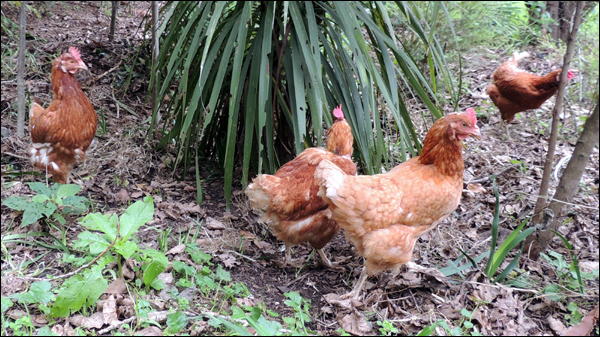
The four rescued hens, scratching around in the leaf litter.

Our four new girls have settled in well.  They picked up the business of being free range surprisingly quickly and are now integrated into the main flock.  We have 11 hens altogether; our 3 original Red Shavers (Lottie, Lulu and Leila), our 4 Black and White Orpingtons (Francesca, Pearl, Fatima and Hannah) and our 4 new rescued hens (Perky, Pompom, Crinkle and Honey).

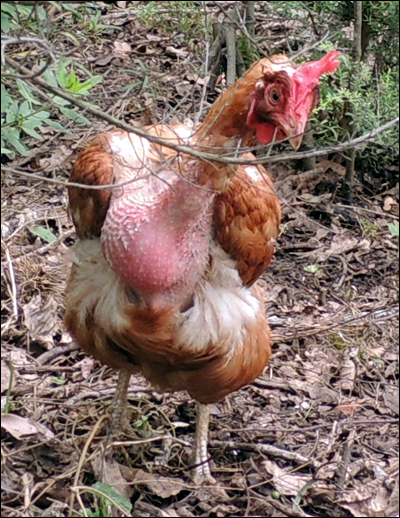
Poor little Perky of the Bare Crop.

Pompom, Crinkle and Honey have almost all their feathers now, but Perky is still being picked on.  And pecked on.  When she arrived she had hardly any feathers around her crop and even though new quills start to form, they get pulled out by (we think) Crinkle.  I guess she’s at the bottom of the pecking order.

To solve this problem, I’m knitting a little outfit for her to wear. I should have it finished this evening and we can dress her in it tonight when she’s half asleep.

All the new hens are becoming quite tame, but I haven’t yet felt like trying to pick any of them up, for fear of scaring them.  It’s been a lot for them to take in over the past few weeks. Going from being squashed into a small cage with their days governed by artificial lighting, to being free to come and go, feeling dirt and grass under their feet, able to flap their wings, build hollows in the dirt to bathe in, etc., etc.  I think they are doing remarkably well, considering.

They still haven’t mastered perching for sleep, however.  At the moment they are still in their own little house at night so it doesn’t matter if they hunker down on the floor, but at some point we’ll have to try to teach them how to use the perches.

Fruit and Funghi

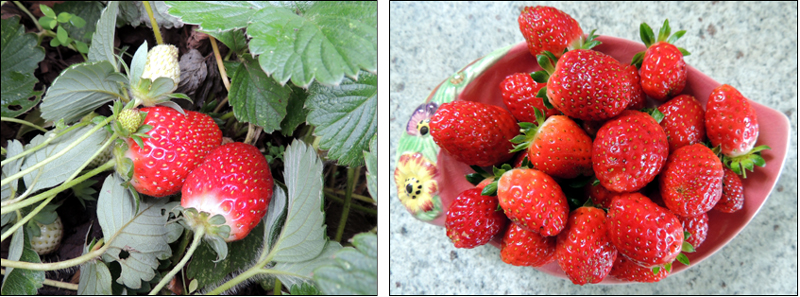
Juicy strawberries growing at the end of Autumn

It seems an odd time of the year to be picking strawberries, nevertheless, that’s exactly what I was doing earlier today. I’d noticed the odd berry amongst the leaves over the past week or so, and had been eating them when I spotted them, but today I’ve picked enough for dessert this evening. Yummy.

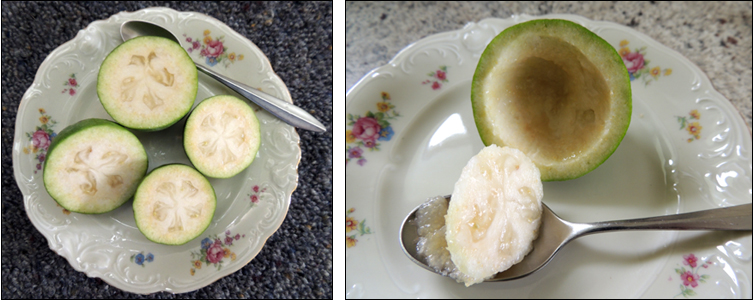
Exquisitely-delicate tasting Feijoa.

Our feijoas have been phenomenal. If there ever was an amazing feijoa season, this has been it. Numerous fruit are still falling on a daily basis and whether they are tiny or large, they taste exquisite.  I know some people can’t abide the flavour, but ours are so JUICY and not at all dry. We have two trees and the fruit from each tastes different.

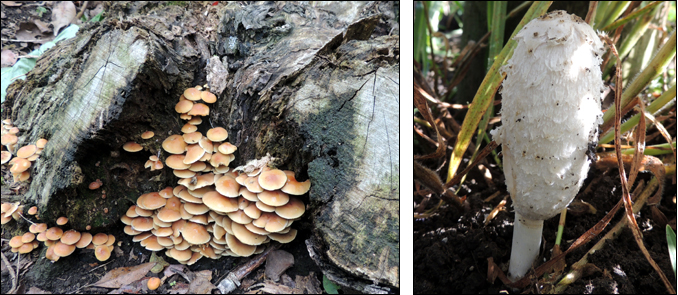
Hypholoma acutum and Coprinus comatus.
Left to Right: Hypholoma acutum, Coprinus comatus.

It’s also the right time of year for funghi. Today I found a spectacular crop of Hypholoma acutum on an old tree stump in the native area, and in the weekend we found a couple of Shaggy Ink Caps when we were pulling out some Kikuyu grass from by the fence line.

Sadly I think the season for Shaggy Ink Caps is mostly over, as I’ve seen dissolving black patches of black goop around the edges of the property.  Now that I know what they are and that these funghi are edible (they taste really good) I’ll be on the lookout for them a year from now.

Tropical Plants

A couple of interesting plants we put in recently are thriving: –

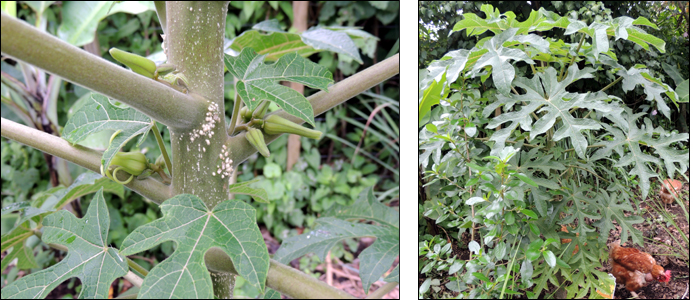
Papaya
Mountain Pawpaw (Carica Pubescens)

Our Mountain Pawpaw has flower buds and has put on a heap of growth.  We planted it in our ‘native’ area where it’s sheltered and the soil is very good.  Also, I gather they are happy in partial shade so it should suit the plant perfectly as it grows.

Grenadilla
Sweet Grenadilla (Passiflora ligularis)

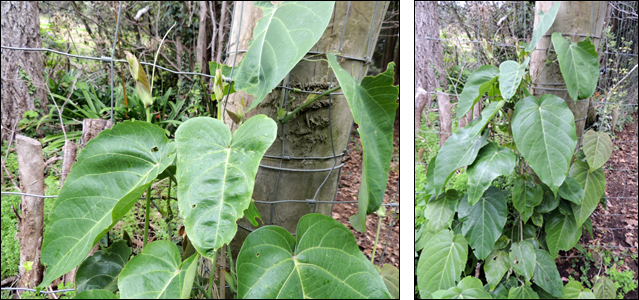
We also planted the passion fruit variety, Sweet Grenadilla, to make up for the fact that we took out our old regular passion fruit vine. I’m very hopeful that this won’t succumb to the same disease as the other did.  It certainly looks completely different, leaf-wise and it’s eagerly sending off tendrils this way and that.  We’ve chosen a very sheltered corner for it.

So… watch this space.  I’ll take some photos of Perky wearing the little outfit and post some in the next day or so.

Changing of the Season

 End of Summer

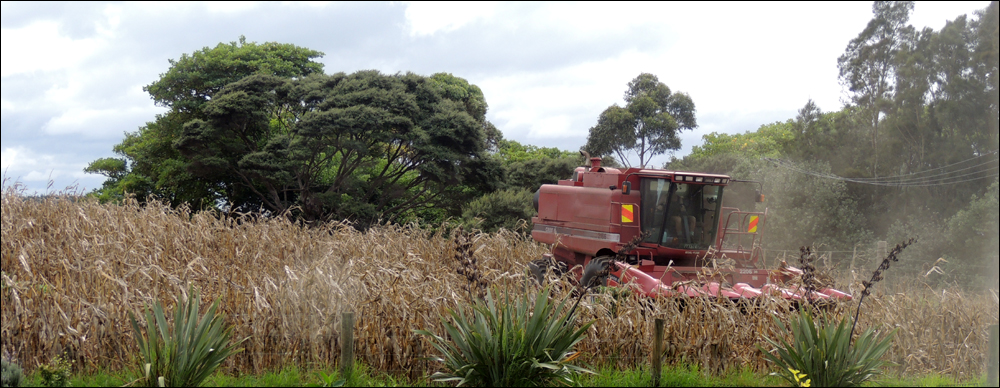
Maize being harvested.

It’s definitely Autumn.  As I sit at my computer I can hear the rumble and whirr of the combined maize harvester driving along the paddock adjacent to our property.  As it moves down the rows, capturing everything in its path and discarding all but the individual maize kernels, great clouds of dust rise around it.

The wind has picked up this afternoon and is blowing in from the north… It was supposed to rain, and perhaps it still will, but right now it’s a mixture of bright sunlight and racing clouds.

The Garden

This beautiful buttercup squash weighed 3.189 kg.
This beautiful squash, ‘Burgess Buttercup’  weighed 3.189 kg.

Clean Up Tasks

It’s the time of year for clean-up and maintenance tasks in the garden. The squash and pumpkins are ready to be cut from their vines and stored in a dry and airy place.

The twisted brown tomato stalks need to be pulled out and burned, along with the remains of our former passion fruit vine.

I made the decision to remove the vine after it had finished cropping, due to it being afflicted with disease.  It has been incredibly productive this year, and I’m sure we have eaten more than 200 individual passion fruit.  So, it was with a heavy heart that I cut it away from the fence yesterday.  All that is left is to dig the roots out of the soil.

Fruit

A scattering of fruit; Feijoa and Guava.

Plump feijoa and red and yellow guava are strewn on the grass outside our kitchen window; an array of yellow, green and red baubles.

While the guava are quite definitely edible, now that the feijoa are ready they won’t get a look in with me. Back in Spring when the blackbirds were stripping the petals from the flowers, I could not have imagined that the trees would be so heavily-laden.

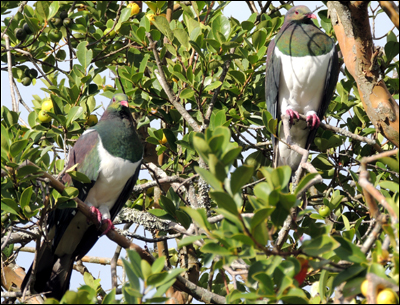
A pair of kererū in the yellow guava.
A pair of kereru in the yellow guava.

For several days we’ve had two plump kereru camped out in the fruit trees.  At night they seem to seek refuge in the golden totara, but by day they stay in the yellow guava, gorging on the fruit (they can swallow the guava whole!) or just sitting still in the sun.

Juicy pears.
Juicy pears.

We’ve also had many pears.  The only problem is getting to them before the blackbirds!  But if we go out early in the day we can usually rescue most of them.

Vegetables

peppers
Capsicum, Eggplant and Chillies.

For the first time, we’ve had eggplants that have grown to maturity and we’ve had an amazing crop of capsicum.  I’m hoping that these will keep cropping until May or June.  We also have abundant habanero and one other (unidentified) chilli pepper.  This latter plant came from a packet of chilli ‘Caribbean Blend’ so I’m not really sure what it is. We sampled it (with trepidation), and although it was hot, it didn’t seem as hot as a habanero, nor did it have the beautiful floral flavour that a habanero has.

Chilli peppers strung up in the barn.
Our new seasons’ chilli peppers strung up in the barn.

As you can see from the photo above, I’m going to dry the chillies this year.  We have such a huge chest freezer, that even with the baskets at the top, we tend to lose track of small things.  It will be interesting to see if I’m successful or not.  I thought it would be great to grind them up and use them with a pepper shaker.

This morning I took a bucket to the farm across the road and collected some field mushrooms. Yum!!! These are my favourite funghi.  They have such a rich taste in comparison with button mushrooms purchased from the supermarket.

Field mushrooms, freshly-picked this morning.

They’ll be great sauteed in butter and stirred through some freshly made pasta.

After the Harvest

What's left after the harvester has done its job.
What’s left after the harvester has done its job.

The harvester has finished in the field.  All that is left behind are the husks and a few dried leaves.  It’ll be tough for the small shrubs we have on the fence-line, especially now that the wind is coming from the north.  For a good six months they’ve been sheltered by the maize!

The maize field is now stark against the sky.

Coming Home to Roost

 Rescued Hens

Some of the rescued hens awaiting the arrival of their adopted parents.
Some of the rescued hens waiting for collection.

We are now the proud ‘parents’ of four former battery farm hens.  We adopted these from The Animal Sanctuary and drove across to Dairy Flats last Wednesday to collect them.

They were part of a group of several hundred hens saved from being killed after reaching the end of their very first egg-laying cycle. This is usual practice for battery farms – they don’t wish to feed the hens when they go off the lay (the latter state being a natural part of a hen’s yearly cycle).  Hens can’t keep laying eggs non-stop without a rest and usually go ‘off the lay’ for a few weeks when the days start to get a little shorter.

We're waiting to get to know them a little better before we name them.
We’re waiting to get to know them a little better before we name them.

Our four new girls are in their own separate area, in their own house and sheltered amongst native vegetation.

For the very first time in their lives they can walk about freely, feeling the dirt under their feet and waking and sleeping by the natural day.

One of the hens enjoying a soothing dirt bath.

They don’t yet know how to perch, but have already figured out how to take a dust bath.  We think this is pretty cool.

We’ll keep them apart from our other hens until their feathers have grown back some, and they are more confident in their surroundings.  Then we’ll gradually introduce them to the flock and … in time, allow them to roam freely with their sisters.