Category Archives: Recipe

Pickled Beetroot

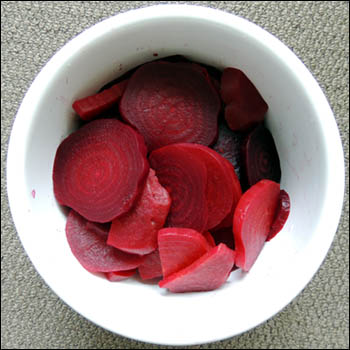
Freshly pickled beetroot

Beetroot Preparation

This recipe requires about 5 – 6 medium-sized beetroots.

Prepare the beetroots by washing off any soil, and trimming the stalks back close to the root.  Leave the long ends of the roots in place so that the beetroots don’t lose too much colour while being cooked.  Cook in water until just tender.  Drain and allow to cool.

Set aside the sliced beetroot in a bowl.

Once cool, remove the skins – the easiest way is by hand, under slowly-running water.  Slice the beetroots evenly and set aside in a bowl.

Pickling Liquid

Combine the following ingredients in a pan and bring to the boil.

  • 3/4 cup white sugar
  • 1/4 teaspoon plain salt
  • 1 1/2 cups white vinegar
  • 3/4 cup water
  • 1/2 teaspoon peppercorns
  • 1 bay leaf
  • 2 cloves
  • 1/2 teaspoon yellow mustard seeds
  • 1/2 cinnamon stick
The pickling liquid simmering on the stove.

Simmer for five minutes then strain through a sieve or muslin.  Bring back to simmer heat.

Pack the beetroot into hot, sterilised jars and pour in the pickling liquid until the beetroot is covered.  Seal.

Pickled beetroot can be kept for some months stored in a cool place, but once opened should be kept in the refrigerator.  If finished using the water bath method, it will last longer.

Sun, surplus veges and soy cheese

Summer at South Head

It’s radiantly sunny again today, but we did have a couple of hours of rain for part of Sunday.  It fell heavily which was a welcome boost to our water tank, as well as providing much needed moisture to the various gardens.

Left to Right: Plum Chutney, Corn Relish (Southern), Beetroot Chutney, Cilantro Corn Relish, Plum Sauce, Pickled Gherkins, Pickled Zucchini

I was very busy preserving more surplus food over the weekend, including beetroot, zucchini, corn, cucumber and gherkins.

For the beetroots I tried out a Nigella Lawson recipe for Beetroot Chutney.  The resulting chutney set very well due to having apples included in the recipe.  It is very sweet and spicy and was pretty yummy straight from the pan, but will also improve with age.

I also experimented with a new Corn Relish recipe from a Southern Foods website.  This recipe included tomatoes, green pepper and cucumber, as well as the corn, but I ended up adding a wheat flour paste (1/2 cup flour / 1/2 cup water) to thicken it.

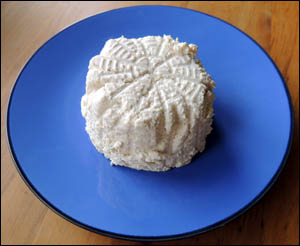
Ricotta Salata, day 2 of salting process.

On Sunday I made a batch of ricotta cheese, which I have pressed into a mould and am now resting on a rack in the fridge for a week, lightly salting the outside each day, with the aim of turning it into a cow’s milk version of a Ricotta Salata.  After the salting period, the cheese will need to be aged further in the refrigerator (for approximately 2 – 4 weeks).

Freshly-made soy ricotta.

This set me thinking about the vegans in our family and whether I could do the same with a litre of soy milk.  So using the same method, I made a batch of soy ricotta last night.

It actually turned out very well, considering that it was an experiment.  The soy milk I used was Soy Milky as this is our favourite drinking soy milk, but I think that the added sugars and flavours have had an impact on the flavour of the soy cheese.

1/2 cup dried soy beans soaking in 2 cups water.

So, today, I’m soaking some soy beans to see if I can make some soy milk from scratch, and then use this to make the soy ricotta.

It would be great if I could go on to convert this to a soy version of the ‘Ricotta Salata’, as a harder cheese is so much more versatile.  The soy cheeses available from specialty vegan shops are very expensive so I’d love to make an edible version of my own.

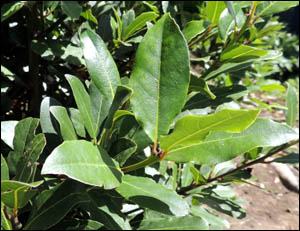
Bay tree in our garden.

I suspect  that the addition of a bay leaf to the milk during the heating process would provide an interesting dimension to the flavour – especially as bay leaves can enhance both savoury and sweet recipes.  Our two bay trees (Laurus nobilis) are very valuable members of our home garden.

Two juvenile turkeys sneaking through our property.

Finally, when I was working this morning I kept hearing an unusual chirping sound – when I went into the living room to see if I could identify which bird was making this sound, I saw two young turkeys walking across our front lawn in the direction of the pumpkin patch.  I only just manage to take a photo before they disappeared out of sight.

Simple South Head Corn Fritters

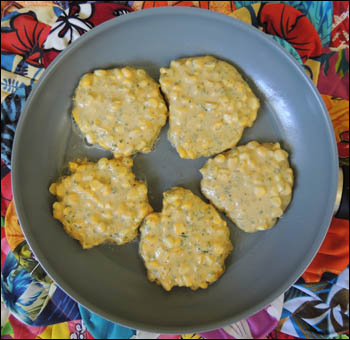
Corn fritters, ready to be eaten!

Ingredients

  • 1 cup fresh corn kernels
  • 1 freshly-laid hen’s egg
  • 1 tsp freshly chopped oregano
  • freshly ground black pepper (to taste)
  • 1/2 cup plain white flour
  • 1/2 tsp baking powder
  • 1/4 tsp plain salt
  • a healthy pinch of ground cumin
  • Soy milk to make batter

Method

1 cup fresh corn kernels

To 1 cup of fresh corn kernels, add 1 tsp finely chopped oregano (or marjoram) and one fresh farm egg.  Mix these together with a fork.

corn, egg & oregano
corn, egg & oregano

Then add the flour, baking powder, salt, pepper and cumin and stir these in with the fork.

Add dry ingredients
Add dry ingredients

To this mixture add enough soy milk to make a smooth batter.  This recipe is light on batter and heavy on corn, so don’t make the mixture too runny.

Add soy milk to make a batter

Heat a pan to medium to hot heat, and add a small amount of sunflower oil and butter – just enough to prevent the fritters from sticking.  Add mixture in approximately 1/4 cup portions – this will make 5 small fritters.

Fritters cooking in the pan

Turn fritters when they have browned on one side and serve when cooked through and nicely browned on the other side.

Notes

Using equal amounts of both oil and butter allows the pan to heat without the butter burning, yet retains the flavour butter provides.

The backdrop to the photos on this page is a colourful hand-sewn fabric rug from Nalauwaki village, Fiji Islands.

Sweet and Spicy Plum Sauce

Image

Image

Ingredients

  • 1 kg plums (halved and with stones removed)
  • 2 onions
  • 1/4 cup water
  • 12 whole cloves
  • 6 allspice
  • 6 black peppercorns
  • 2 cm length of cinnamon stick
  • 2 cm length of peeled root ginger (skin removed)
  • 1 tsp yellow mustard seeds
  • 3/4 cup soft brown sugar
  • 1 tsp plain salt
  • 1 1/4 cups malt vinegar

Method

Wash and chop plums coarsely.  Peel and chop onions.

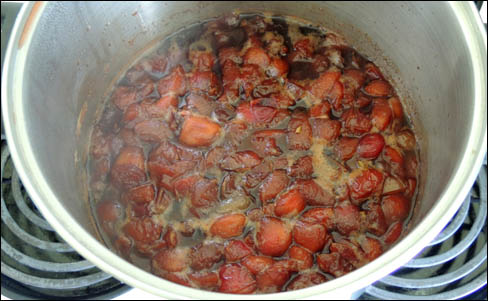
Add both the plums and the onions to a large cooking pan, along with the 1/4 cup of water.  Cook gently until soft.

Tie the cloves, allspice, peppercorns, cinnamon stick, root ginger and mustard seeds in a muslin bag using a length of string.  Place the spice bag in the pan so that it is submerged in the plum/onion mixture and tie the end to the handle for easy removal.  Add the brown sugar, salt and malt vinegar.

Cook uncovered, until mushy, then push through a colander or sieve.

Return the sieved pulp to a saucepan and simmer until it has reached the thickness of sauce required.

Bottle using your usual method in hot sterilised jars.  Seal and store.

Image

Image

Additional Notes

The easiest way to remove the skin from root ginger is by scraping gently with the curved edge of a small spoon.

This time round I used around 2/3 red-fleshed and 1/3 yellow-fleshed plums.  Both had dark red skins.

I used the water bath method, heating the filled jars at 90C for 20 minutes.

This recipe makes around 600 – 800 mls, depending on how thorough you are with pushing the pulp through the sieve.

The sauce itself lasts a year and possibly longer.  We tend to use it all before more than a year has elapsed.

As it ages it takes on a very rich dark colour, with a notable improvement in flavour.

Zucchini Pickle

Image

Ingredients

  • 500 grams zucchini, very finely sliced
  • 1 small onion, finely chopped
  • 2 tbsp plain salt
  • 500 ml cider vinegar
  • 140 grams caster sugar
  • 1 tsp yellow mustard seeds
  • 1 tsp mustard powder
  • 1 tsp celery seeds
  • habanero pepper to taste
  • 1 tsp ground turmeric

Method

Thinly slice the zucchinis using a sharp knife or a mandolin.  Place these in a bowl with the finely-chopped onion and sprinkle with the salt.  Cover with ice-cold water, stir to dissolve the salt, and leave for 1 hour.  Drain the zucchini well and pat dry using a clean tea towel.

Image

While the zucchini are soaking, add the vinegar, sugar, mustard powder, mustard seeds, celery seeds, habanero and ground turmeric to a preserving pan and bring to a simmer.  Allow to bubble for 3 minutes, stirring to ensure the sugar is dissolved, then allow to cool until just warm.  Add the zucchinis and stir.

Add the pickle to sterilised jars.  I then used the water bath method to finish off this recipe.

Notes

This will make approximately 1 litre of the pickle.  For this recipe I used the zucchini, Costasta Romanesco as it’s the only zucchini I grow these days.  Not only does it produce the huge male flowers useful for stuffing and deep frying, but the texture and flavour of the flesh is far superior to that of regular zucchini.

Adapted from the ‘Crunchy Courgette Pickle’ recipe, posted on the BBC Good Food website.

http://www.bbcgoodfood.com/recipes/681665/crunchy-courgette-pickle

Plum Chutney

ImageIngredients

  • 2 kg plums, stones removed (and skins, too, if you have the energy)
  • 500 grams finely chopped onion
  • 1 cup raisins
  • 1 cup sultanas
  • 1 clove of garlic (crushed)
  • 4 cups of soft brown sugar
  • 2 tsp plain salt
  • 1 tsp mixed spice
  • habanero pepper to taste (seeds removed)
  • 4 cups malt vinegar

Method

Combine plums, onions, raisins, sultanas, garlic, brown sugar, salt, mixed spice and habanero in a preserving pan.  Add enough malt vinegar to almost cover and stir well.

ImageBring to the boil and simmer gently with frequent stirring for 2 hours, or until the chutney as thickened to a jam-like consistency.

(I was too lazy to remove the skins before cooking, so I picked them out once they were floating on top.)

Pack into sterilised jars and seal while hot.

ceriselineNotes

This will make enough for 6 x 350 ml jars.

Unopened, this chutney will keep for up to 1 year.  Once opened, store in the fridge.

Adapted from the recipe for Fruit Chutney, published in ‘Edmonds Chutneys, Pestos, Jams & Other preserves, (2000), p. 12.

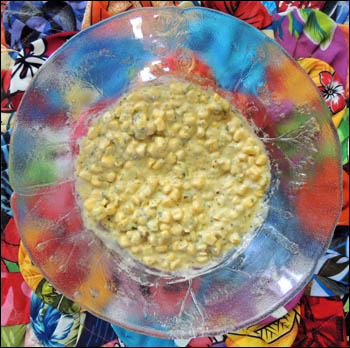
Corn Relish

Image

Ingredients

Method

Finely chop the oregano and the coriander, (until the moisture in the leaves is starting to ooze out).  Neatly dice the capsicum and chop the onion finely.

ImageImage

Toast the ground cumin in a medium saucepan for 1 – 2 minutes (until aromatic).  Add the onion, vinegar, sugar, oregano, habanero and salt, and bring to boiling point.  Simmer for about 5 minutes. Add the capsicum and corn, and simmer for a further 3 – 4 minutes, or until the corn is cooked through.

Pour into hot sterilised jars and preserve using the water bath method.

ImageAdapted from the recipe for ‘Cilantro Corn Relish’ from About.Com Home Cooking.

http://homecooking.about.com/od/condimentrecipes/r/blcon92.htm

Simple Curd Cheese

Image

Ingredients

  • 1.5 litres full cream milk
  • Juice of 1 large lemon
  • Salt to taste

Heat the milk to boiling point in a stainless steel pan.

Remove from heat and add the lemon juice.  Move the liquid very slowly with a plastic or wooden spoon, until a curd begins to form.  The curds will start to cling together.

Image

Leave for about 5 minutes, then pour through a colander or sieve lined with muslin or cheese-cloth.  Ensure that the colander/sieve is sitting over another pan or a bowl to collect the whey.

Tie the neck of the cloth and hang the cheese from the tap so that it can drain into the sink.  In about 10 minutes all of the whey will have drained off, and the remaining curd can be turned into a storage container.  At this stage salt can be added to taste.

ImageYou can see the pattern from the cheese-cloth on the cheese I made today.

This cheese should be stored in the refrigerator and eaten within a few days.  It’s great for savoury or sweet dishes. e.g. cheesecakes, as a base for dips, creamed for a dessert topping, sliced or crumbled into salads, etc.

Image

Ode to a Prickly Gherkin and other tales

Rain was forecast for this morning, but it bypassed South Head altogether. I had decided to water the flower garden at dusk last night, which proved a sensible choice. There are clouds scooting across the sky as I write, and out the window I can see the neighbour across the road riding his farm bike across the paddock. There were black and white cows there last night, but they’ve moved on today.

Image

We had an unwelcome visitor this morning, in the form of a wild rabbit. Not that a pet rabbit would be any more welcome. I’ve seen him a few times lately and hope that he doesn’t make a habit of visiting us, or of bringing his extended family with him!

Outside I can hear ‘kihikihi-wawā’ cicadas (Amphipsalta zealandica), named for their loud chorus in the summer months. And there is a new tui hanging around – I’ll call her a ‘she’ although she could just as well be a male. She sings with just the one repetitive call – a sort of sharp ‘qweel’ sound with the first note dropping off to a lower note, not unlike the sound of a squeaking gate. She started calling this morning at around 5.30 am, right outside the bedroom window. I wonder if she’s looking for a mate as she is usually alone, which is uncommon for the tuis around here. She looks too fat to be a juvenile bird.

Image

On my garden ’rounds’ this afternoon, I spotted a couple of monarch butterflies, coupling on the grass. Then they actually flew away (not sure how), soaring upwards and disappearing over the top of the trees. High on love, I guess.

When I got to the pumpkin patch I was distraught to discover that the hens had scratched up some of our freshly-sprouted melon seedlings. The baby plants had been fenced-in with sturdy sticks, but these had been knocked down, and all that remains is a dusty hollow amongst the wood-chips. The hens are such little monkeys! I had to physically remove Lottie three times or she’d have destroyed several runners on the gherkin vine.

Just the one gherkin ready today, but many more on the way. I know that once they really start ripening I’ll be busy pickling every other day.

Image

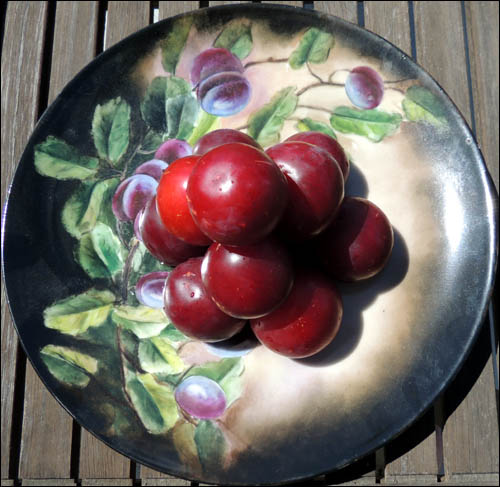
The best remaining plums are either on the other side of the southern fence or at the top of the tree, so we walked around to the back paddock with a ladder to collect a bowl full. Ben will make a plum cake this evening for dessert.

I searched on the internet last night to see if I could find a stockist in New Zealand of electric water bath preservers, but without success. This seems to me the perfect appliance, with all our fruit and vegetables and just the two of us here.

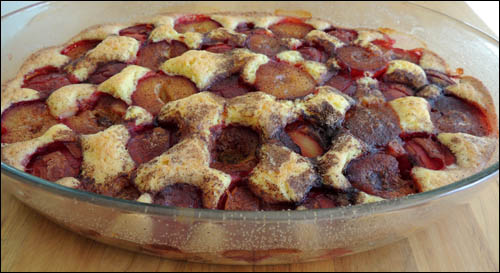
I can smell the plum cake cooking. Yum!

And here come’s my mojito! Time to finish. 🙂

Image

Image

Ode to a Prickly Gherkin (Hei kīnaki mō te kōrero ki runga)

It lay in wait,
Under lush and scratchy leaves,
Growing from stretching vines,
The curling tips of which reach in all directions,
Towards the sunlight and up and over the old tree stump.
In and out of lush soil and wood-chips,
The tendrils strong enough to forge ahead
Through any obstacle.

It lay in wait,
A fat spiky chrysalis,
Hanging from a woven flax thread,
The flowering tip long dried up,
The skin striped sage and mint green,
Not moving,
Fattening beneath the shelter
Of its mother leaves.

Until I picked it.

Image

Image

Simple Plum Cake

(Serves 12)

150 grams castor sugar
115 grams softened butter
140 grams plain flour
1 teaspoon baking powder
2 fresh free-range eggs
1 pinch salt
12 freshly-picked plums, pitted and halved
1 teaspoon ground cinnamon
1-2 tablespoons caster sugar, for sprinkling

Preheat oven to 180 C

Beat sugar and butter until fluffy. Mix baking powder with flour and sift into creamed mixture. Beat in eggs and salt. Mix everything well.

Pour mixture into a large greased baking dish and smooth out with a palette knife. The mixture should be about 2-2.5 cm deep. Top with the 24 plum halves, alternate with cut side up. Then sprinkle with the sugar/cinnamon mixture.
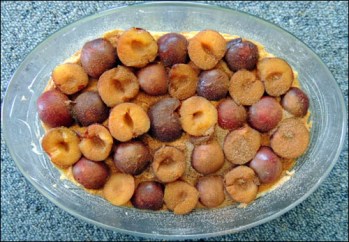
Image

Bake in a pre-heated oven on the lowest shelf for about 45 minutes, or until a skewer comes out clean. Cool to room temperature or serve warm.
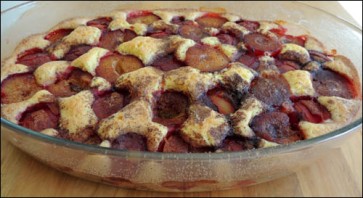
Image

This recipe has been adapted from the Easy Plum Cake recipe at: http://allrecipes.co.uk/recipe/17476/easy-plum-cake.aspx

It is simple and really delicious. It works just as well with frozen plums, which is why we’ve been freezing so many plum halves over the past few days.

Pumpkins and cherry slugs

We’ve had a few sunny days in a row and this has been reflected in the growth in the pumpkin & squash patch.  This year, I raised three varieties from seed and they are all doing really well (‘Thelma Saunders Sweet Potato’, ‘Burgess Buttercup’ and ‘Butternut Chieftain’).  There are quite a few pumpkins set already, some growing quite round and fat.  We planted and sowed most of our cucurbits in the native garden this year, and already I can see that it was a very sensible choice.  In previous years we’ve tried the back paddock (too dry and windy), in the main vegetable garden (too invasive) and on the grass in front of the barn (became overgrown with grass).  The native garden is sheltered and sunny, with very rich loamy soil.  The worst two weeds are convolvulus and madeira vine.  But I feel that I can control these two by digging them out when they come up and either leaving in the sun to shrivel up (convolvulus) or putting out in the rubbish collection (madeira vine).

Our zucchini ‘Costasta Romanesco‘ is huge, the fat yellow and green fruit remind me of smooth alien guinea pigs.  The hens have stirred up the wood chips around them and the zucchinis are difficult to find until they have grown too big for my liking.  Costasta Romanesco is a variety grown especially for their huge male flowers, which can be stuffed, coated in batter and deep fried.  But the zucchinis themselves also taste really good sliced thickly and fried in olive oil with sage leaves – they are much starchier than the commonly-grown zucchinis, with a lovely nutty flavour, and the sage leaves turn all crispy.

Ben has been collecting plums by the tray load, halving them and freezing them free flow.  This particular old prunus was here when we moved in and is quite gnarly and covered in lichen.  There wasn’t much fruit last year in comparison with 2011, but this year it is completely laden with beautiful red-skinned, golden-fleshed plums.  They taste the best if you can pick them when they turn purple but before they drop to the ground.  Each morning when we let the hens out, they hurry over to feast on the plums that have fallen over night.  There are more than we can keep up with.  I eat them whenever I walk past the tree but it barely makes a difference.  In the past we’ve made plum wine and plum sauce.  At least if we manage to freeze a good deal of them, I’ll still have the option to do this when life isn’t so busy.

Cherry slugs on my cherry Stella

The big shock yesterday was when I discovered that the leaves of our tiny dwarf cherry tree ‘Stella’ were covered in slimy little slugs.  We picked them all off and offered them to the hens, but they weren’t interested.  I later identified them as larvae of the sawfly (caliroa cerasi).  Many of the leaves had been converted over night from healthy green to lacy brown.  Thank goodness I do tend to walk around the complete garden on a daily basis.  When I checked again this morning there was only a solitary slug, so it seems that the crisis has been averted.

White-tailed Spider
White-tailed Spider

I also saw my very first ‘white-tailed’ spider, (Lampona spp.)  I’m always looking for different and interesting bugs and plants so when I saw this particular spider sitting near the ceiling of our porch, I rushed to fetch my camera and a stool.  I had to get really close up to take the photo and was surprised when I saw the white tip on its abdomen when I looked at the image later on.  There is quite a bit of negative hype about these spiders, but from what I have read, they are somewhat maligned.

It’s been a good day for power generation.  At the time of writing (7.30 pm), our 2KW system has generated just under 14KWh.  It has been a very hot and calm day, with the temperature ranging from 18C when I arose at 7.30 am and reaching over 30C in the sheltered patch by the bromeliad garden at around 3.00 pm this afternoon.  The sweet corn is ripening in the paddock behind the barn and the maize that stretches away to the north is very tall and lush.

Sitting here I can see across the Kaipara to the East.  The distant hills are a hazy blue grey, sandwiched between the palest blue sky and the silvery forget-me-not blue of the water.  In the foreground are our harakeke, which have flowered for the first time, sending straight spurs of rusty red flowers towards the sky.

Tomorrow I have to head to Wellington for an overnight meeting.  A major garden task for when I return will be to attempt to sort out part of our vegetable garden that is filled with scattered sweet-corn plants (a blackbird hen dug up most of them), self-sown Cleome (I want to plant these around the climbing beans), a few pumpkins and squashes, and other self-sown vegetables.  We are going to try to move all the corn to one end before they get too tall, rescue the Cleome and make some sense of the array of other vegetables that are growing there.