It was foggy when I awoke this morning, and a rather chilly 7 degrees Celsius.
The paddock next door glowed a mellow brown against the leaden sky. It had been freshly-plowed a couple of days ago and the rich earth bristling with broken maize stalks reminded me of a rough slice of dark rye bread.
I walked a circuit of the property several times (my usual practice). This combines exercise with the chance to see the myriad changes in the garden from the previous day.
Spider Webs
What captured my attention today was the texture of the light through the mist and the way it picked out the delicacy of the tiny things it touched.
For example, I saw the work of countless orb-web spiders. Their intricate webs are strung from fence wires, dangling from branches and woven between the leaves of the harakeke and other native shrubs.
This morning, each web was heavily laden with tiny drops of water.
The Colours of a Misty Day
At first glance, the garden appeared to be clothed in muted greys and pastels.
Paradoxically, as I drew close to them, trees and shrubs seemed somehow fresher. They appeared to loom up out of the grey and stood out with greater clarity than I’d noticed on days where there is no mist.
All the while, the sun was trying to break through the moisture-laden air.
Tahou
Zosterops lateralis lateralis (Waxeye or Silvereye)
A tiny Tahou fed on small insects on the lichened branch of the old plum tree.
I was interested to read in Lynette Moon’s Know Your New Zealand Birds that this pretty little bird is protected.
Waxeyes are classified as native, which means they are either naturally found here, or self-introduced; large numbers migrated to New Zealand from Australia in the 1850s.
Who is the specimen here?
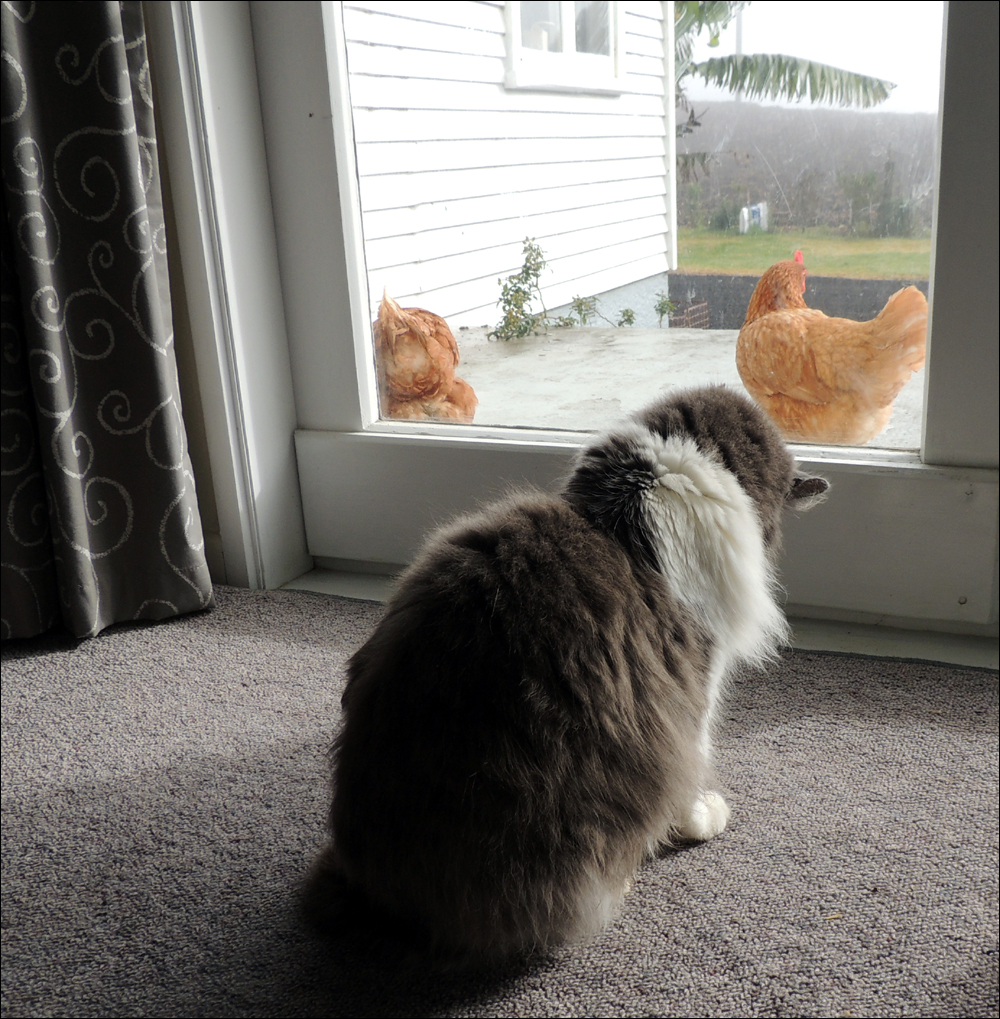
When I came back indoors, several of the hens were on the terrace, looking in at me through the living room window. Sometimes I have the distinct impression that I’m a specimen in a zoo.
Molly joined me. She looked at the hens, the hens looked back. Then they walked away. Slowly.
This always amuses me. Had she stared them down? What is the pecking order here?
On rainy days when the hens are sheltering near the window, Molly often looks out at them. Sometimes she goes right up to the window and just looks. I’d like to be able to read her mind.
Reference:
Moon, Lynette (2006) Know Your New Zealand Birds New Holland Publishers (NZ) Limited, Auckland.
Perky chicken bare of feather Looks out at the murky weather Not for her the field next door Nor sunny nooks on forest floor
Perky looking out towards where the other hens are scratching.
Attempt 1: The Knitted Jumper
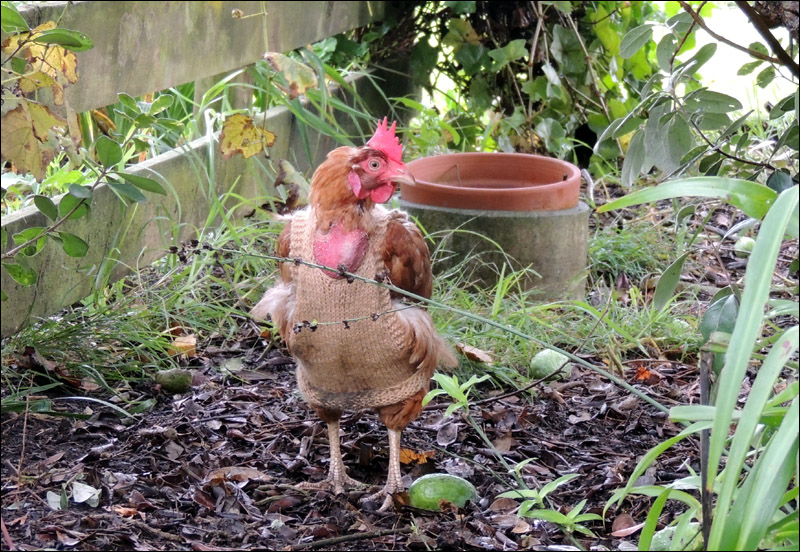
The idea of knitting a little outfit for Perky didn’t work out as we’d planned. And I suspect that Perky wasn’t impressed with the whole process, either.
Ben found a jumper pattern online, as well as comments indicating that dressing Perky in such an item would be a workable idea, and would help protect her and keep her warm until the feathers around her neck, chest and crop grow back. I duly knitted away and produced the outfit below: –
The completed hen tunic.
That night, we crept up to the hen house under the cover of darkness, grabbed Perky (who was sound asleep) and while Ben held her snugly, I put the tunic over her head, fastened the two buttons, freed her wings and adjusted it as best I could. Perky wasn’t that impressed but didn’t wriggle much.
Ben went out later on to see if she was still okay, and she was sleeping peacefully with the woolly jumper on. So far so good.
A disgruntled Perky, wearing her new ‘jumper’.
The next day I went out first thing to check and was dismayed to discover that Perky had become entangled in the little outfit. She’d somehow managed to lift one of her legs through the ‘armholes’, where usually only her wings would go. So part of the garment was now under her body and the bottom edge of the garment was wet and muddy and dragging on the ground – of course to make matters worse, it was raining.
Dismayed, I managed to corner Perky and pick her up. I stroked her for a bit to soothe her, and then re-adjusted the tunic, ensuring it was sitting correctly and that her wings and legs (and head, of course!) were free. I pulled it up so that it sat nicely below her neckline and set her back on the ground.
Even after adjusting the tunic, I could see that it was too loose.
Thirty minutes later when I went back to check, I could see that the tunic was actually too large for her – she’s such a tiny scrap of feathers. The hem was down to her ‘knees’ (not sure if hens have knees) and it was clearly annoying her – she kept trying to lift her legs to scratch it away with one or other of her feet.
Sadly I had to catch her again – Poor Perky, I hate chasing her to catch her when she’s not really tame enough. I gave her some cuddles and removed the offending item.
Attempt 2: Stockholm Tar
The other three saved hens were still pecking at her bare skin, so on Saturday we applied some Stockholm Tar to the exposed flesh, thinking this would be a good solution.
Wrong again. The other hens just pecked it off – we could see who the main culprit was (Crinkle) by the tar on her beak.
Attempt 3: Isolation
It doesn’t seem fair that Perky has to be the one kept away from the outside world.
Perky is now all by herself in the rescued hen section of our fenced off area. The other three saved hens have been integrated into our main flock and are doing fine.
One amusing thing though… while chasing Perky on Saturday to apply the Stockholm Tar, Ben found a pile of more than 30 eggs, all nicely piled up under some long grass.
The secret nest area. We’ve left a fake egg there so that Perky has something to lay her own egg beside.
We checked them all using the ‘will they float in water?’ test, and ended up only discarding about 10. We had visitors over the weekend so have eaten the remainder already. It would appear that all the rescued hens have been laying since we’ve had them. I think that’s ironic considering that the battery farms cull them for going off the lay.
The short poem to Perky at the top of the page is a quatrain.
I started this post over a month ago but recent circumstances got the better of me and I didn’t get it finished. Today I’ve made the commitment to at least get something posted – after all, the whole point of a blog is keeping up with it.
We’ve had a little rain – just enough to prevent it being declared a drought in our area, unlike some other parts of NZ – but it’s getting very dry now. As I write a large truck has come scuttling down the hill and along the gravel road beyond our gate. Huge clouds of dust drift and settle on our property.
I think of the solar panels and how they will most likely need to be cleaned manually if we don’t get a decent rainfall soon. You’d be surprised how much dust settles up there! Or perhaps you wouldn’t.
As I write it’s around 1.30 pm and 27 C outside in the shade. By the time the sun comes around it will get very hot where I’m sitting, even with all the windows open. It’s much too warm and humid for me outside at this time of day. The sun just bears down relentlessly – hence the garden is quite neglected. I’m hanging out for cooler mornings and evenings now that it’s Autumn.
Garden
Late summer vegetables
The garden has still been remarkably productive, considering that until last week (when I put in a row of broccoli and rocket) I hadn’t sowed anything new since December. We are still producing enough vegetables not to have to purchase anything other than the occasional bag of potatoes.
The basket above shows some of the vegetables we’ve been harvesting since I last wrote, but the green beans are finished now. As are the peas and we just didn’t eat any of the lettuces I diligently sowed in Spring and early Summer – they kept going to seed as we were eating other vegetables, so I stopped sowing them.
Vegetables
The vegetables we’ve been consuming the most of, lately, have been tomatoes, turnips and zucchinis.
The heirloom golden ball turnip is a delicious little vegetable and easy to prepare.
A simple recipe I use is to peel them, then cut them into cubes and blanch in boiling water. Drain the water off and saute the cubes in a little oil of your choice until they start to brown in patches, add 1 tbsp butter, 1 tsp brown sugar and 2 tsp apple cider vinegar. Stir through to form a light glaze. Season with salt and pepper and they are ready to eat.
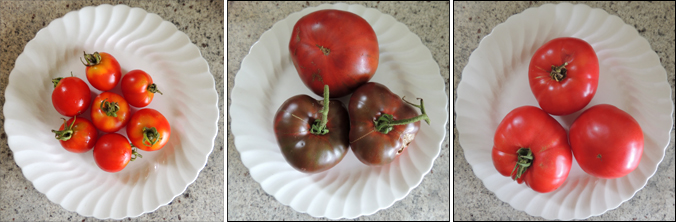
Tomatoes (Left to Right): Bloody Butcher, Black Krim, Mortgage Lifter
The three varieties of tomato that I grew this year are ‘Black Krim’, ‘Mortgage Lifter’ and ‘Bloody Butcher’. Of the three, I definitely prefer Black Krim and Mortgage Lifter.
Tomatoes (Left to Right): Bloody Butcher, Black Krim, Mortgage Lifter
While Bloody Butcher has a nice flavour, I much prefer the texture and size of the other two. As a matter of interest, I collected one of each and cut them in half to show how different they are from each other, inside. (Hence, the images above.)
We’ve had enough cucumbers to keep us going, but not too many, and of course the usual carrots, rocket, basil… silver beet, beetroot, that we usually have on an ongoing basis.
Our harvest of Egyptian Walking Onions
I’ve lifted our almost all the garlic (yes, I know, it’s very late in the season not to have completed this task) and all the Egyptian Walking Onions. We had amazing crops of each of these. The onions are great and we have strung them up to dry out, and the garlic bulbs are very fat this year.
We do have a large section of our garden devoted to main crop potatoes but I have a bad feeling about them. We didn’t really realise how much water they require and should have been watering the plants as they developed. We poked around beneath the soil of a couple of plants a few weeks back and they really had nothing much under there, just some tiny, tiny potatoes.
Oh well, there’s always next year, I guess. At least we did have a decent amount of ‘earlies’ prior to Christmas.
Fruit
Passion fruit and Plums
Yummy Passion fruit, Passiflora edulis
Fruit-wise we’ve had a glut of Passion fruit and are making sure that we each consume several per day so that they don’t go to waste. They are lovely big Passion fruit and are extremely juicy and flavoursome. We still have pulp from last season that we froze a year ago as it was so precious (haha!). I’m definitely not going to freeze any this year.
Juicy, red plums
I did manage to process some of our plums in January. We had so many, all ready at the same time, so we halved and froze some for later, ate a great deal and used the rest for jam and plum wine.
Plum Wine
Plum wine: a new batch and the finished product.
The left-hand image above shows this year’s batch of plum wine directly after the first racking off. Prior to that I’d fast-fermented the must on the skins for the first few days, to bring through a little of the red colour – the plums themselves are yellow-fleshed.
We also opened a bottle of our plum wine from 2010 – we tend to forget that we have bottles of fruit wine in our cellar. It was actually not bad!
Fiery Plum and Habanero Jam
The jam was basically just plums, sugar and habanero pepper. I had to keep tasting the jam as I went along to ensure it was hot enough (but not too hot!); I added more habanero as it cooked. It turned out really well.
It’s very rich in flavour and ideal either just as jam, or added to casseroles or curries to give them an extra zing. It’s also good with cold meats and cheeses. Nice and spicy! I love the taste of habanero.
Molly
Well, there’s a sad tale to tell about Molly (it has a happy ending, though). I’ll have to write up what happened in a separate blog or I’ll never get this posted.
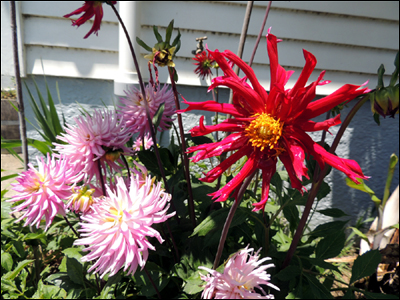
I’ll finish with a photo of a couple of my dahlias. They are very pretty… this photo was taken a week or two ago, they don’t look so perky today, due to the lack of rain.
The south-easterly is howling through the maize in the field adjacent to our land.
South-Easterly
We were away from South Head from Saturday morning until Sunday early evening, and while we were gone, a very strong south-easterly wind developed. The prevailing wind for our area is supposed to be a southerly, but in actual fact, a straight southerly doesn’t really affect our property due to the fact that there is a convenient rise in the land that protects us. We do sometimes get a nor-easterly. While this is annoying, we’ve put things in place to protect our vulnerable plants – sturdy stakes and protective shelter material… that kind of thing. But this south-easterly is coming in from an angle we haven’t experienced before.
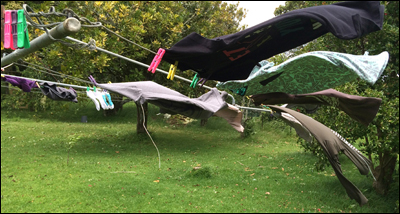
The wind is doing its best to separate the washing from the line!
When I hung out the washing earlier I had to use twice as many pegs per garment. It reminded me of trying to wrestle with cloth nappies in Lyall Bay, Wellington, back in the 70s.
Plums
This doesn’t really show the extent of the plum loss – they are scattered over a wide area of ground
I was too exhausted last night to look at the garden, but the first intimation I had that all was not well was when Ben reported that nearly all the fruit had been blown off from my favourite plum tree. This is the plum tree in what we now term our ‘native’ area – it’s an old tree that has less plums than the one growing closer to the vege garden. But the plums are larger and have a deep red flesh.
I love them and have been looking forward to eating them.
Fallen plums
When I went out earlier this morning to take stock, I felt like crying.
And I do still have a heavy heart, but I suppose there is no point in shedding tears over lost fruit. At least we aren’t dependent on our fruit or our crops for our livelihood.
The second plum tree – mostly unaffected by the wind
Fortunately, the other plum tree is situated out of the worst of the wind. It’s still laden with fruit.
Local Birds
The wind has has had an impact on the birds that have chosen to make their homes here, as well. I’m sure they were just as unprepared for the wind’s unusual direction.
We’ve found quite a few parts of nests on the ground, and the sparrows are busy with recycling; flying down to collect the broken nest parts from the ground and carrying them back up to their respective nesting sites.
A tiny nest lined with hair of some kind.
Ben found the above nest below the macadamia tree, although it’s so light that it could have blown from anywhere.
It’s quite a bit smaller than any I’ve seen on the ground before. The diameter of the inner bowl is approximately 4.5 to 5 cm and it’s lined with silvery grey hair of some kind. I pulled a couple of strands out and it’s too coarse to be human or from a cat. And I think too long to be from a dog… I’m wondering if it’s horse hair or something like that. I really have no idea.
It’s a beautiful little nest, though, with moss and lichen woven in to the outside.
Possibly a blackbird’s or a thrush’s nest.
The above nest is much more loosely-woven than the smaller one. It’s also quite a bit larger – around 9 to 10 cm across the bowl of the nest. We’re pretty sure it belonged to either a blackbird or a song thrush. We could only see the tail of the bird sticking up when it was sitting on, it as it was just out of eye sight.
The nest had been built in quite a small, spindly broad-leaf, and right from the start was partly tipping out, so it’s not surprising that it was dislodged by the wind. This nest is constructed almost entirely from grasses, with a tiny bit of lichen visible… and it seems to be lined with fine mud.
Three Blackbird eggs
Our resident Blackbird couple are raising their third batch of eggs this season. The female is currently sitting on three eggs – I had first observed her back on the nest on 09 December, which surprised me. Raising young seemed to be a never-ending process for her and I wasn’t sure if was because something had happened to her previous babies or whether she would keep on raising new broods if time allowed.
With her second batch I had noted the following: –
19 November: 2 whole eggs, 2 hatched
20 November: 4 hatched
02 December: 4 chicks, well feathered and alert
03 December: Nest empty
It seems amazing to me that it only took 13 days to go from hatching to flight.
I found an excellent page which provided me with the answers on the Tiritiri Matangi site. It seems that Blackbirds do raise 2 – 3 broods per year, and that the chicks fledge at 13 – 15 days. The other interesting fact I read is that a Blackbird’s possible lifespan is 15 years.
Garden Diary
It’s going to be a bumper season for passion fruit.
The garden has been flourishing, and as usual, I’ve been struggling to keep on top of things. There has been more rain in November & December in comparison with the past couple of years, which is a good thing. We’ve only had to water the vegetable garden once, and that very evening it rained, so …
The tomatoes are coming along nicely.
We’re been well-served by our vegetables and have been eating asparagus, beetroot, silver beet, green beans, peas, lettuces, rocket, new potatoes and Florence fennel. Probably some other things as well but it’s hard to keep up.
Sweet Peas
My favourite early Summer flower.
I can’t finish today’s entry without putting in a plug for Sweet Peas. I was very disappointed with the strike rate for the seeds I sowed in winter. I had used up a whole packet but only a handful of seeds germinated.
Well… the ones that did sprout, combined with a few self-sown plants, have provided a wonderful display once again. I’m sure the extra rain has helped, too.
I love these flowers and every other day have picked enough to fill two vases. Even as I sit here writing I can smell their sweet and spicy scent from across the room.
Rain is being blown across the paddocks, watering the maize.
It was incredibly windy on Tuesday, with strong gusts blowing in from the west all day. It was also very sunny.
Today, the wind is still howling and it’s bringing torrents of rain every 30 minutes or so. It’s noticeably cooler, too.
Vegetables
Yesterday was a great day for the garden, despite the wind. I’d decided to dedicate a decent amount of time to tidying up and sowing some more seeds, so started around 9.30 am.
The first thing I had to do was re-tie the young tomato plants to their stakes. They are hardening up nicely and the first two I planted out are flowering, but some of the spindlier ones were definitely being battered by the wind.
New seeds have gone in between the beetroot and the carrots & peas.
I then set to work tidying up a patch of the garden that had some bolting lettuces. After pulling them out and sifting through the soil, I sowed a second row of Edamame and a row of the heirloom carrot, ‘Touchon‘. I was reassured to see that despite the dryness of the surface, there’s still evidence of moist soil about a trowel’s depth in.
On Sunday I had already sowed rows of organic Basil ‘Sweet Genovese’, Turnip ‘Golden Ball’ and Beetroot ‘Crosby’s Egyptian Flat’, so I’m feeling much better about the state of the vegetable garden. I don’t think I’ll ever get on top of the required tasks, though.
The wonderful South Head growing conditions that produce so many vegetables, also produce weeds that grow with alarming vigour and scatter their seeds all year round. And there is never a frost to kill anything off.
Spring Greens
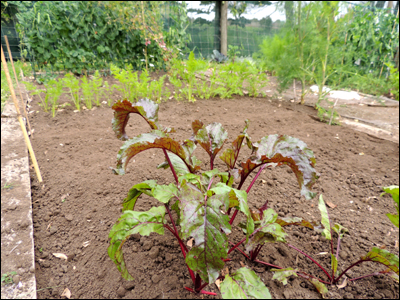
Beetroot (foreground), kale and broad beans.
The vegetables are providing us with choices each day – it’s a matter of juggling between them all and trying to work out what we particularly feel like eating for any given meal.
In the past week we’ve enjoyed Silverbeet, Asparagus, Kale, Lettuce (not just the green variety), Rocket, Broad Beans, Red Cabbage and Peas.
Asparagus
I couldn’t say which is my favourite, though I do love to have asparagus spikes every other day of the week at this time of year.
Fresh garden peas.
Close behind would be fresh peas, and tender young broad beans are wonderful, mashed up with butter and a little garlic.
And I found a really easy (and yummy) recipe for Red Cabbage – so we’ve cooked this up a couple of times. I think this is on the menu for tonight, actually. Sautéed Red Cabbage.
Other Vegetables
Florence Fennel
Florence Fennel (foreground) and Peas.
The Florence Fennel has been putting on a good deal of growth. Fingers crossed they won’t bolt before forming their bulbs. We’ve had good crops for several years now, and one that went straight to seed.
You can see dried Lilly Pilly leaves in all my photos. They seem to fall at all times of the year and I’m always scraping them out of the garden in an attempt to keep it looking tidy. But I guess I’ll never have a tidy garden as the slightest breeze sends them showering back down.
Runner Beans and Lettuces
Lettuces and Runner Beans.
The runner beans seem a bit slow. Ben put in some ‘King of the Blues Runner’ in between the Scarlet Runners from last year. Scarlet Runners are perennial, although most people tend to pull them out at the end of the season and put in new seeds the following year.
Growing in front of them are a few lettuces and some self-sown Viola Tricolor (Heart’s Ease).
Potatoes and Sweet Corn
I poked around beneath the soil by one of the early potatoes and was pleased to see at least one beautiful new potato. It was quite a good size for an ‘early’ so I’m hopeful that we may have better luck this year with growing spuds.
Ben hasn’t been so lucky with his sweet corn, though. He sowed a whole packet and only two sprouted. It’s hard to know if it’s something in the soil, or our friendly blackbirds have been in and dug them out. It’s disappointing and exasperating, but given that our back paddock has been sowed in a commercial crop of sweet corn and that we always get to help ourselves after the first picking, I’m philosophical about it.
I don’t think we’ll bother to try to grow sweet corn again. (We did have a really good crop the first year we were here.)
I’ll be glad to have these as I’ve had bad luck with trying to grow regular onions. The seeds have struck well enough, but have been dug up by birds before becoming properly established.
Silver Beet
This Silverbeet never stops growing.
Our Silverbeet is amazing. These plants are a couple of years old, but don’t seem to want to go to seed. They have actual trunks now – somewhat like pyramids, with the leaves forming in a circle around the upper edges.
A week or so ago I pulled off all the ratty leaves, thinking that we’d be pulling the plants out soon. They responded by sending out new glossy leaves, immaculate. We had to cook some up last night just to work our way through them. The ribs are so wide and the leaves so large that we can’t eat both.
Strawberries and Bananas
The strawberries, protected from the blackbirds.
The strawberries have been coming along well. The problem with them (is there a common theme, here?) has been the blackbird hen. And probably a few other birds as well.
Each morning I’d go down to the garden only to find sharp pecks in the strawberries – even before they’d ripened properly. I’m sure the hens were happy, though, as I’d throw them all the half-pecked fruit which they’d eat avidly.
Ben’s built a clever frame with netting to keep the birds off, so the berries are having a chance to ripen and be eaten by humans, rather than birds. We’ve probably picked around a kilogram so far.
Banana ‘Mons Mari’.
The bananas are also looking good. They seem to be forming better than the ones from earlier in the year – perhaps due to the improved growing conditions. It’s warm, and we’ve had a good deal of rain compared to a year ago.
Blackbirds and Feijoa Flowers
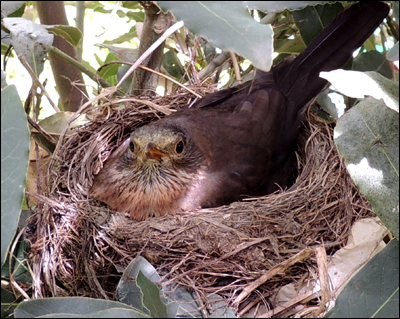
Blackbird hen, back on the nest.
Speaking of the blackbird hen, she’s back on the nest again! This is the same nest she used to raise her last batch – built inside a small Sweet Bay tree situated within our fenced-off vegetable garden area.
I took the above photo yesterday and had to poke the camera in quite far as it was so windy that the branches were being rocked and shaken.
As you can see, she stares steadily out at you, but doesn’t budge. Not that I’d want her to – and I tried to be as quick as I could as I’d hate to put her off her task.
Despite the damage the birds do to our garden we do love having them here. They are so tame and so pretty.
We regularly see two or three young birds from her first brood. They have grown from chubby little birds with short tail feathers and speckled breasts, to much sleeker specimens. And where originally they weren’t very skilled at flying, they are now adept.
Feijoa flowers are irresistible to birds.
We don’t see the male (father) blackbird very often, but the hen and young ones are often in the Feijoa, eating the crimson flowers. I was worried about this until I read that birds eating the petals help pollinate the flowers. However, it seems to me that the birds not only eat the petals but destroy the whole flower. Often the complete flower drops to the ground and the bird will fly down and finish it off there. I guess time will tell.
Freshly-plucked Feijoa flower.
The other thing I read with interest is that the fleshy petals of the Feijoa flower are edible and can be sprinkled in salads, etc. I decided to check this out this morning (even though I didn’t want to remove a potential Feijoa) and can confirm that they have a pleasant taste. They are more fleshy than they look, so have a bit of texture to them, and have a delicate sweet and spicy flavour. No wonder the birds like them!
Neoregelia
Neoregelia
Here’s another member of the Bromeliad family that is currently looking good in the garden. I love the way water collects in the centre of the leaves.
Neoregelia are native to the South American rain forests. I’m pretty sure that this particular specimen is Neoregelia ‘Everlasting’.
A welcome glass of Corbans 2002 Private Bin Hawkes Bay Chardonnay, after a day gardening
After a calm and rainy Saturday, the sun showed its face again today and we spent our time trying to knock some items off our ever-growing gardening ‘To Do’ list. The trouble is, one thing always leads to another – and the ‘other’ is usually something that wasn’t on the list to begin with.
For example, we had two lovely dahlias growing (or trying to grow) under the Feijoa trees. This had turned out problematical for two reasons…
it’s extremely dry under the Feijoas and even though they have struggled on bravely, the dahlias have definitely suffered during the height of summer.
The hens. (Isn’t it always the hens?) They love to sit in the shade under the Feijoas and scratch around, digging up anything that isn’t solid rock. Their scratching shreds any new growth trying to push through the dusty soil.
Multiplication and Division
So, the plan this morning was to move both of the dahlias to a new site. Stage One was accomplished without undue hassles. This thanks to the fact that a space became available yesterday when Ben removed the Buddleja Globosa growing alongside the banana plant at the front right of the house. The Buddleja had been a disappointing addition to that part of our garden – it had never done very well, hadn’t even flowered in the three years it had been there, so we’d decided to get rid of it.
Actually getting rid of any plant is always difficult for me, but this decision was made easier by the fact we’ve been able to take two rooted runners from it and plant them elsewhere.
The new site for the dahlias with Campanula persicifolia around the edges.
It was while Ben was digging up the dahlias that I noticed the clump of Campanula persicifolia growing alongside. I’d grown this from seed way back in 2011, but it, too, had never flowered. However, the clump was looking surprisingly healthy this morning. So we dug this out as well.
It’s really too late into Spring to divide a perennial – and it had quite a bit of new growth – but we managed to split it into about 20 separate plants. These have now been transplanted into various other flower gardens, and watered copiously. Fingers crossed, they’ll survive. I should have done this a couple of months ago when we divided the Geums and the Asters.
Vegetables
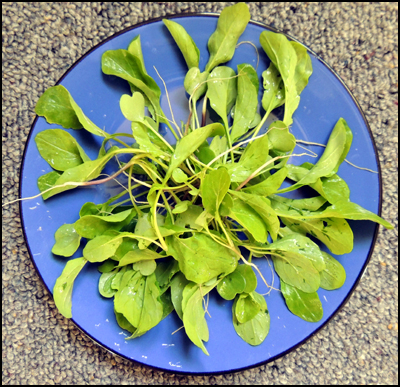
Rocket thinnings – these were great in lunchtime sandwiches with avocado and egg.
I didn’t get much achieved in the vegetable garden today – in fact I pretty well gave it a wide berth. But I did manage to thin out the rocket seedlings. I’m so glad we have rocket again – just the smell of it makes my mouth water.
Pruning – Long Overdue
Left: Mandarin trimmings – pity about the fruit but we couldn’t reach it anyway; Right: Firewood-sized plum tree trimmings.
Another task that hadn’t been tackled yet was the pruning of the old branches off some of our very old fruiting trees – especially the apricot and one of the three plum trees. We’ve been working away at this judiciously each year to encourage new growth further down the trunks. It’s a slow process, but of course today I noticed that we still hadn’t done this for this season. Again, it’s getting too late into Spring for this task – but what is the best solution? To just leave them as they are?
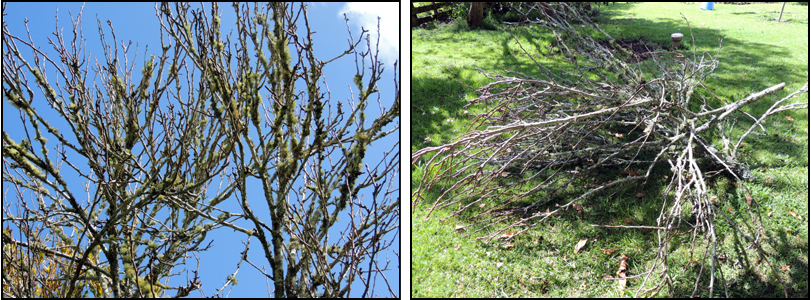
Left: View of the lichen-encrusted branches on the old pear tree; Right: Pear prunings.
I still felt it was better to clean things up a little bit, so we set aside one hour and spent that time cutting back branches on our two mandarins, the pear and that one plum tree. Mainly to remove the worst of the out-of-reach lichen encrusted limbs and to (hopefully) encourage lower growth to sprout. Many of the branches we removed had died back, or had only a few straggly leaves.
We didn’t manage to get to the apricot – this will have to wait for another day.
Perhaps we should just give up on these old trees, as they don’t always produce much fruit, but I like the fact that they’ve been here so long and that someone else planted them all those years ago. I like to feel the links to the past, I guess, the continuity. And why destroy a tree if it still provides something – even if it’s just shade, a place for birds to build their nests and the occasional piece of fruit.
We were away from South Head almost all of Friday. When we arrived home later in the afternoon and I checked the blackbird nest, it was empty. There was no sign of any damage to the nest, nor were there any signs of anything worse, i.e. feathers or baby chick body parts. I can only assume that they grew large enough to fly. I last took a photo of them on Wednesday 15th (see above).
We’ve seen the hen blackbird a few times today and she seems to be taking worms, etc., up to the Lilly Pillies over the fence behind the plum tree. We’re hoping that this is where the family has moved to.
Vriesea
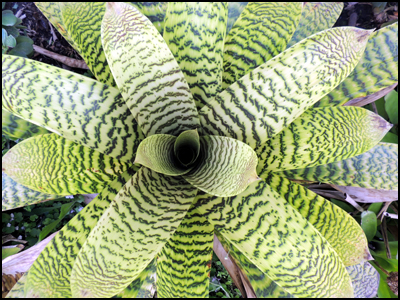
Vriesea hieroglyphica.
Finally, here is another photo of one of our bromeliads. Again this is a form of Vriesea hieroglyphica. A striking green one, this time.
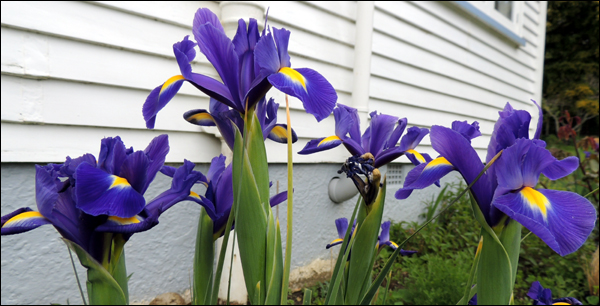
Siberian Irises (Iris sibirica) growing against the west-facing wall of the house.
For the first time in several weeks, there is no wind. (Hooray!!!) It’s a beautiful, partly overcast day with a very light breeze. Every time the sun comes out from behind a cloud I’m reminded of how hot it will soon become – it’s currently sitting at about 21C in the shade.
New Life
I was in the vege garden on Friday when quite by accident I came across something especially evocative of Spring.
Our young Sweet Bay tree (Laurus Nobilis)
We have a small (but very bushy) Bay tree situated within the fenced off (that is, hen-free) section of our garden. I had gone there to collect a few good-sized bay leaves for a batch of fagioli I was preparing.
A blackbirds’ nest, complete with chicks.
I parted the top leaves looking for some decent leaves and was surprised to discover a nest complete with four tiny chicks.
We’ve been watching the black bird pair all year. We think they are most likely the same two that built a nest in the right-hand section of the barn last spring. The hen, in particular, is very plucky and will fly down beside me when I’m weeding in the vegetable garden – usually to pull out worms or scratch around where I’ve been weeding. For some time we’ve been wondering where their nest might be. It seems so obvious now!
The parents don’t seem to mind us peering in – earlier today when I checked to see if the babies were okay, I saw four bright-eyed little faces peering back at me. Mum and Dad were watching from the branches of the plum tree, above. The chicks are very quiet, which is just as well, as our cat Molly could easily knock the nest out of the tree. I’m sure she’d love to munch on some tender young chicks!
On Saturday, Ben found another nest on a shelf in the ‘man cave’ section of the barn; but all that was inside were broken blue pieces of shell. It’s hard to know if any chicks ever hatched, or (and this seems more likely) a rat got them. The amusing thing about the second nest is that the parents had woven some red and black plastic-coated leads (still attached to a small battery charger) into the base. It was very well-constructed – they’d put down a base of mud, then built up the sides with twigs and stalks. The inside was a perfectly formed circle, made with delicate pieces of dried grass. I’m always impressed at how beautifully these nest are made.
Banana
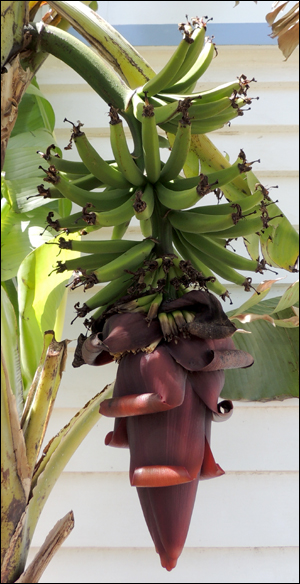
A new flower on Banana ‘Mons Mari’.
The new flower spike on our Banana (Banana Mons Mari) is already developing fruit. Earlier today, I spent twenty minutes or so cutting away some of the old and battered growth from the plant. The howling winds I’ve been complaining about really wreak damage on the leaves, but the plant itself is surprisingly resilient.
Vegetable Garden
Broad beans.
The vege garden is coming along nicely. The broad beans survived the wind – thanks to some stakes and string.
Peas.
The peas are forming pods.
Rocket sprouts
And I’ve had a good strike rate with the edamame, rocket and lettuce I sowed a couple of weeks ago. Thank goodness!!
The early potatoes (Cliff’s Kidney) have needed earthing up a couple of times and are looking very vigorous. The asparagus patch is producing fat shoots each day, so we are eating them as they appear.
Passion fruit flower, after pollination.
The passion fruit is in good shape after my fairly brutal pruning. It’s started to flower and their are many, many unopened buds on the vines.
Vriesea
Vriesea hieroglyphica
To finish, I just had to include a photo of this spectacular bromeliad, Vriesea hieroglyphica, as it’s flourishing at the moment. It’s growing in the sunnier of the two gardens we have devoted to plants from the family Bromeliaceae.
This time of the year all our bromeliads are putting on new growth and developing ‘pups’. We’re hoping to establish some of the varieties more suited to the purpose, in some of our larger trees – many grow as epiphytes in their natural environment.
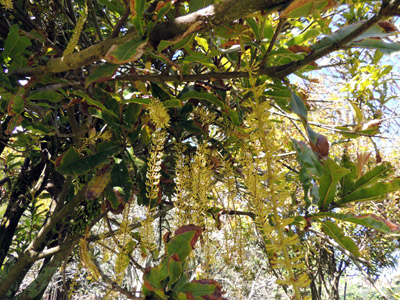
Now that the Macadamias are fully in flower, the nuts have all fallen from the trees. We’ve had a good crop this year. We have about 11 kilos of the nuts with shell – a decent-sized carton full, although still not as many as we harvested in 2012.
After being away for a week, I can really notice the changes in the garden. The mass of white flowers that adorned our most prolific plum tree is now mostly replaced with the bright green of new leaves. We are still eating the plums we froze from this tree last November and I’m reminded of the fact that everything is just an ongoing cycle. This is one of the things I really take pleasure in with having a garden.
Avocados
Avocado ‘Fuerte’ in flower.
Both of our small avocado trees are flowering prolifically. We’ve had terrible trouble with these – right from when we first planted them they were afflicted with Root Rot (Phytophthora cinnamomi). We probably should have destroyed the trees then and there, but we’ve been spraying them until they grow big enough for us to inject the cure directly into their trunks in the hope that they will overcome this scourge.
I’ve also been reading about some alternative remedies involving compost – obviously I’d much prefer not to spray but for now we are just trying to prevent the trees from becoming more badly afflicted.
We have a both a Fuerte and a Hass variety and also a small tree that Ben grew from a stone. The latter has grown quite tall now, although isn’t yet old enough to flower. It seems not to be afflicted with the same problem as the other two. Avocados do well in this area, so we are hopeful.
Eggs and More Eggs
The unexpected ‘egg’ discovery – the white egg is a plastic one.
For some time we’ve not had a full quota of eggs each day. Always 5 or 6 but never 7. We’d put this down to the fact that every hen doesn’t necessarily lay an egg every day of the week. However, when Ben went into the barn yesterday morning he found 10 eggs in one of the old nesting boxes that we thought the hens didn’t use. This was unexpected.
I suppose this means that one or more of the hens started laying there while we were away in Finland. This would make sense as we do tend to look at that nesting box from time to time, ‘just in case’, and up until we left, we certainly hadn’t seen any eggs there. But it was quite a surprise as neither Ben nor I have seen a hen go into that part of the barn, and we frequently observe them as they go about their daily tasks.
Passion Fruit
Passion Fruit showing signs of Brown Spot (Alternaria passiflorae)
Our Passion Fruit vine is afflicted with Brown Spot. Yesterday I made a priority of cutting off all the diseased leaves. We’ll burn these later on today.
The Passion Fruit vine, after hard pruning.
There is a great deal of new growth and a good many flower buds, so I’m optimistic for a good crop this year. If I cut off and destroy all infected parts early on in the season, and we then apply a copper spray to the vine, we seem to be able to control this disease sufficiently.
Early Birds
I heard my first ‘definite’ Pīpīwharauroa call for this Spring, yesterday. I’d heard what I thought could be them last week, but only the first part of their notes, without the final downward sound, so wasn’t sure.
The Long-tailed Cuckoo and the Shining Cuckoo are New Zealand’s only forest birds that migrate out of the country. They both breed in New Zealand, parasitising endemic species, using them to raise their offspring for them
I posted yesterday’s ‘sighting’ on the Birds of New Zealand Cuckoo Study page. If you hear the call of either the Shining Cuckoo or the Long-tailed cuckoo, you can submit this information via a form on this page. I’d love to actually sight the Shining Cuckoos we hear at South Head, but I’ve not been that lucky so far. Sometimes they seem so close, up in the Lilly Pillies or in one or other of our tall trees, but they are well-camouflaged. I do feel sorry for the poor Riroriro, though, knowing full well that the cuckoos will lay their huge eggs in their tiny nests.
The partially-built Welcome Swallow nest.
A few weeks back, some Warou, or Welcome Swallows started building a nest in the barn.
Sadly, they’ve given up this endeavour. Probably due to the human ‘comings and goings’. The first year we were here a whole family was raised in the barn and we loved seeing the parent birds flitting to and fro, and later, the chicks learning to fly.
Bananas
Many people think that bananas are palms, but in fact they are members of the Musa family of plants. Our plant is Banana Mons Mari (Musa acuminata), which is a quick-growing dwarf variety.
Two of our sweet little bananas, (Banana ‘Mons Mari’)
The large bunch of bananas was taking too long to ripen on the plant, so in August we cut the branch down and hung it in the porch with a very large brown paper bag over it. Because of this they all ripened very quickly and at the same time so we’ve had to eat several each day to avoid wasting them. They are starting to get a bit ‘past it’ now, but the small fruit are delicious – very sweet.
After removing the fruiting bunch, Ben cut down the whole growing ‘stalk’ and put it through our mulcher. We then returned this mulch to the base of the plant. What started out as a huge, fat stalk, was reduced to a remarkably small mush of mulch.
Glimpse of the new flower bud, taken through a bedroom window.
I was wondering yesterday if the plant would produce another flower in the new year… Gazing up at the plant I noticed… a new flower shoot.
It still seems amazing to me that we can actually grow bananas here. We have three additional baby plants growing in a sheltered corner of the garden – these are suckers that we removed from the plant earlier in the year.
Vegetable Garden
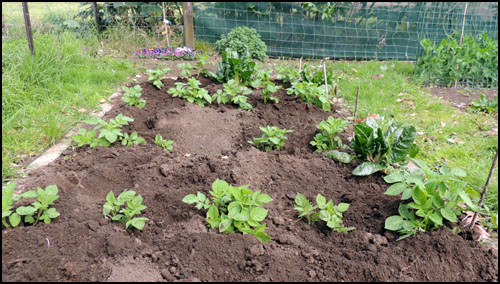
Early potatoes after first ‘earthing-up’.
I’ve spent a couple of days putting work into weeding the remainder of the vegetable garden. There’s always so much to do here. The early potatoes we put in a couple of weeks ago are looking really good, so we earthed them up yesterday.
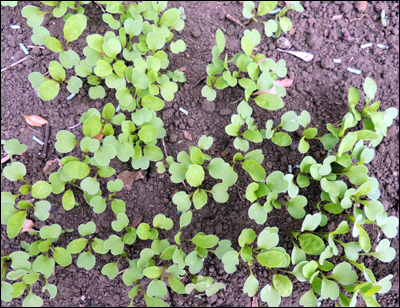
The bad news is that, all but one of the Edamame (Soy Bean, Glycine Max) I sowed on 26 August have been eaten by snails. The same applies to the Rocket I sowed on 24 August. Although in the case of the rocket, not a single plant has survived. I’m not even sure if any sprouted, or if the blackbird hen we see in the garden dug them out, or if they were eaten by some bug in the soil before they had a chance to grow. Very disappointing, but it’s due to the fact that (again) I try to avoid applying slug and snail bait around the garden. But yesterday I relented and resowed both the edamame and the rocket.
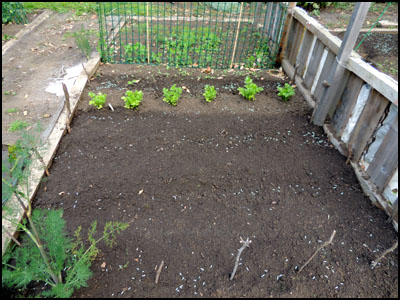
The newly tidied-up patch of the vegetable garden.
I also sowed a row of Lettuce Mesclun Mix and Sugar Snap Peas, and threw in some seeds that are past their ‘sow by’ date. These were Rock Melon and Sweet Basil. If they don’t come up I won’t be too disappointed. I have so many seeds that are past their ‘sow by’ dates – I’ll have to try to be more efficient at using up all the seeds while they are still fresh.
In the above photo you can see a rogue Dill plant flourishing. These come up all over the garden, but I leave them there (if they aren’t too much in the way) as Ben likes to have fresh dill on hand for Gravad Lax.
Spring is finally here. I can tell by the unsettled nature of the days. One minute sunny, the next rainy, interspersed with strong winds from both the south and the north. Today there is only a light breeze, however.
The new garden gate.
Garden Gate
Yesterday, Ben installed a wooden gate in the back fence, which means we can now easily walk through to the ‘wild’ area under the Lilly Pillies. There is a pile of prunings over there that we can put through the shredder for mulch, and also cut up for kindling. With the change in weather, more warmth in the sun, etc., I am keen to get out there and knock the garden into shape after the winter months.
Growing from Seed
I’ve been sowing seeds for my more tender crops indoors to get them started and have had a really good strike rate with tomatoes, especially. But also with zucchini and buttercup squash. I’ve transferred these wee babies to the barn to harden up a bit before planting out.
Fruit Trees
Blossom on the plum tree.
The first plum tree (the one with the dark red flesh) is a mass of white blossom, and I was pleased to note this morning that it’s being frequented by many bumble and honey bees.
The bumble bees are such great little insects for pollinating the fruit trees. Season after season they are always there. Sadly, honey bees are less common these days – I think this is a feature for many parts of the country, not to mention the more populated areas of our planet. But seeing so many honey bees this early on in the season has made me optimistic for the rest of Spring and Summer.
The Macadamias are covered in buds.
The last few nuts are still dropping off our macadamia trees, but they are covered in blossom, too. Again, they are buzzing with the busy little bee bodies.
And finally, it looks like we may get our first olives this year, as there are tiny buds appearing for the first time.
Vegetable Garden
A selection of the lettuces we have at the moment.
In the vegetable garden we are eating our first asparagus, and are still inundated with lettuces. The latter grow all year round and we never seem to keep up with eating them all.
We are getting to the end of our broccoli and cauliflowers – it will soon be too hot here for Brassica, anyway.
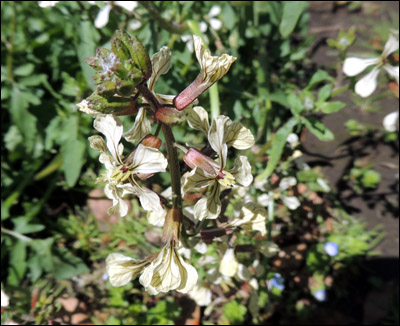
Rocket (Erica Sativa) in flower.
I’m allowing a couple of Rocket(Eruca Sativa) plants go to seed, the plan being to collect our own seed and use this for successive crops. We’ll see, I may get fed up with them sprawling there amongst the ‘soon to be tidy’ (do you believe that?) garden.
A row of green peas. (The messy leaves are from the Lilly Pillies – they are all through the garden).
I’ve also sown two rows of green peas and these are looking great, as is the garlic I put in on the shortest day. The strawberries are in flower and desperately need to be weeded. Sadly, a row of Edamame beans I sowed a fortnight ago, have been chewed up by (most likely) slugs. I had to put some bait out earlier – but I really do hate putting slug bait down in our garden.
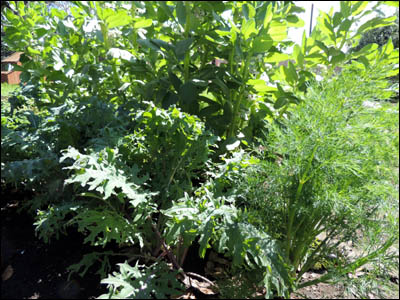
Russian Kale in the foreground, with self-sown Dill to the left and Broad Beans behind.
The other plant successes in the vegetable garden are the Russian Kale (this, thanks to my friend Maureen who provided me with seeds from her own garden) and the always reliable Broad Beans. The latter are simply covered with their pretty white & black flowers at the moment. I can’t wait until we can eat them!!
Early potatoes popping up through the soil.
The early potatoes are up and will hopefully ready for Christmas. 2014 was such a bad season for potatoes… fingers crossed we’ll have more success this year.
Hens
The hens are still going well. All seven of them. (The three Red Shavers and four Orpingtons.)
We’d toyed with attaching a mobile phone to Lottie’s back in order to track her using a phone app.
Lottie is still wandering, but now comes back, which is very odd. We even installed a low fence along the front and edge of our property – these are the two places the hens can wander out – but Lottie just climbs over it. She trots off along the newly-ploughed field adjacent to ours, following the fence-line next to the road, until she disappears out of sight. Later in the day she is back – I never actually see her return, she’s just there. I’d love to know where she goes and why. She was missing for two or three months, before one day just turning up again. Ben and I spend a good deal of time musing on this.
The nuts are starting to drop from our macadamia trees. I’ve collected over 100 in the past week, with more falling when it’s been breezy overnight. Even our smallest tree is producing a few this year. We still have a decent amount of nuts from 2012, which we’ll have to get through. It just takes time to crack them but it’s something that can be done in the evening while watching TV. Once they are shelled, I’ll be toasting them and then grinding them; mixed with a little sugar and coconut oil, they make a really yummy gluten-free, vegan crust for a dessert pie.
Bristly Ox-Tongue
I’ve finally managed to identify a weed we have on our property. Helminthotheca ecioides, or Bristly Ox-tongue. It was apparently naturalised in NZ in 1869. It’s a horrible weed as it grows up with nasty hairy spikes on its stalk and leaves, and these can really hurt if you try to pull one out with bare hands. We’ve mostly eradicated these from our property, but they still come up here and there. This is one ugly weed.
The Prodigal Hen
Strangely, Lottie came back last Friday. It was a rainy, squally day and I hadn’t been outside much, but when we checked the hen house after dark before closing the gate of their enclosure for the night, Lottie was sitting on the very top perch (having evicted Lulu and Leila) as if she had never been away. The poor Orpingtons had had to vacate the bottom perch and were sleeping together on the floor. We were away overnight Saturday / Sunday and weren’t sure what we’d find when we came back on Sunday afternoon – I was very curious to see if Lottie was still at home, and if she was, what shape she was in.
When we arrived, Lottie, the two White Orpingtons (Francesca and Pearl), and one of the Black Orpingtons (Fatima) were nowhere to be seen. Lulu, Leila and Hannah (the youngest Black Orpington) were pecking around the property in their usual fashion. We called and called, at first to no avail. Then the four wanderers appeared, casually walking back from across the road. My heart sank at the thought that Lottie might start luring the other hens away during the day. That night when we shut them into their enclosure, we wondered what would happen the following day.
As it turned out, as soon as I let them out on the Monday morning, Lottie strutted off at great speed, across the grass, past the garage, down the driveway and across the road. She hadn’t even had the decency to lay an egg before leaving! Fortunately the other hens didn’t notice her departure, so not one followed her. She didn’t return on Monday evening, but to be honest, I wasn’t worried as my thoughts were that she was likely to cause more problems if she did come back permanently.
Then surprisingly, later on this afternoon, who should we see but Lottie making her way back home across the road. Tonight she has been shut in a separate area of our enclosure, and I won’t be letting her out tomorrow. We’re going to see if she copes with being kept shut in for a few days… it will be interesting to see if she lays an egg while she’s here. When we checked her tonight, she was sleeping on the top perch of her house – all alone (of course). At least she won’t be pecking and bossing the other hens around, and nor will she be leading them astray (tomorrow, at least).
Seasonal Fruit
We are still eating feijoas (although surely they will have all finished ripening, soon) and are starting on tamarillos. There is a farm up the road that sells bags of the latter for $2. These are so much nicer than any I have ever purchased from a store, and our own orange variety, ‘Tamarillo Bold Gold’ is also producing fruit for the first time. The fruit is smaller than the reds, but very juicy and sweet.
The bananas look like they are starting to ripen. They are certainly getting fatter and the top rows are definitely turning a lighter colour. As these are the first bananas I’ve ever grown, I have no idea what to expect as far as time to maturity is concerned.
Our two young lime trees are a mass of flowers and small fruit. Typically, a strong wind started blowing in today from the North West. I’m hoping that it doesn’t inflict too much damage on the new growth. The lemon trees also look to be producing buds, but not as energetically as the limes.
Garden Diary
It’s been wet off and on for over a week now. We do get a degree of sunshine during most days, but then the clouds build up and it’s gloomy again. I think this June our solar generation will be the lowest ever. Thank goodness it’s not long until the shortest day.
In the vegetable garden, broad beans have come up, as has curly kale. The Egyptian Walking Onions are looking good, as are our mixed lettuces, beetroot, rocket and radishes.
I don’t know why I grow radishes – probably because the variety I have sown, ‘Easter Egg’, is so pretty when they are small – white, pink, purple and red – but I tend not to eat them myself as they are too peppery for me. And this from someone whose favourite chili is the Habanero. 🙂
Speaking of which, I am still picking habaneros, and our basil still hasn’t died off, although it’s getting a little straggly as I have omitted to keep up with removing the flower spikes. I have had absolutely no luck with parsnip seeds this season – nor with leeks. I’ve sown a couple of rows of each of these, but none have germinated. Very annoying.




























 Heni Irihapeti's Blog