All posts by Hēni Irihāpeti

I live in sunny Napier/Ahuriri, Aotearoa/New Zealand. I write about day to day life and occasionally, write speculative fiction. My stories are reflective, character-focused, and richly detailed, exploring the nuances of memory, curiosity, and the subtle wonders within everyday life.

September at South Head

Spring

Spring is finally here.  I can tell by the unsettled nature of the days.  One minute sunny, the next rainy, interspersed with strong winds from both the south and the north.  Today there is only a light breeze, however.

The new garden gate.

Garden Gate

Yesterday, Ben installed a wooden gate in the back fence, which means we can now easily walk through to the ‘wild’ area under the Lilly Pillies.  There is a pile of prunings over there that we can put through the shredder for mulch, and also cut up for kindling.  With the change in weather, more warmth in the sun, etc., I am keen to get out there and knock the garden into shape after the winter months.

Growing from Seed

seedlings_2

I’ve been sowing seeds for my more tender crops indoors to get them started and have had a really good strike rate with tomatoes, especially.  But also with zucchini and buttercup squash.  I’ve transferred these wee babies to the barn to harden up a bit before planting out.

Fruit Trees

Blossom on the plum tree.

The first plum tree (the one with the dark red flesh) is a mass of white blossom, and I was pleased to note this morning that it’s being frequented by many bumble and honey bees.

The bumble bees are such great little insects for pollinating the fruit trees.  Season after season they are always there.  Sadly, honey bees are less common these days – I think this is a feature for many parts of the country, not to mention the more populated areas of our planet.  But seeing so many honey bees this early on in the season has made me optimistic for the rest of Spring and Summer.

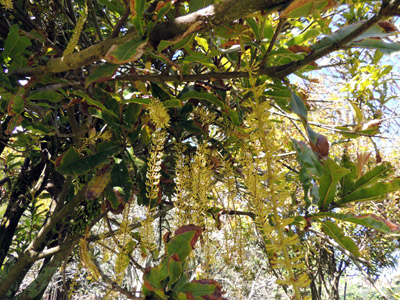
The Macadamias are covered in buds.

The last few nuts are still dropping off our macadamia trees, but they are covered in blossom, too.  Again, they are buzzing with the busy little bee bodies.

olive

And finally, it looks like we may get our first olives this year, as there are tiny buds appearing for the first time.

Vegetable Garden

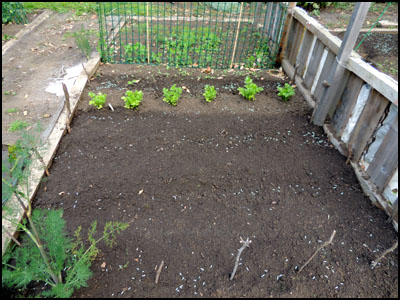
A selection of the lettuces we have at the moment.

In the vegetable garden we are eating our first asparagus, and are still inundated with lettuces.  The latter grow all year round and we never seem to keep up with eating them all.

We are getting to the end of our broccoli and cauliflowers – it will soon be too hot here for Brassica, anyway.

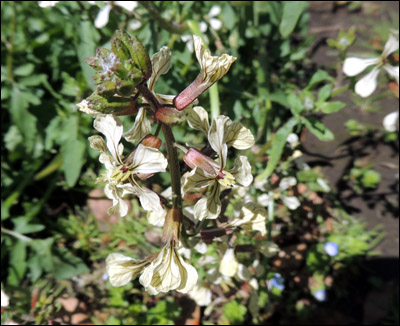
Rocket (Erica Sativa) in flower.

I’m allowing a couple of Rocket (Eruca Sativa) plants go to seed, the plan being to collect our own seed and use this for successive crops.  We’ll see, I may get fed up with them sprawling there amongst the ‘soon to be tidy’ (do you believe that?) garden.

A row of green peas.  (The messy leaves are from the Lilly Pillies - they are all through the garden).
A row of green peas. (The messy leaves are from the Lilly Pillies – they are all through the garden).

I’ve also sown two rows of green peas and these are looking great, as is the garlic I put in on the shortest day.  The strawberries are in flower and desperately need to be weeded.  Sadly, a row of Edamame beans I sowed a fortnight ago, have been chewed up by (most likely) slugs.  I had to put some bait out earlier – but I really do hate putting slug bait down in our garden.

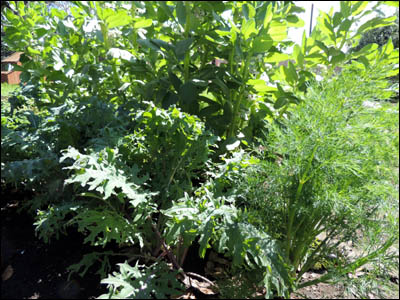
Russian Kale in the foreground, with self-sown Dill to the left and Broad Beans behind.

The other plant successes in the vegetable garden are the Russian Kale  (this, thanks to my friend Maureen who provided me with seeds from her own garden) and the always reliable Broad Beans.  The latter are simply covered with their pretty white & black flowers at the moment.  I can’t wait until we can eat them!!

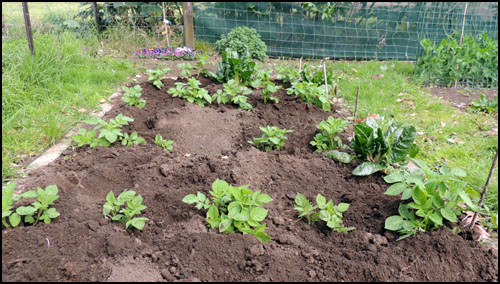
Early potatoes popping up through the soil.

The early potatoes are up and will hopefully ready for Christmas.  2014 was such a bad season for potatoes… fingers crossed we’ll have more success this year.

Hens

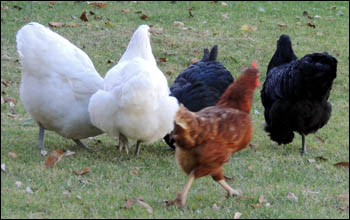
The hens are still going well.  All seven of them.  (The three Red Shavers and four Orpingtons.)

We'd toyed with attaching a mobile phone to Lottie's back in order to track her using a phone app.
We’d toyed with attaching a mobile phone to Lottie’s back in order to track her using a phone app.

Lottie is still wandering, but now comes back, which is very odd.  We even installed a low fence along the front and edge of our property – these are the two places the hens can wander out – but Lottie just climbs over it.  She trots off along the newly-ploughed field adjacent to ours, following the fence-line next to the road, until she disappears out of sight.  Later in the day she is back – I never actually see her return, she’s just there.  I’d love to know where she goes and why.  She was missing for two or three months, before one day just turning up again.  Ben and I spend a good deal of time musing on this.

Winter!

Nuts in June

The nuts are starting to drop from our macadamia trees.  I’ve collected over 100 in the past week, with more falling when it’s been breezy overnight.  Even our smallest tree is producing a few this year.  We still have a decent amount of nuts from 2012, which we’ll have to get through.  It just takes time to crack them but it’s something that can be done in the evening while watching TV.  Once they are shelled, I’ll be toasting them and then grinding them; mixed with a little sugar and coconut oil, they make a really yummy gluten-free, vegan crust for a dessert pie.

Bristly Ox-Tongue

I’ve finally managed to identify a weed we have on our property.  Helminthotheca ecioides, or Bristly Ox-tongue.  It was apparently naturalised in NZ in 1869.  It’s a horrible weed as it grows up with nasty hairy spikes on its stalk and leaves, and these can really hurt if you try to pull one out with bare hands.  We’ve mostly eradicated these from our property, but they still come up here and there.  This is one ugly weed.

The Prodigal Hen

Strangely, Lottie came back last Friday.  It was a rainy, squally day and I hadn’t been outside much, but when we checked the hen house after dark before closing the gate of their enclosure for the night, Lottie was sitting on the very top perch (having evicted Lulu and Leila) as if she had never been away. The poor Orpingtons had had to vacate the bottom perch and were sleeping together on the floor.  We were away overnight Saturday / Sunday and weren’t sure what we’d find when we came back on Sunday afternoon – I was very curious to see if Lottie was still at home, and if she was, what shape she was in.

When we arrived, Lottie, the two White Orpingtons (Francesca and Pearl), and one of the Black Orpingtons (Fatima) were nowhere to be seen.  Lulu, Leila and Hannah (the youngest Black Orpington) were pecking around the property in their usual fashion.  We called and called, at first to no avail.  Then the four wanderers appeared, casually walking back from across the road.  My heart sank at the thought that Lottie might start luring the other hens away during the day.  That night when we shut them into their enclosure, we wondered what would happen the following day.

As it turned out, as soon as I let them out on the Monday morning, Lottie strutted off at great speed, across the grass, past the garage, down the driveway and across the road.  She hadn’t even had the decency to lay an egg before leaving!  Fortunately the other hens didn’t notice her departure, so not one followed her.  She didn’t return on Monday evening, but to be honest, I wasn’t worried as my thoughts were that she was likely to cause more problems if she did come back permanently.

Then surprisingly, later on this afternoon, who should we see but Lottie making her way back home across the road.  Tonight she has been shut in a separate area of our enclosure, and I won’t be letting her out tomorrow.  We’re going to see if she copes with being kept shut in for a few days… it will be interesting to see if she lays an egg while she’s here.  When we checked her tonight, she was sleeping on the top perch of her house – all alone (of course).  At least she won’t be pecking and bossing the other hens around, and nor will she be leading them astray (tomorrow, at least).

Seasonal Fruit

We are still eating feijoas (although surely they will have all finished ripening, soon) and are starting on tamarillos.  There is a farm up the road that sells bags of the latter for $2.  These are so much nicer than any I have ever purchased from a store, and our own orange variety, ‘Tamarillo Bold Gold’ is also producing fruit for the first time.   The fruit is smaller than the reds, but very juicy and sweet.

The bananas look like they are starting to ripen.  They are certainly getting fatter and the top rows are definitely turning a lighter colour.  As these are the first bananas I’ve ever grown, I have no idea what to expect as far as time to maturity is concerned.

Our two young lime trees are a mass of flowers and small fruit.  Typically, a strong wind started blowing in today from the North West.  I’m hoping that it doesn’t inflict too much damage on the new growth.  The lemon trees also look to be producing buds, but not as energetically as the limes.

Garden Diary

It’s been wet off and on for over a week now.  We do get a degree of sunshine during most days, but then the clouds build up and it’s gloomy again.  I think this June our solar generation will be the lowest ever.  Thank goodness it’s not long until the shortest day.

In the vegetable garden, broad beans have come up, as has curly kale.  The Egyptian Walking Onions are looking good, as are our mixed lettuces, beetroot, rocket and radishes.

I don’t know why I grow radishes – probably because the variety I have sown, ‘Easter Egg’, is so pretty when they are small – white, pink, purple and red – but I tend not to eat them myself as they are too peppery for me.  And this from someone whose favourite chili is the Habanero. 🙂

Speaking of which, I am still picking habaneros, and our basil still hasn’t died off, although it’s getting a little straggly as I have omitted to keep up with removing the flower spikes.  I have had absolutely no luck with parsnip seeds this season – nor with leeks.  I’ve sown a couple of rows of each of these, but none have germinated.  Very annoying.


May Update

Harvesting the maize

I haven’t written for a while, but items of note include the harvesting of the maize in the paddock next door, way back at the beginning of April.  The big machines came powering through, collecting the complete plants, discarding the husks and stalks, and feeding out golden maize kernels into the waiting truck.

field

Left behind is a flattish, spiky field, stretching into the distance.  We’ve had no strong winds from the North or West since then, but when they do come, we’ll miss the shelter that the maize provided for the plants and shrubs we are trying to establish along the fence-line.

a typical crack opening in our lawn

The months of March and April were incredibly dry, after almost no rain since January.  Patches of bare soil were beginning to crack all across the garden.

There wasn’t much happening in the vege garden – only silver beet, pumpkins, a few lettuces, some jalapeno and habanero chili peppers, basil, beetroot and carrots.  We had switched to lake water to conserve the water in our tanks and were using the latter for drinking, only.

Cherry Guava, Yellow Guava, Pear, Feijoa

Surprisingly, our Autumn fruit has been more productive than at the same time in 2013.  We ate the last of the pears, and the feijoa are still dropping, even a month later.  They are very sweet and juicy.  There are also red cherry guava and yellow guava – which attract the Kereru.  Our macadamia nuts are also on the point of being ready.

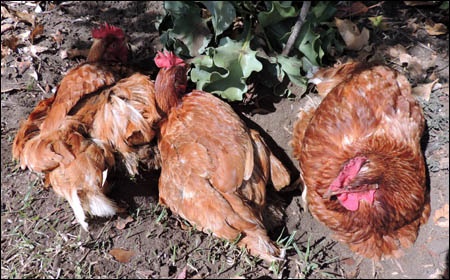
Red shavers taking a dust bath
Red shavers taking a dust bath (prior to Lottie’s departure)

The hens still spend a great deal of time bathing in the dust, or lying under the shade of the trees.  They continue to make huge basin-shaped hollows all through my gardens.  But they are very cute and I’m still intrigued to watch them taking their dust baths.

The above photo was taken of the edge of the lawn where it comes up to the flower garden below the Feijoa trees.  I use the word ‘garden’ very loosely, thanks to the hens and the lack of rain.

Fatima
Fatima

The Orpingtons don’t tend to take their baths in the same place or at the same time as the Red Shavers.  They’ll often wait until the older girls are finished, then hop in after them.

The good news is that the Orpingtons are now laying, but the bad news is that Lottie (one of our red shavers) has gone.  She had a bad habit of disappearing across the road to  – goodness knows where – on a daily basis, and one day she just didn’t come back.  I fear the worst – run over by a milk truck or caught by a hawk or dog, but perhaps she has merely found a better place to live.

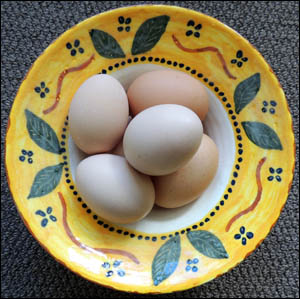
Freshly laid eggs
Freshly laid eggs

As far as the eggs are concerned, the small eggs weigh about 50 grams, whereas the eggs from Lulu and Leila weigh around 75 grams.  I have been very disappointed that the White Orpingtons don’t lay pure white eggs – I was so sure that they would.

Pine Nut (family Pinaceae, genus Pinus)

Our small Pine Nut tree is finally producing some cones.  We’ve had this small tree since we lived in Titirangi.  It was purchased in a pot for a Christmas Tree, and fared very badly under all the kauri trees due to the paucity of sunlight.  Pine Nuts take about 8 years to produce cones – which would be about right.   Apparently the cones take two full seasons to mature.  It’s very exciting!

Lake Rototoa, May 2014

There has been scattered rain in May, and the days tend to start out sunny, before fat cumulus clouds build up in the afternoon.  The temperature in May has ranged from around 13 C overnight, to low 20s during the day.

We have swum in the lake as recently as a week ago – which is quite unexpected for this time of year.

Garden Diary

My current daily garden tasks involve tidying up all the vegetable garden beds in preparation for planting garlic and sowing more seeds.  I’ve recently sown lettuces, leeks, spinach, carrots, beetroot, rocket, radishes, parsnips and celery.  I raised seedlings of broccoli, cabbage and cauliflower and have since planted these out.  It was too hot and dry to sow the seeds directly during March / April.

I’ve also planted a dozen Egyptian Walking Onions.  I was delighted to see bulbs for sale recently as I used to grow them years ago in Dunedin.  Perhaps I’ll have more luck with these than I have with trying to grow regular onions from seed.

Pear and Avocado Smoothie

Ready to eat.  Yum Yum!
Ready to eat. Yum Yum!

At this time of year when there are lots of avocados and pears around, this recipe is just perfect.

I came across it in the book, ‘Good Housekeeping Easy to Make Smoothies & Juices (2009), Collins and Brown’, and the result is an incredibly yummy smoothie-dessert.

The texture is velvety, the colour is sublime and the flavour!  Well, let’s just say that although the combination of pear and avocado may sound unusual to some, it’s definitely worth trying.

Ingredients

  • 1 small lemon
  • 2 ripe dessert pears
  • 1 small, ripe avocado
  • Juice of 1 lime

Method

  • Peel and core the pears.
  • Cut the avocado in half, remove the stone, and separate the flesh from the skin.
  • Peel the lemon, removing as much of the white pith as possible, cut into segments and remove any pips.
  • Put the pears, avocado and lemon  into a blender, along with the lime juice.  Blend until smooth.

If you’d like to add a ‘zing’ to your smoothie, a dash of something hot would enhance it.  Add a dash of ‘Kaitaia Fire‘ or Tabasco sauce, or a tiny piece of habanero chilli to the blend.

Pears are falling daily from the old pear tree.
Lovely fresh, ripe pears.

This and That

View to the north as the sun was setting last night.

Pumpkins and Squash

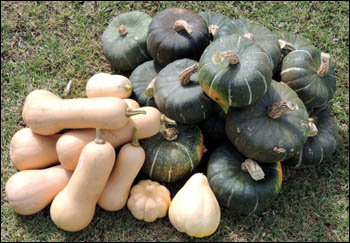
We harvested most of our squash during the past week.  It was a very good crop and I’m pleased with the varieties we chose to raise from seed this year.

Squash 'Butternut Chieftain' and 'Burgess Buttercup'
Squash ‘Butternut Chieftain’ and ‘Burgess Buttercup’, with ‘Thelma Saunders Sweet Potato’ in the foreground.

Even though I’ve tended to grow the larger pumpkins in the past, the beauty of the smaller varieties is that you can cut into one and don’t end up with a huge vegetable to eat or process in a short amount of time.

The butternut and buttercup squashes are ideal for a family of two.

Pumpkin Pie

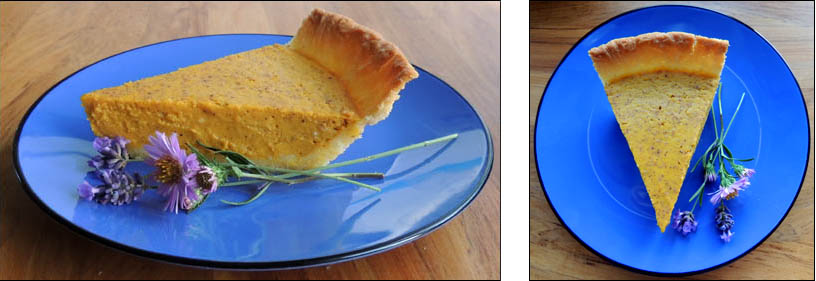
Pumpkin pie, straight from the oven.
Freshly-baked Pumpkin pie.

Keeping with the theme, I baked a pumpkin pie on Sunday, using some frozen mashed pumpkin from last year’s crop.  This was from a Crown pumpkin – a large variety with smooth, pale grey skin and sweet orange flesh.  Despite being frozen for all this time, the puree tasted very good.

A healthy serving of pumpkin pie.

The filling is comprised of  pureed pumpkin, evaporated milk, eggs, ground ginger, ground allspice and caster sugar.  The base is formed using sweet shortcrust pasty, which I baked blind before adding the filling.  The pie is topped with freshly-grated nutmeg.

I’m interested in experimenting with tofu to see if I can make a vegan version.

Rum Pot

Pears are falling daily from the old pear tree.

You may recall that back at the beginning of January, I started a Rum Pot using strawberries, plums and some cape gooseberries.  With the pears ripening and dropping each day, I decided to add some in.

The fruit that has been macerating in the rum and sugar for the past couple of months, smelt extremely enticing.  I couldn’t resist tasting some of the liquor – it was very heady and almost spicy, reminding me of Christmas.  So, now the rum pots have pieces of pear in them as well!

A view of the fruit macerating in the rum pot.
A view of the fruit macerating in the rum pots.

The next fruit to ripen should be our feijoa.  I must admit that I’m not exactly sure how well the feijoa will enhance the mix, but we’ll see!  As much as I love fresh feijoa, they do sometimes have something of a chalky texture.

Brassica

On Wednesday (05 March)  I sowed seeds of the following Brassica – Broccoli ‘Premium Green’, Cabbage ‘Scarlet O’Hara’ and Cauliflower ‘All the Year Round’.  Brassica don’t seem to do so well in our hot, dry summers, but we have had good results during Winter and Spring.

I’m hoping that these will be ready to plant out in a month or so’s time.  The broccoli and cauliflower have sprouted already (5 days).

Swan Plants

Swan plant seed head, and monarch butterfly on flowers

The ‘swans’ on our swan plants (Asclepias physocarpa) are bursting with fluffy seeds.  We appear have the full cycle happening at once – tiny caterpillars, fat caterpillars, cocoons, adult butterflies, mating butterflies, flowers and seed pods.

The grass in some areas of the garden is carpeted with the ‘down’ from the seeds.  I suspect we may have something of a swan plant problem in 2014/2015.  But at the moment I can’t see that we’d ever have too much of them.  I love having the butterflies always present in the garden.

Swan Plant Beetle

beetle in seed-head and bursting swan pod.
Close up of swan plant beetle, and view of bursting seed pod.

When I was photographing the seed pods and their bursting seeds, I noticed a small insect inside.  I have since identified this as Arocatus rusticus, a native of Australia that has become established in New Zealand.

Despite the foliage and sap of the swan plant being toxic to plant-eating creatures, it seems that Arocatus rusticus has evolved the ability to overcome the toxin and store it in its own body.  You can’t really tell from my photo, but the insect is orange/red and brown in colour.  This is to warn off predators as the toxins stored in its body has made it toxic, too.

Molly and the Hens

Lottie does like to boss the Orpingtons around, though.
Lottie does like to boss the Orpingtons around.

The four new Orpington hens have settled well alongside our three Red Shavers.  Lottie is the boss of all seven, and every so often has to assert her dominance, usually by pushing in on a choice item of food, or by chasing one of the stragglers.  They all choose to sleep in the same hen house nowadays, often trying to squeeze onto the same perch!

Francesca, Pearl, Fatima and Hannah (the four Orpingtons) mostly stick together and if Lottie isn’t around, Leila and Lulu will often be found nearby.  Their favourite spot on these hot Autumn days is to sleep and dust bathe under the shade of the Feijoa trees.

Hannah and Fatima
Hannah and Fatima

When the Black Orpingtons were little, they looked so cute running around.  From a distance they looked like they were wearing burqa – hence the name Fatima.  We named the other Black Orpington, Hannah, to maintain balance.

The Red Shavers are very naughty.  Lottie has taken to ‘disappearing’ in the mornings and not returning until sometime in the afternoon.  One day I spotted her hurrying across the road and into the trees on the other side.  We think that perhaps the house down the road may have something interesting to attract her – a rooster, maybe, but we’re not sure.  I’ve taken to not letting the hens out until after 10.00 am or so, to be sure they have laid all their eggs before one of them heads off further afield.

Yesterday Leila caught a small field-mouse which must have strayed from the maize field.  Poor wee thing – all three red hens set upon it – it didn’t have a chance.

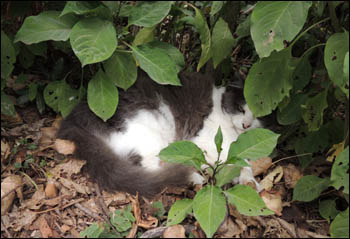
Molly often watches the hens from a secluded spot.

Molly and the hens have developed a ‘kind’ of respect for each other.  But to me it seems like the only advantage Molly has, is that she is allowed inside the house and the hens aren’t.  Sometimes they look through the living room window at Molly, looking out.

I’ve seen them peck at her if she comes too close to them, but I’m sure she could defend herself if she had to.  When I go into the hen’s enclosed area in the morning to collect their eggs, Molly always accompanies me.  She has a good look around their area when they aren’t there.  I find this amusing.

Spitikos Domatopoltos

Greek Tomato Paste

In Greek: σπιτικός ντοματοπολτός
Pronounced: spee-tee-KOHS doh-mah-toh-pol-TOHS

A portion of the finished tomato paste, covered with a film of virgin olive oil

I tried two different tomato paste recipes this year, but the Greek version is far superior in flavour.  If you have extra tomatoes at this time of the year, it’s definitely worth the time spent in making your own tomato paste when it turns out like this – rich, dark red and extremely flavoursome.

This paste is actually too nice to waste in a recipe as a mere addition to a vegetable or meat sauce.   I could easily just eat it all by itself, straight out of the jar (but will restrain myself).

Ingredients

  • About 2 kilograms of end-of-season overripe tomatoes, peeled
  • 1 red capsicum (red bell) pepper, seeded
  • 1 tablespoons sea salt
  • Extra virgin olive oil
Freshly chopped and skinned, end-of-season tomatoes

Method

Blend tomatoes and capsicum until smooth

Process tomatoes and pepper in a food mill, processor, or blender until well pulped.

Transfer to a pan and bring to a boil.  Boil for 2-3 minutes.

After cooking, strain the tomato mixture over cheesecloth overnight
After cooking, drain the tomato mixture over cheesecloth for 12 hours (overnight is good)

Place mixture in a piece of muslin or cheesecloth, and using a strainer, suspend it over a bowl.  Leave to drain for 12 hours in the refrigerator to remove all excess liquid.

Transfer mixture to a glass or ceramic baking dish and stir in the salt.  Allow the mixture to reach room temperature, then dry in a lukewarm oven (95-100°C) for 15 to 20 minutes.

Remove paste from oven and transfer to sterilised glass jars

Spoon into sterilised glass jars, taking care to avoid creating air pockets, and top with 1/4 inch of extra virgin olive oil (enough to cover completely).  Store in the refrigerator until ready to use.

Home-made Greek tomato paste

Notes:

This recipe can be multiplied by increasing all ingredients proportionately.
As the tomato paste is used, top up with more oil to cover, as needed.
These will keep well until next year’s tomato crop is ready!

I found this recipe at: –

http://greekfood.about.com/od/doityourself/r/domatopoltos.htm

I only used 1/2 the salt recommended in the original recipe as that seemed plenty.  (I tasted the paste after adding the 1 tablespoon of salt.)

There was an additional comment that in Greek homes, this paste is often spread on slices of country bread with a little olive oil, and topped with a crumble of feta cheese.  Of course I had to try this with our home-made feta cheese, and it tastes incredible!

Tangy Vegan Curry

Vegan curry with Basmati rice and roti
Tangy Vegan curry with Basmati rice and Roti

Serves 4

This curry could be adapted to use any combination of vegetables, but to my personal taste, is enhanced if potato is included.

We had a surplus of zucchini and had to dispose of some tomato plants that weren’t surviving very well in the heat and dryness of our front porch – hence the green tomatoes.   Ripe, red tomatoes would do just as well, as would using tofu in the mix.

The mix of vegetables in the curry is about 1/3 potatoes, 1/3 zucchini and 1/3 green tomatoes.

I served this curry with white Basmati rice and freshly-made Roti.

Ingredients

  • Potatoes (a good floury variety)
  • Green tomatoes
  • Zucchini (starchy Costata Romanesco is ideal)
  • 1 medium onion (finely sliced)
  • Sunflower oil
  • Freshly crushed garlic (2 or 3 cloves)
  • Fresh chili to taste (I prefer Habanero)
  • 1 tablespoon black mustard seeds
  • 1 teaspoon coriander seeds
  • 1 teaspoon ground cumin
  • 1/4 teaspoon ground turmeric
  • 1/2 teaspoon salt
  • Freshly ground black pepper
  • Lemon juice (1/2 large or 1 smallish lemon)

Preparation

Chilli, spices, garlic and onion

Habanero chilli, spices and crushed garlic

Finely chop the chilli, measure the spices, crush the garlic and slice the onion evenly, ahead of time.  This will enable the curry to be cooked quickly, which is important if you wish to retain the best features of the ingredients.

Potatoes

Sauteed potatoes
Sauteed potatoes

Peel and dice about 3 medium sized potatoes and sauté them in  a little oil until they are cooked through and have started to develop a crispy golden coating.  Remove these from the pan and set aside.

Zucchini

Sautéed zucchini
Sautéed zucchini

Do the same with the zucchinis.  Slice them into chunky pieces and sauté them in a little hot oil until they are ‘just’ beginning to cook through and have developed a golden colouring.  Set these aside, also.

Green Tomatoes

Roughly chopped green tomatoes

Peel and roughly chop the green tomatoes.  They can be irregular in size as long as they aren’t too thick – they will soon soften once they are added to the curry.

Method

Wipe out the pan, add a couple of tablespoons of oil and raise the heat.  When it is good and hot, add about a tablespoon of black mustard seeds and heat them until they start to pop.  Then add the turmeric, cumin, coriander seeds, chilli, ginger and lemon juice to the pan and cook for 1 minute.

Turn the heat down to less than half way and add the sliced onion.  Gently cook this until it turns transparent, but don’t over-cook it – you want to still be able to see the slices in the curry.  About half way through this cooking process, stir in the crushed garlic so that it has the chance to cook through.

Add the vegetables to the onion and spices and stir through

When the onion is ready, add the potato, zucchini and green tomato.  Stir these through carefully, mixing them in with the spices and onion but taking care to keep the pieces intact.  Cover the pan with a tight-fitting lid and turn the heat down to low.

Gently cook until the tomatoes have softened, and the zucchini and potatoes are well-heated, stirring from time to time.  This should take no more than 20 minutes.

When the curry is cooked through, check for seasoning and serve.

Pickled Beetroot

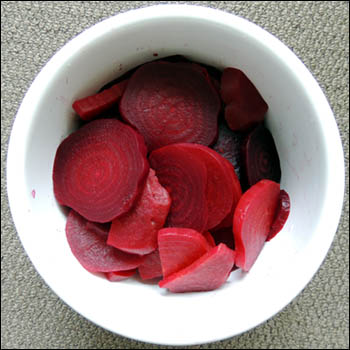
Freshly pickled beetroot

Beetroot Preparation

This recipe requires about 5 – 6 medium-sized beetroots.

Prepare the beetroots by washing off any soil, and trimming the stalks back close to the root.  Leave the long ends of the roots in place so that the beetroots don’t lose too much colour while being cooked.  Cook in water until just tender.  Drain and allow to cool.

Set aside the sliced beetroot in a bowl.

Once cool, remove the skins – the easiest way is by hand, under slowly-running water.  Slice the beetroots evenly and set aside in a bowl.

Pickling Liquid

Combine the following ingredients in a pan and bring to the boil.

  • 3/4 cup white sugar
  • 1/4 teaspoon plain salt
  • 1 1/2 cups white vinegar
  • 3/4 cup water
  • 1/2 teaspoon peppercorns
  • 1 bay leaf
  • 2 cloves
  • 1/2 teaspoon yellow mustard seeds
  • 1/2 cinnamon stick
The pickling liquid simmering on the stove.

Simmer for five minutes then strain through a sieve or muslin.  Bring back to simmer heat.

Pack the beetroot into hot, sterilised jars and pour in the pickling liquid until the beetroot is covered.  Seal.

Pickled beetroot can be kept for some months stored in a cool place, but once opened should be kept in the refrigerator.  If finished using the water bath method, it will last longer.

End of February

Garden Update

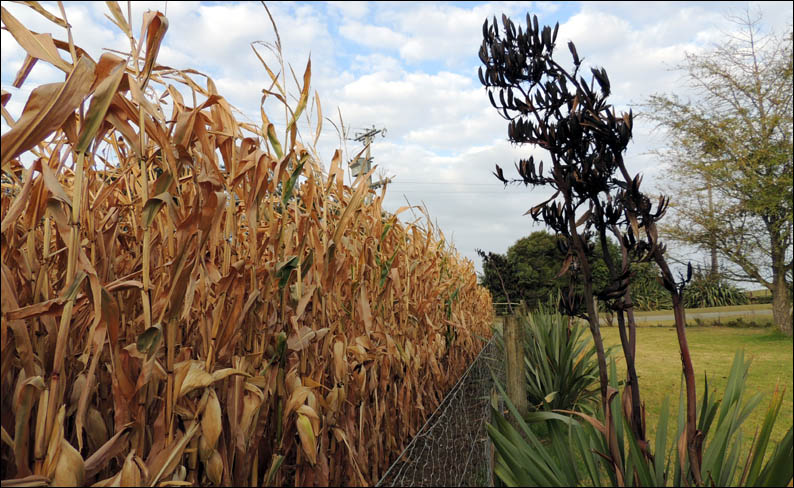
The maize in the paddock next door is dry

It seems ages since I’ve posted anything.  February has been so busy and now that it’s almost over, I can’t think where the days went to.  The sun is rising noticeably later and setting noticeably earlier.  The temperature range is still in the high 20s to low 30s Celsius, but there is the ‘smell’ of Autumn in the air. It has been extremely humid, and almost unbearable for sleeping at night.  During the hottest parts of the day I still stay inside where it’s shady and much cooler.

The maize in the paddock next door has dried to a pale golden colour and rattles in the wind.  The days are loud with the clicking of cicadas, and the nights with the more musical chirping of black field crickets.

Much has been happening in the garden, including our banana flowering for the first time, tomatoes, tomatoes and more tomatoes, and a very good crop of garlic.  It’s been extremely dry, and sadly, I fear that some of the newer small shrubs may have been lost – many are looking very dry and shriveled up and it’s just about impossible to water them as the earth has become so dry and hard.  Large cracks are spreading in some places, and there are many patches where the grass has completely dried off.  The pumpkins and squashes are dying back and we’ve given up on our zucchinis.  There have been just too many of them.

In the vegetable garden, our best crops at the moment are basil, peas, silver beet, the last tomatoes, beetroot and chilli peppers.  We have a new batch of scarlet runners that look pretty healthy and the passion fruit are dropping from the vine.  I am always amazed at how lushly basil grows, even when it’s so dry.

Banana ‘Mons Mari’

Banana with first sign of flower spike.

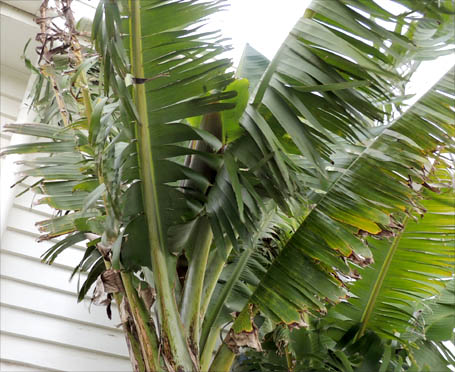
The most exciting development has been our banana ‘Mons Mari‘ flowering for the very first time.  I observed the very first spike of purple (which was the beginning of the flower stalk) on Monday 03 February.

This plant has been in our garden since April 2011 – I realise now that we didn’t plant it in a very good place – it’s exposed to the wind from the North and is also in very poor soil.

The flower stalk appears out of the centre once the plant is fully grown, hanging down as the flower develops.  The male flower develops at the end of the flower stalk creating a bell, with the female flowers spiralling around the stem.

The bananas just keep on forming!

Nevertheless, it has produced an amazing flower stalk of small bananas with more still forming.  We counted 170 the last time we checked – and remarkably this is only 3 weeks or so since the flower first appeared.

Tomatoes

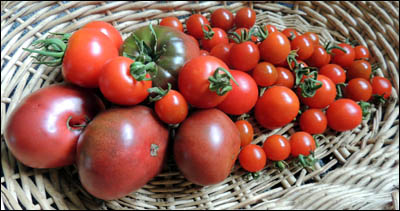
A selection of tomatoes from the garden

We’ve had so many tomatoes that I couldn’t keep up with picking them.  The most successful have been the heirloom varieties, ‘Cherokee Purple‘, ‘Black Krim‘ and ‘Black from Tula‘, and the cherry tomato, ‘Suncherry’.

The latter have been dropping to the ground like berries and to be honest, we haven’t kept up with them.  I also grew ‘Bloody Butcher‘ and this was a very nice, smaller tomato, but nothing really beats the taste of the big beauties.  Some of the tomatoes were tunneled into by caterpillars, but not too badly.  And this year all have ripened, so I won’t be making any Green Tomato Chutney.

Left to Right: Spicy tomato sauces, Greek tomato paste, Tomato sauce
Left to Right: Spicy tomato sauce, Greek tomato paste, Tomato sauce

I’ve ended up turning just about all the excess tomatoes (and there have been kilos of them!) into tomato concentrate and tomato sauces.  I’m really pleased with a couple of recipes, so will post these in the near future.

This year is the first time I’ve tired making  tomato concentrate.  I tried two recipes – a plain one and a Greek version.  The taste of both, compared with the tomato paste you can purchase commercially, is far superior.  Sweet, tangy, fragrant and rich with the flavour of tomatoes that have been ripening in the sun.

Garlic

Garden bulbs hanging on the fence to ripen

I’ve grown garlic for three years now at South Head and this is the best crop I’ve harvested.  There are more than 30 bulbs, a few of which I’ve left in the ground to mature a little longer.

I’ve read that garlic grows to its own conditions, which means that each year, if you use cloves from your own crop, the results will be better.  I love it that I can grow enough garlic to last an entire year.  We were literally turning the last of our 2013 garlic cloves into paste on the same day as we lifted the first bulb for 2014.

Garden Critters and Hidey-Holes

The 'hidey-hole', looking in.
The ‘hidey-hole’, looking in.

Forest Semilooper

Forest Semilooper (Declana floccosa)

I spotted this charming little moth (above) when I was trimming the ‘hidey-hole’ this afternoon.  I wasn’t able to identify it, so posted it on NZ’s NatureWatch website, where it was ID’d.  It wasn’t until I looked at the photo that I realised how pretty it is.  It looks to me like it is garbed in a crocheted cloak, woven in shades of silver grey.

The Forest Semilooper is a moth of the Geometridae family, and native to New Zealand.

Hidey-Hole

Left to Right: View heading towards the hidey-hole; looking inside; view from other side.
Left to Right: Looking inside the hidey-hole; view from above; view from the other side.

Regarding the ‘hidey-hole’ – this is being created from the fresh stump of a redwood.  When we moved here, the tree itself was in poor shape, having been smothered in nasty ivy for several years – it had a great deal of die-back and the limbs were distorted and many, while still alive, lacked any needles.  It was also blocking the Eastern sun from our solar panels. 🙂

We arranged to have it cut down a couple of months back, but when it started to sprout new growth from the base, I decided to fashion it into a hidey-hole for any little visitors (of the human kind) that we may have.

On the topic of ‘redwoods and regeneration’, I read on the internet that due to the fact that seed germination is very low, most redwoods grow more successfully from sprouts that form around the base of a tree, utilising the nutrients and root system of a mature tree.  When the parent tree dies, a new generation of trees rise, creating a circle of trees that are often called fairy rings.

This amused me as this is exactly what I thought of when I saw the new growth around the sawn-off stump.

Scar Back Gem (Ctenoplusia limbirena)

Scar Back Gem moth
Scar Back Gem moth

This exotic noctuid moth originally hails from Europe and was first sighted in New Zealand in 2011 (Auckland).  It was not considered enough of a pest to warrant special attention and has been removed from the Unwanted Organism Register.  We have found a couple indoors in the past couple of days.  They are pretty cute with the frilly tufts on the top of the thorax.

Green Vegetable Bug

Green Vegetable Bug on Calendula spp. seed-head
Green Vegetable Bug on Calendula seed-head

Green vegetable bugs (Nezara viridula) are back in the garden again.  This one is sitting on the seed head of a marigold (Calendula Officinalis ‘Indian Prince’).  Our first three hens (who have sadly left us for the free range in the sky) loved to eat these bugs and I used to collect them from around the garden for them.  But current three red shavers don’t seem to recognise them as a food item, and I think the Orpingtons are still too young to be given these to try.

Asian Paper Wasp

Asian Paper Wasps on jade plant
Asian Paper Wasps on a Jade Plant (Crassula ovata)
This is the third Asian Paper Wasp nest we have found this season.  According to the Department of Conservation, they are tolerant of human activity unless their nest is physically disturbed, and feed mostly on caterpillars.  There is also anecdotal evidence that they decimate monarch caterpillars and may therefore do likewise to native butterflies and moths.
As far as ‘unwelcome visitors’ are concerned, the Asian Paper Wasp is the most recent, having been first found in New Zealand (Auckland, again) in 1979.  Attempts to eradicate it failed as it was too well-established and it has since been found throughout the North Island and at the top of the South Island. 
The nests of paper wasps (both Asian and Australian Paper varieties) can be found hanging from small shrubs and trees, fences and walls, and under the eaves of buildings.
Monarch Butterfly Caterpillar
Caterpillar of the Monarch Butterfly, on a Swan Plant
The comments about monarch butterfly caterpillars interested me, as we have many on our swan plants at the moment.  The plants have self-sown incredibly successfully and are growing all over the property – in my flower beds, in the dry gravel of the drive-way, in the vegetable garden, cottage gardens, etc. 
The first year we had only 6 baby plants and they were almost completely eaten up by caterpillars, but I don’t think we’ll have that problem again.