Tag Archives: Otaru

JAPAN DIARY

十九 Overnight Trip to Otaru – Part 3
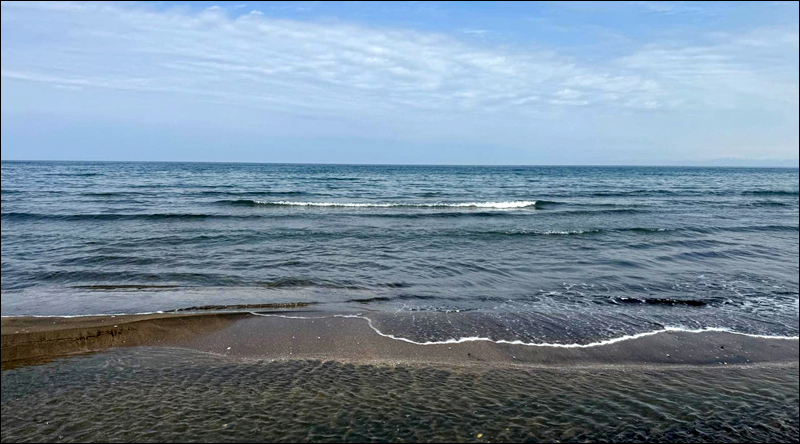
Zenibako Beach, looking out to the north-west. Not so different from a North Island west coast beach.

All good things must come to an end, and so it was with our mini break to Otaru. We’d hoped to be back in Asahikawa by early afternoon, April 04, but had also planned to initially drive back along the coastline so that I could finally walk along a real Japanese beach, and dip my toes in the sea.

Breakfast at Hotel Sonia

We set our alarms for 7.00 am and once we were up and dressed, we met up outside our rooms and headed downstairs for the buffet breakfast. The dining room was moderately busy, with a scattering of Japanese and Chinese travellers, and one other foreign couple–a woman and a man. The former of the two was in the line beside me and was complaining loudly to her companion about the choice of oatmeal. Or apparent lack thereof. Her accent was North American.

A selection of breakfast items

Breakfast was arranged buffet style around the edge of the dining room. The food selection was comprehensive, although there weren’t many items  that I felt able to eat so early in the morning.

When I looked at my choices, they were unexpectedly colourful, in shades of yellow, orange and pink–a couple of crumbed ebi, a slice of tamagoyaki, a small croissant, a slice of cooked salmon, some diced raw salmon, a dollop of mashed tuna, scrambled egg, and a couple of strips of bacon (just in case you can’t tell from the photo!).

I’d somehow managed to avoid anything green, but I did collect some slices of melon and a few grapes after I’d done my best with the main course. The scrambled eggs were difficult to eat as they were very runny. Usually they’re a safe choice no matter where I’ve been.

Alongside Ishikari Bay

Our plan for the morning was to travel up the coast to Zenibako, about 25 km from Otaru, situated at the bottom of Ishikari Bay. Amiria had previously been there in summer, and told me it was a popular resort area.

On the last stages of our journey to Otaru the previous day, there had been a clear view of the bay and despite the distance I’d noticed a very large and solitary terracotta-coloured building dominating one area of the coastline. I was super curious about what it might be and hoped the mystery would be solved when we headed that way.

Hotel Luna Coast

Hotel Luna Coast – a ‘love’ hotel

Zenibako is a coastal settlement with a long stretch of beach, and when we arrived we could not miss the edifice I’d been seeking. It turned out to be the Hotel Luna Coast an ‘adults only’ love hotel (rabu hoteru). It was standing there all by itself, surrounded only by small dwellings. Amiria mentioned that this wasn’t particularly unusual–she said that in Japan there are often tall hotel buildings in coastal areas, but to me it looked completely  incongruous. At just on 10.00 a.m., there was no sign of life. Perhaps the hotel was closed for the off season.

Zenibaku Yacht Harbor, adjacent to a stream that ran down to the water’s edge.

There were no car parks in the area, so we had to drive onto the gravelly edge of the road near to a small stream that ran down to the water’s edge. We hoped it would be okay to leave the car there. It wasn’t that we thought that it would be broken into or stolen (this would never happen in Japan), but we didn’t really wish to  engage in conversation with a local to explain what we were doing.

Bounty from the sea

An Anpanman, trapped in debris adjacent to a stream running into Otane Beach. Photo courtesy of Amiria Paterson.

On our walk down past the stream, Amiria spotted an Anpanman almost completely buried in the flotsam and jetsam that had accumulated on the bank. The sight was a bit sad–someone’s once-loved toy (possibly?), discarded and forgotten.
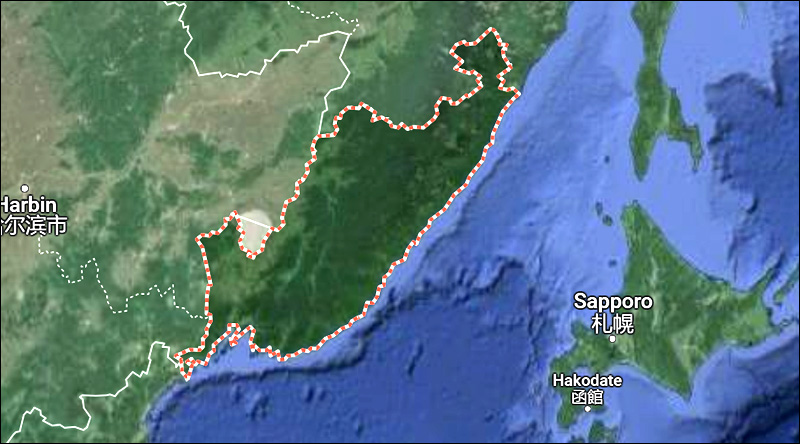
Directly across the Sea of Japan from Hokkaido, is the Russian federal state of Primorsky Krai.

It was a blustery grey-gold-blue kind of day, with the dry grasses, the sand, the sea and the sky all displaying versions of the same colour palette. I looked out across the water and realised that directly across from where we were standing (north-west), was Russia, approximately 600 km across the Sea of Japan. Specifically, Primorsky Krai, a ‘federal subject of Russia’, in the Russian Far East. It was hard to get my head around the fact that it was about as close as Auckland would be from Wellington.

It’s disapponting that trash from the Sea of Japan ends up on a stretch of coastline in such an isolated area, and I was depressed by the state of the foreshore. The grey sand was littered with rubbish, from the tiniest of multi-coloured scraps, to plastic bags of all shapes and sizes, to larger plastic drink bottles, to orange and yellow net floats. I didn’t have the heart to take many photos of the human detritus, so have left this to the imagination.

‘Girl holding Japanese glass net float with mussels on top it’, circa 1950. OSU Special Collections & Archives : Commons, No restrictions, via Wikimedia Commons

I was, however, interested to read that before the transition to plastic or aluminium, Japanese net floats were fashioned from glass and were predominantly green, due to the use of recycled sake bottles.  Clear green globes washed up on the beach would be a far more attractive sight.

Everywhere we looked, rubbish had accumulated on the surface of the beach.

Curious, I inspected a few of the larger plastic items and discovered that those that did have any identifiable writing on them, were all Japanese. I’m not sure whether this fact made me feel better or worse. I’d assumed that the trash had washed up from a range of sources, not just from Japan.

We wandered along the water’s edge for about 30 minutes, searching for interesting shells, or seashore flora and fauna to photograph, but were unrewarded. There wasn’t much else to see or do, and with the wind whisking our hair into our faces and finding its way under the cuffs of our jackets and pants, we were getting cold, so we headed back to the car.
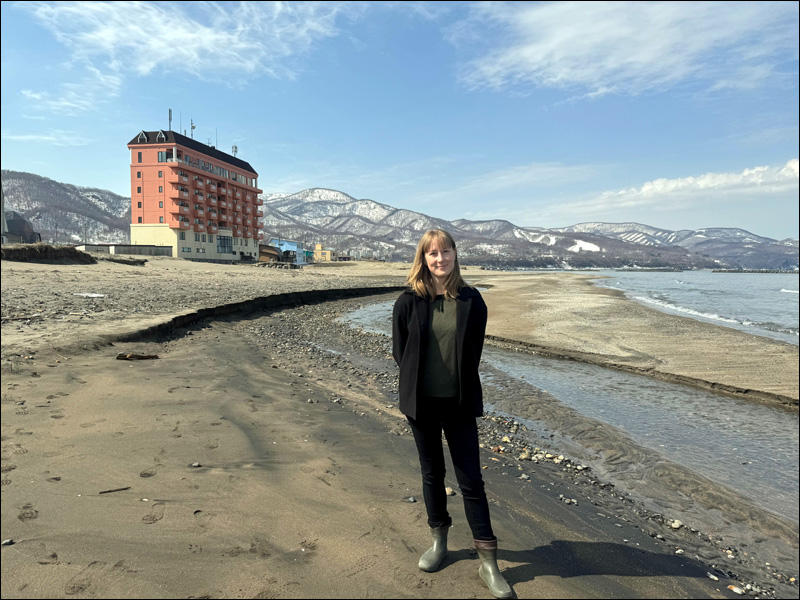
Amiria on Zenibako Beach, with Hotel Luna Coast looming behind her.

I looked back once, to impress upon my memory the overall feel of the place, with the knowledge that it was unlikely that I’d ever stand on that particular shore again. I tried to absorb everything. The feel of the air, the briny smell of the wind, the sharpness of the winter sunlight, the infrequent squawks of the seagulls soaring and diving in the sky overhead.

I’m left with the impression of a vast sweep of barren coastline, curving away in both directions. From the nub of land to the south-east (where Otaru is situated), along and up to the north along Ishikari Bay to Cape Ofuyu. It was April, and in Japanese terms, especially further south, it would clearly be Spring, as that month marks the peak of the Sakura season. Far to the north in Hokkaido, however, it would be another few weeks before the first buds of the cherry blossom began to open.

I decided that although Aotearoa has its own empty swathes of coastline, and although our west coast beaches often have grey or even black sand,  the wintry view from Zenibako beach was quite different from one from home.  Also the fact that the view from Zenibako beach was dominated by the strange apparition that was the hotel. I couldn’t imagine seeing something similar in New Zealand.

In Hokkaido, once Spring truly starts, everything happens in a really short space of time. I’ve observed this many times in Asahikawa. One minute it’s freezing and the next, it’s too warm. The trees sprout buds and new leaves, the rice paddies turn a brilliant green, new growth pushes through the soil to replace the dry grasses, and wild flowers at the edge of the beaches begin to flourish. The Ishikari Bay coastline was merely in a state of waiting for Summer to arrive.

Back to Asahikawa

The tunnels thorugh the hills that separate Asahikawa from the

We didn’t waste time on our way back to Asahikawa, only stopping once on the way for a toilet stop, and to pick up some snacks and a drink. At just after midday, I was glad to see the familiar tunnels that indicated we would soon be back in Asahikawa.


On Zenibako Beach

Plastic scraps dispel
memories of green glass spheres.
Grey pebbles rattle.

Jane Percival – 08/08/24


Next Japan Diary: Karaoke in Sangenjaya – a memory from 2023


JAPAN DIARY

十八 Overnight Trip to Otaru – Part 2

We crossed the canal on our way to Minatomachi, to explore the warehouse area.

After checking into Hotel Sonia, there was time to head over to the Minatomachi district, for a nosey along the back street that ran parallel to the main canal. The street itself is lined with brick and stone warehouses that date back to the Taishō Era (1912-1926). The sun was beginning to set, which added unexpected shadows to what were already very interesting looking buildings.

Brick buildings, a brewery and an abandoned railroad

The road was lined with interesting brick and stone warehouse buildings.

There were still dirty piles of snow everywhere, but I was glad that they’d melted enough for us to see the buildings’ features. A lot of the structures looked abandoned, but it was hard to know for sure. Certainly the rusted doors in the photo above looked like they hadn’t been dragged open in some time.

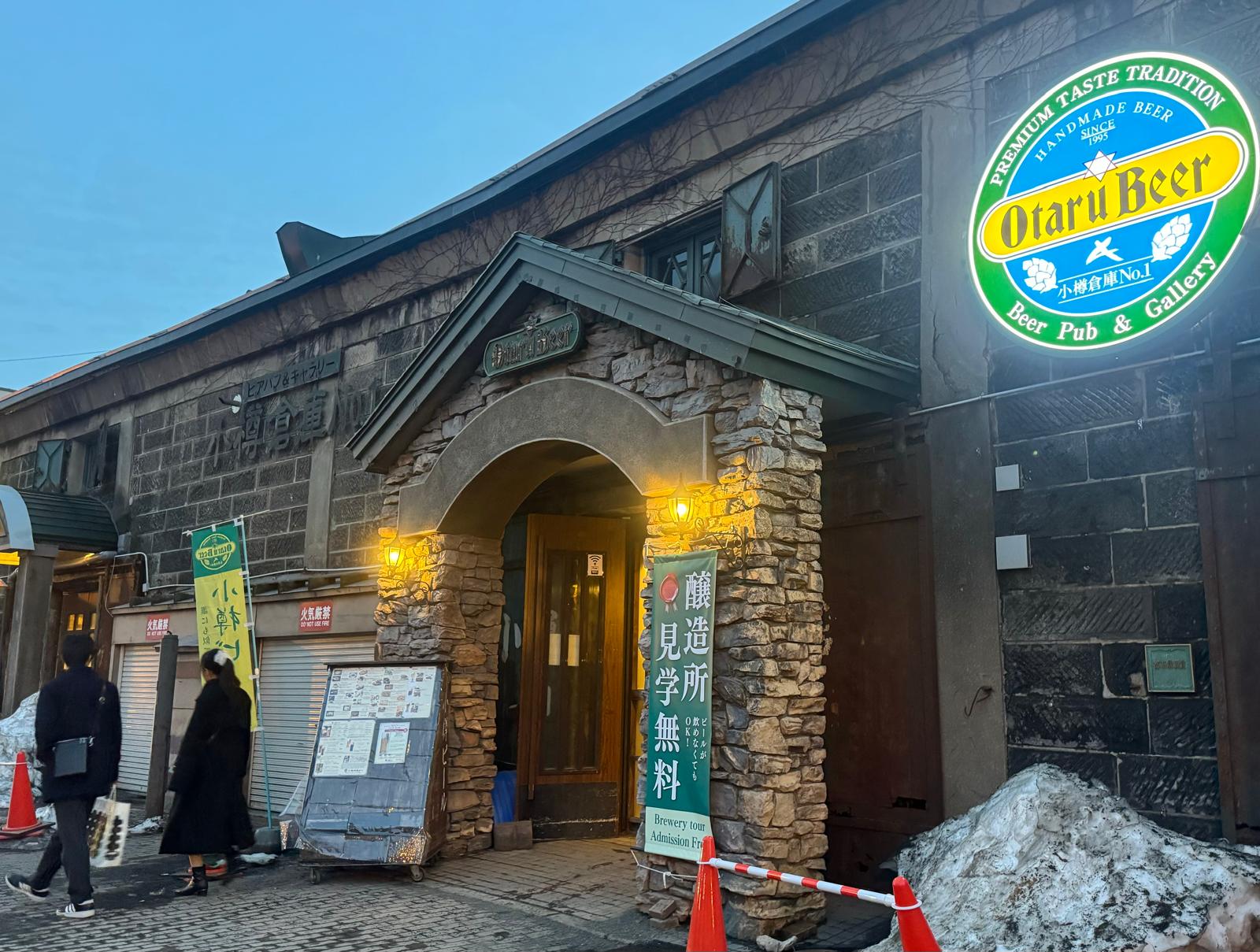
Otaru Soko No. 1 Brewery

It was getting quite chilly with the sun going down, and after walking a little way we were drawn to a brightly lit doorway we could see ahead of us. It was the entrance to Otaru Beer’s Soko No. 1 Brewery, and we decided to check out the interior. It looked warm and inviting.

Left: Me, uncharacteristically drinking a beer. Admittedly, it *was* flavoured with woodruff; Right: a magnificent copper mash kettle, centrepiece of the bar area.

The establishment was in the style of a German beer hall, with the seating arranged around a huge copper mash kettle. I’m not usually a drinker of ale, but I was tempted to try the Woodruff flavoured Weiss beer. I really enjoyed it!

We could easily have stayed much longer than our one drink, but we had to move on as we had a dinner booking for 6.30 pm.

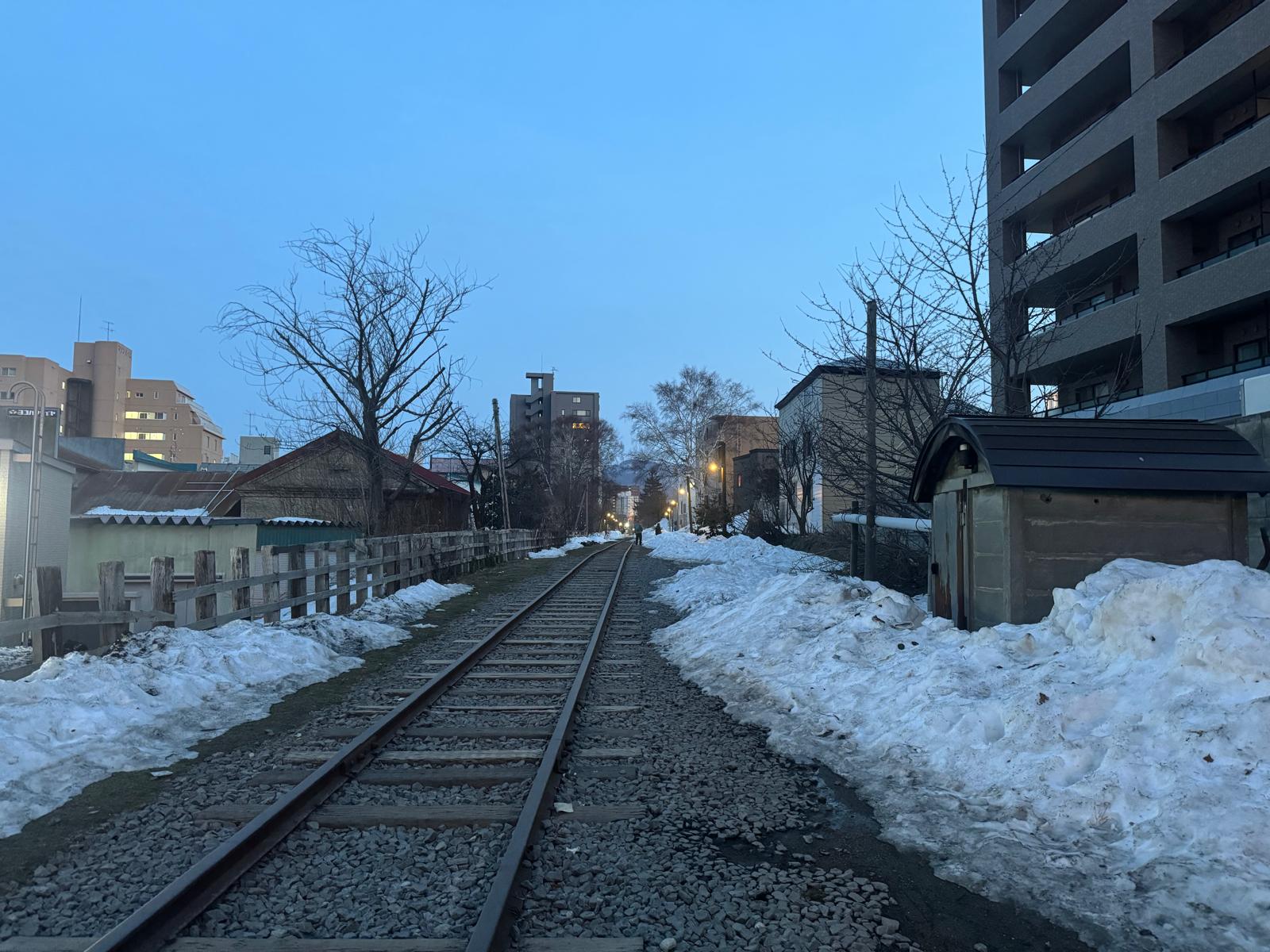
A section of the Temiya Line, at dusk (6.20 pm).

We took a shortcut along the Temiya Line, a narrow gauge former railroad that linked Minami-Otaru and Temiya Stations. At one time, the trains carried both freight and passengers, but the line closed in 1985, and sections of track, such as those we walked along, have been preserved.

Koji in Otaru

We arrivced at Koji restaurant, 2-13-17 Inaho, Otaru, just after 6.30 pm.

When we entered Koji restaurant, we were told that it was fully booked–I guess they thought we were casual visitors, not expecting that a couple of gaijin would have booked ahead. And it was difficult to believe that it was fully booked as we didn’t see any other patrons while we were there–in fact another group (Japanese this time) was turned away.

I’d heard that restaurants in Japan are suffering from people booking and then just not turning up, and we hoped that this wasn’t the case on this occasion, as the service was lovely, and the food, very good. There was additional seating upstairs, so perhaps it was filled with very quiet customers and they’d arrived and crept up the stairs without us noticing them.

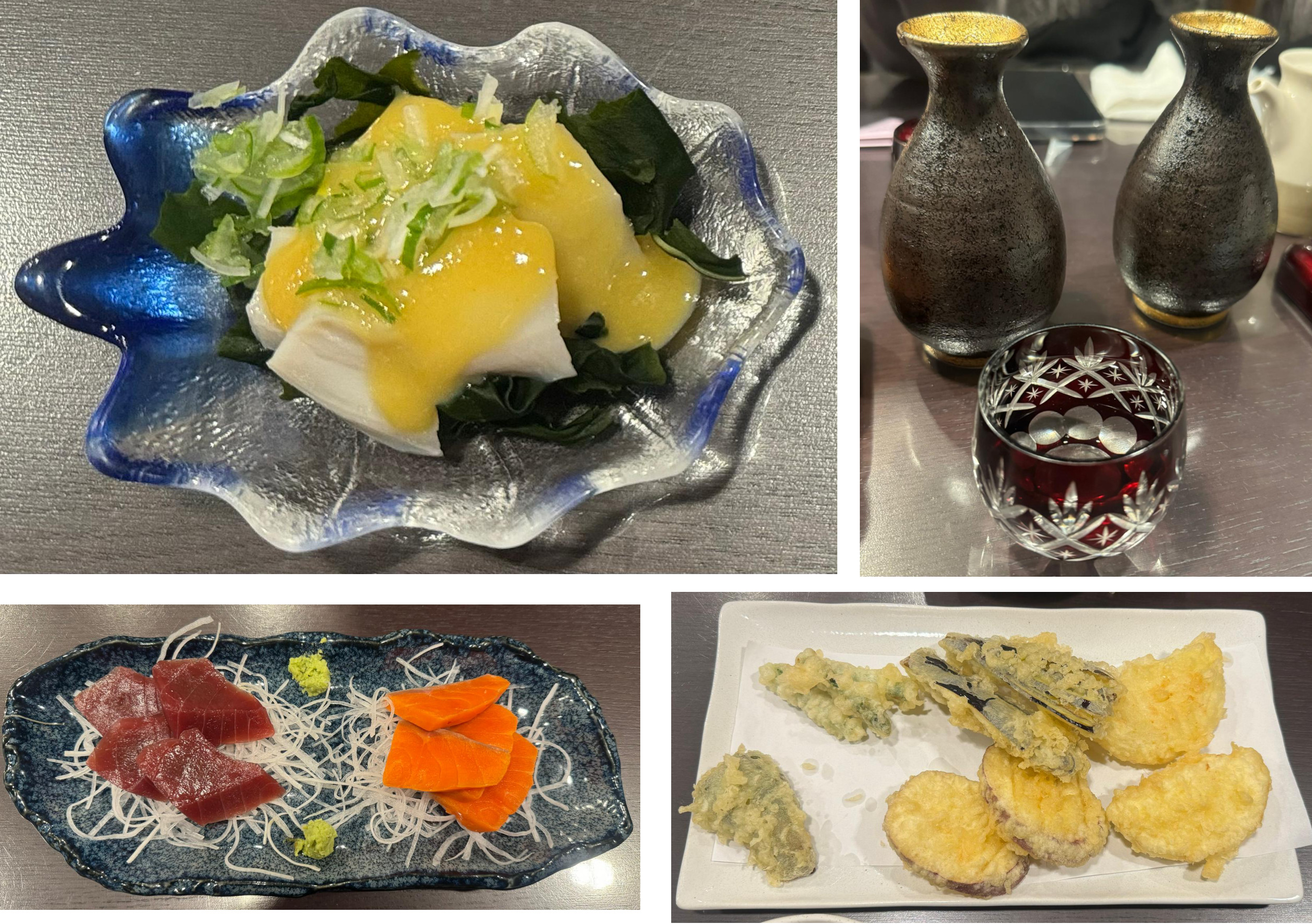
Raw fish, Nihonshu, Tuna and Salmon Sashimi, Tempura vegetables.

Amiria and I ordered a selection of small dishes, some of which we shared. The food came out at regular intervals and of course, we complemented our meal with Nihonshu (日本酒).

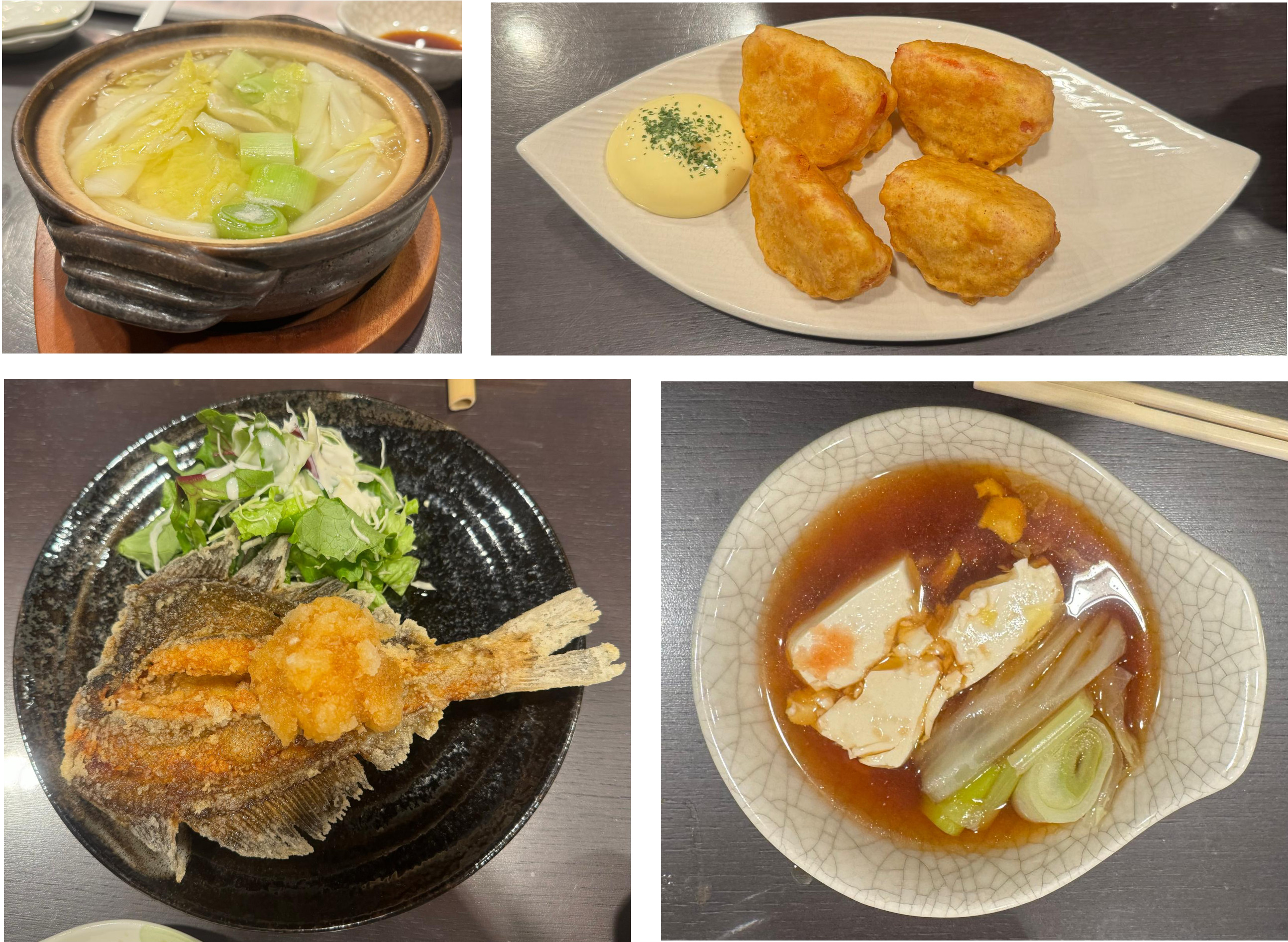
A bubbling bowl of Yudōfu (Tofu Hot Pot), Tasty Tempura Tomato, Karei no karaage, and a serving of the Yudōfu.

It would be a difficult call as to which dish I liked the most, as they were all so different.

In search of parfait

After we’d finished our meal, and despite being full almost to bursting, (speaking for myself, of course) we weren’t quite ready to go back to the hotel, so we wandered off in search of that truly quintessential Japanese dessert, the Parfait.

The back streets were brightly lit. Amiria standing by a wall of posters.

Although the evening was really quiet, people-wise, the small streets were illuminated festively. Amiria had carried out the requisite research and had a possible destination in mind, so we set off in that direction. I had no idea where we were headed, but she’s never let me down.

Left: Our first sight of Polepole Parfait Bar, viewed down an alley; Right: The entrance was cute and welcoming.

At 8.30 pm, it was still early by ‘going out’ standards, but it was completely dark by the time we arrived at our destination, the Polepole Parfait Bar. It turned out to be a tiny bar, and like many of its type in Japan, was most likely an add-on to the owner’s own home.

When we tentatively pushed open the door, we were met with a small strip of bar-style seating, and a couple of equally small tables that could seat a couple of people at most. The two of us had to squeeze in under a sloping roof–for once I was glad that I’m only 151 or so cm (yes, I’ve shrunk!).

Bliss in a tall glass – a Matcha Parfait with all the trimmings.

Of course, I had absolutely no choice, I *had* to order Polepole’s version of a Matcha parfait. And this one didn’t disappoint me one little bit.

Walking the backstreets

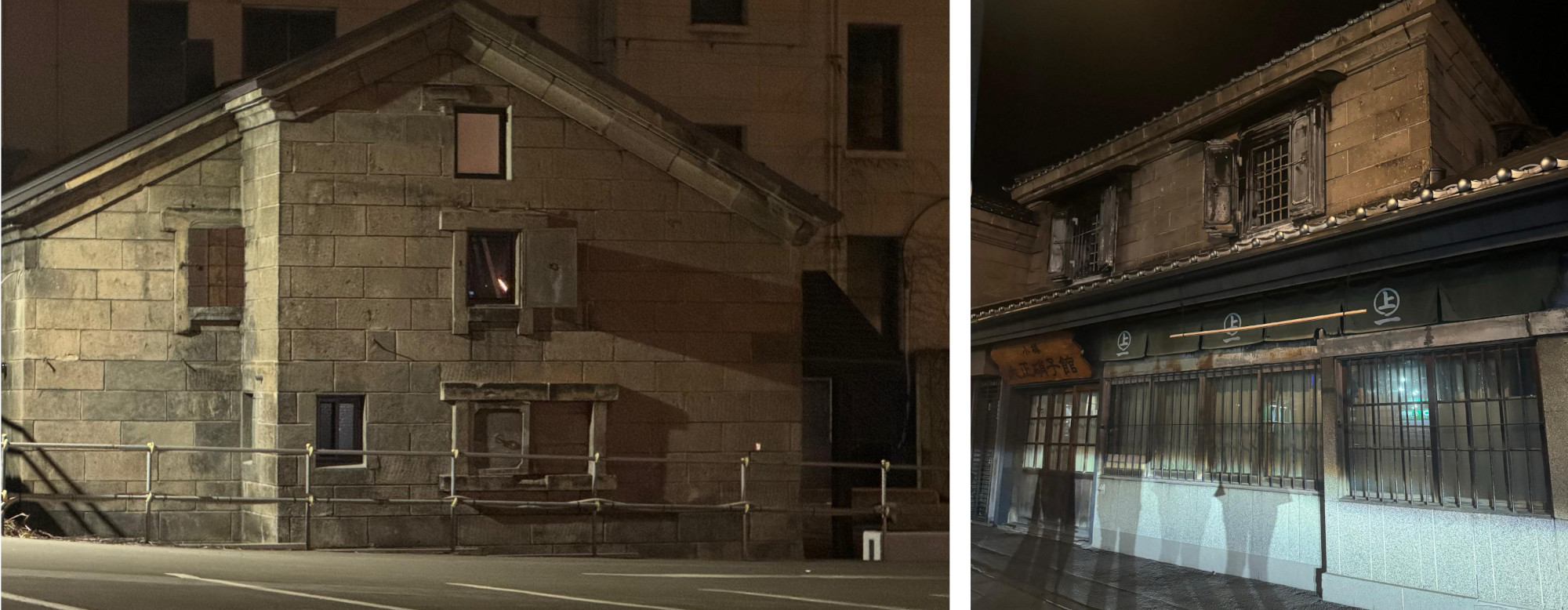
There were many derelict buildings, looking spooky in the streetlights.

After our desserts we made our way back to the hotel, with the aim of looking at the canal one last time, on the way. It was barely 5 degrees Celsius so we walked briskly. Many of the old buildings are lit up at night and I know that a large number are historically significant, but in the semi-darkness we couldn’t really tell which ones were which. It didn’t feel unsafe–that’s the thing about Japan, you can walk just about anywhere at any time of day or night, without fears of being set upon, but the buildings appeared strange to me, and a little eerie–perhaps because there were no other people around, and because many were clearly derelict, with boarded up doorways, and gaping shutters. I was glad when we turned a corner and saw the canal area ahead of us.

The beauty of the canal at night

This is a view taken from opposite the same building, one view looking to the right, and the other, to the left.

It was a calm night and the canal was like a vast mirror, reflecting in perfect detail, everything that was displayed along its edge. I took many photos, and even as I write, I’m finding it difficult to decide on which to post. I think they are beautiful images, but even so, they don’t really capture how the scene looked in real life. It was magical, and I kept seeing a new angle that I *had* to photograph.

It was very quiet and very still. And cold!

I’ve always loved taking photos of reflections. That whole ‘upside down’ effect fascinates me. The duplications are somewhat like a slice of a kaleidoscope image, or a topsy turvy way of seeing the world. The feeling of not being completely sure of which part is real, the top or the bottom… it’s a bit like waking up from a vivid dream that somehow seems more real than being awake. If that makes any sense.

The building on the left is the brewery we had visited earlier in the evening.

I could picture the canal on a summer’s evening, in the main tourist season, with crowds of tourists walking its length. But I liked the lack of people and the complete stillness of everything. Not a breeze, not the flutter of a flag,  nor the rattle of a sign. Just the sounds of our footsteps on the gravel, and snatches of laughter or the soft talk of the few other walkers out along the canal at the same time.

Tired and a little overwhelmed

Lit up buildings on the left side of the canal, and our home for the night, Hotel Sonia.

It had been a long day, and when we arrived back at Hotel Sonia, it was quiet there, too.   One of the reasons we’d chosen to stay at this particular hotel was because it has an onsen (a Japanese hot spring), so we fetched our tiny onsen towels from our rooms and took the lift upstairs.

We were surprised to find that the onsen was busy–which was unexpected as we’d hardly seen any other guests. There are strict rules about using an onsen; the first, and probably most important, is that you must wash and rinse yourself completely, before you go anywhere near the water. You do this by seating yourself on a low stool, helping yourself to the supplied liquid soap, and using a  showerhead to thoroughly spray all the nooks and crannies. A very sensible idea imho. So I was basically waiting for a stool to become free, and because you have to remove your clothes before you step into the main area, I was naked with only my tiny towel clasped to my front.

The main busyness turned out to be in the washing area, as the pools themselves (one inside and one outside) were almost empty. We Kiwis are sometimes a little shy about the thought of stripping off in front of strangers, although I personally think that actually, stripping off in front of people we know would be even worse. But an onsen is very discrete. No-one stares at you, except perhaps your curious grandchildren (but that’s a different story).

If you want the perfect end to a day filled with sightseeing, eating and drinking, then there is nothing better than the experience of unwinding in the hot, steaming waters of a Japanese hot spring.

[to be continued]

JAPAN DIARY

十七 Overnight trip to Otaru – Part 1

Map of Hokkaido, showing Asahikawa near the centre, and Otaru (left edge, roughly in line with the ‘H’ of Hokkaido).

I read somewhere that Hokkaido, the northernmost island of Japan, is sometimes described as being shaped like an ‘ishikari nabe’, a type of hot pot dish. This comparison is made due to Hokkaido’s distinctive shape resembling a pot or bowl, with the Ishikari River running through its central region.

Travelling across the ishikari nabe

On April 3rd, my daughter (Amiria) and I went on a road trip from Asahikawa to Otaru, which happens to be sister city to Dunedin, New Zealand, a city I lived in for 25 years.  Otaru is a port city, and is situated adjacent to the Sea of Japan, in the northern Shiribeshi Subprefecture. It was originally an Ainu settlement, and the name , ‘Otaru’, is of Ainu origin, possibly meaning, ‘River running through the sandy beach’.

A derelict building in Shukutsu, near the base of the lighthouse promontory.

Although I’ve visited Hokkaido many times, this was the first time I’d actually been as far as the coast (in any direction), and I was looking forward to the experience. Hence, I took numerous photos, and I apologise if this post has a greater emphasis on images than on content.

Heading south

We drove the 170 km journey south-west via Sapporo, following the tolled highway. Around us the countryside gradually showed signs of the Spring thaw, although every so often, even as far south as Sapporo, we came across fields of thick white snow. As we drove I had the luxury of being the passenger so could gaze out at the scenery and I was once again reminded of how the light in the northern hemisphere is quite different from that of New Zealand, where even the distant features are sharply defined. The Hokkaido hills and mountains appeared as if through a hazy blueish filter, with the effect, i.e., the overall ‘blue-greyedness’, becoming more intense as the distance increased. I recalled noticing the same phenomenon over 20 years ago, while driving on long stretches of road from Nebraska in the mid west of the USA, down through Colorado.

The Venice of the ‘wild north’

Once we’d passed through the outskirts of Sapporo, we headed northwest to Otaru, leaving behind the flat plains of the central region and beginning to follow the jagged contours of the hills. There was a briny feel to the air.

Driving into Otaru–quiet on a Wednesday afternoon in early Spring.

At the somewhat subdued time of year that is winter turning to spring, and when the landscape is neither deeply snowy, nor lush and summery, the small towns and cities can look dull and uninteresting, and yet as we drove into the city, my first impressions of Otaru were of a pleasant kind of town. The air felt open and clean, and there were seagulls squawking, rather than crows. I caught glimpses of small craft bobbing close to shore, and even the steep hills rising up behind the city area had a reassuring feel–no doubt due to having grown up in Wellington, and later living all that time in Dunedin. I love a hilly city.

Otaru has a rich history, and perhaps one day I’ll visit again with more time on my hands. I’ve seen the city referred to as the ‘Venice of the wild north’, due to its famous canal, its thriving glass blowing industry and also its picturesque 19th century European-style buildings.

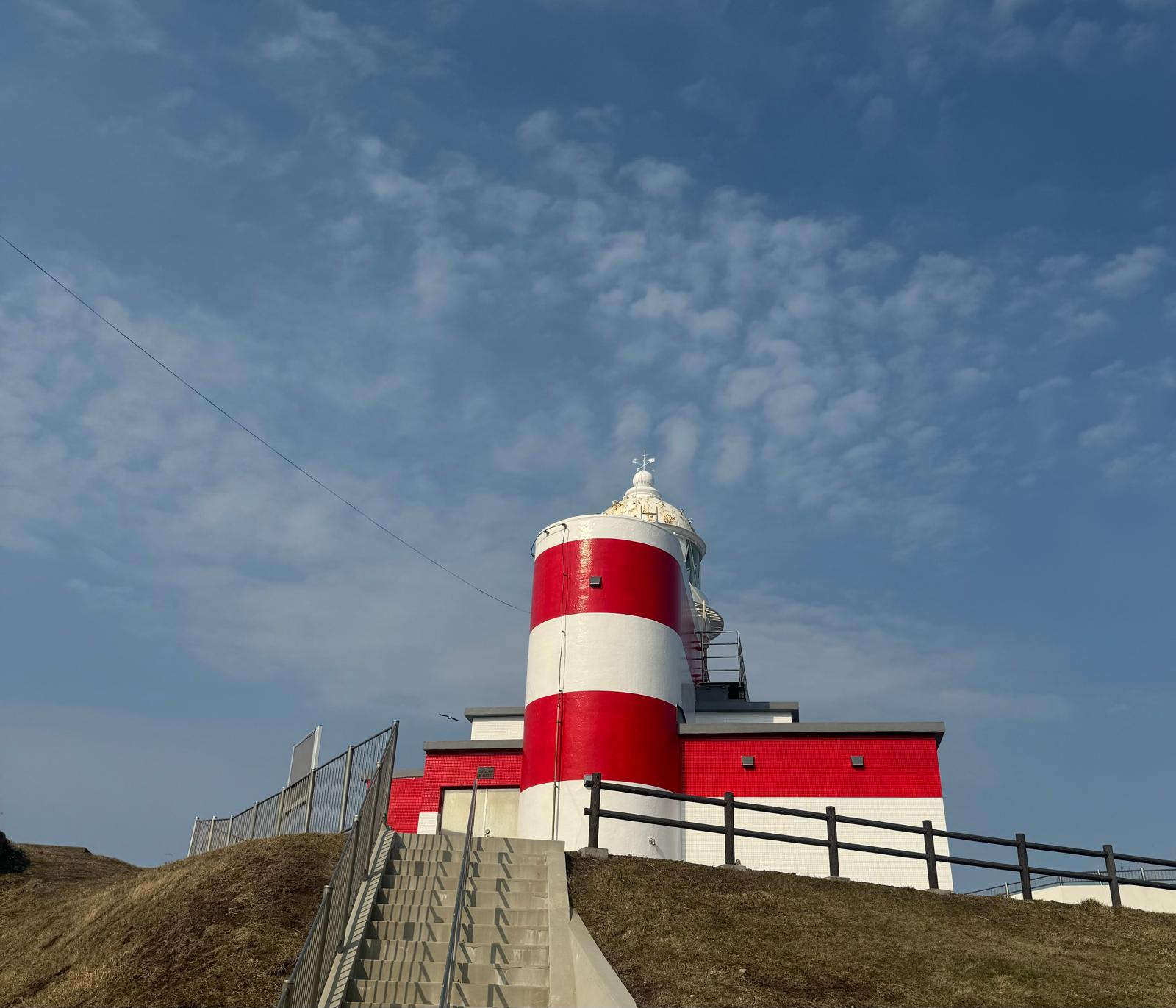
Hiyoriyama lighthouse, Otaru, on a small promontory facing across the Sea of Japan to Russia.

The harbour is situated at the bottom edge of a sweeping upward curve that travels a little to the right, and then stretches up and around to the left, toward Russia. Looking from the sea’s edge toward that curve, you can just make out wind turbines in the distance.

Shukutsu

Shukutusu: View from near the Hiyoriyama lighthouse towards the bay where the city of Otaru is situated.

The Shukutsu area, which encompasses a north-east facing promotory, the Hiyoriyama lighthouse, and an aquarium, originally housed the wealthy tycoons who controlled the herring industry. They built huge mansions where they lived alongside their seasonal workers. Interestingly, much of the herring caught off the Hokkaido coast was destined to be turned into fertiliser, rather than eaten. Over-fishing led to the decline of fish stocks and the herring businesses collapsed in the 1950s.

This collapse, as well as affecting the lives of countless fishing folk, also had a direct effect on the city’s glass-blowers, who, up to that point, made the glass buoys used by the fishing boats. Hokkaido was slow to adopt electrification, so they were already called on to produce glass oil lamps for the outlying areas, and they then turned their skills to producing more delicate items. Otaru is now known for its beautiful glass objects.

Because we basically only had one afternoon to see the local sights (we had to get away early the following day), we decided to (1) visit the city’s two main look-outs, (2) try to get down to the water’s edge so that I could touch the ocean, (3) check in to the hotel, (4) take a walk along the canal, (5) go out for dinner (we’d had the good sense to book a table at a well-reviewed Izakaya), (6) find a place for dessert, (7) walk back to the hotel via the canal, (8) soak in an onsen, and (9) call it a night. I personally felt I’d be quite satisfied if we managed to achieve even 2/3 of the items on the list.

Hiyoriyama lighthouse

Hiyoriyama lighthouse, Otaru, Hokkaido.

So, first of all we drove up to get a closer look at the Hiyoriyama lighthouse, a noticeable red and white striped structure perched at the tip of the promontory.

Looking out across the Sea of Japan.

The views were incredible, and for early April in Hokkaido, it was surprisingly mild and calm; I was only wearing a t-shirt and didn’t feel remotely cold.

Down to the water’s edge

Facing north. We clambered down to the water’s edge so that I could touch the sea.

We then walked down the gravel road we’d just driven up to investigate the sea, as this seemed like the only chance we might have to achieve this.  In Japan, it’s not the custom to just ‘park on the street’, the way it is in New Zealand, and we could see no other place close to the water where we could leave the car while we paid the ocean a quick visit. In fact, it’s not only ‘not the custom’, there are literally no parking spaces on the sides of the roads.

When we drew closer we found that the only area with access to the water was closed off with ropes and ‘no entry’ signs, but there was no-one around so we ducked under the ropes, walked as briskly as we dared across a flat, dusty area, and then scrambled down a steep bank of large stones to the water’s edge. Once we were out of sight of the road, Amiria sat on the rocks while I scrummaged around for interesting things to photograph. The water was crystal clear, but the stones were steep and difficult to balance on, and the small waves kept washing in, so all I saw were a few sea snails, until some blue fish appeared–they seemed as curious about us as we were about them.

One of the ‘interested’ fish that was swimming around near the water’s edge.

The sun was getting lower and we were reminded to get a wriggle on, so we made our way back to the car, then drove to the Cape Observatory for a different view. And of course I took some more photos!

[to be continued]


View from the promontory in Shukutsu–a solitary fisherman down below on the rocks