Tag Archives: Kaipara

This and That

View to the north as the sun was setting last night.

Pumpkins and Squash

We harvested most of our squash during the past week.  It was a very good crop and I’m pleased with the varieties we chose to raise from seed this year.
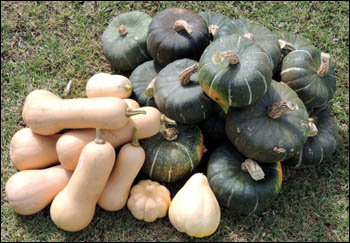
Squash 'Butternut Chieftain' and 'Burgess Buttercup'
Squash ‘Butternut Chieftain’ and ‘Burgess Buttercup’, with ‘Thelma Saunders Sweet Potato’ in the foreground.

Even though I’ve tended to grow the larger pumpkins in the past, the beauty of the smaller varieties is that you can cut into one and don’t end up with a huge vegetable to eat or process in a short amount of time.

The butternut and buttercup squashes are ideal for a family of two.

Pumpkin Pie
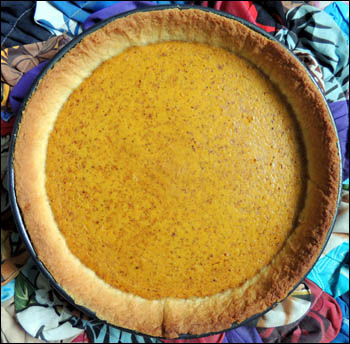
Pumpkin pie, straight from the oven.
Freshly-baked Pumpkin pie.

Keeping with the theme, I baked a pumpkin pie on Sunday, using some frozen mashed pumpkin from last year’s crop.  This was from a Crown pumpkin – a large variety with smooth, pale grey skin and sweet orange flesh.  Despite being frozen for all this time, the puree tasted very good.
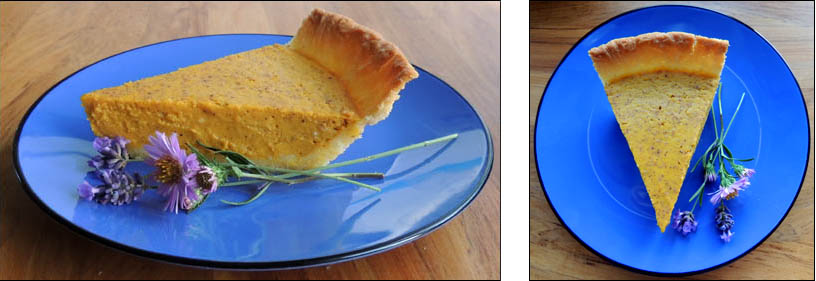
A healthy serving of pumpkin pie.

The filling is comprised of  pureed pumpkin, evaporated milk, eggs, ground ginger, ground allspice and caster sugar.  The base is formed using sweet shortcrust pasty, which I baked blind before adding the filling.  The pie is topped with freshly-grated nutmeg.

I’m interested in experimenting with tofu to see if I can make a vegan version.

Rum Pot

Pears are falling daily from the old pear tree.

You may recall that back at the beginning of January, I started a Rum Pot using strawberries, plums and some cape gooseberries.  With the pears ripening and dropping each day, I decided to add some in.

The fruit that has been macerating in the rum and sugar for the past couple of months, smelt extremely enticing.  I couldn’t resist tasting some of the liquor – it was very heady and almost spicy, reminding me of Christmas.  So, now the rum pots have pieces of pear in them as well!

A view of the fruit macerating in the rum pot.
A view of the fruit macerating in the rum pots.

The next fruit to ripen should be our feijoa.  I must admit that I’m not exactly sure how well the feijoa will enhance the mix, but we’ll see!  As much as I love fresh feijoa, they do sometimes have something of a chalky texture.

Brassica

On Wednesday (05 March)  I sowed seeds of the following Brassica – Broccoli ‘Premium Green’, Cabbage ‘Scarlet O’Hara’ and Cauliflower ‘All the Year Round’.  Brassica don’t seem to do so well in our hot, dry summers, but we have had good results during Winter and Spring.

I’m hoping that these will be ready to plant out in a month or so’s time.  The broccoli and cauliflower have sprouted already (5 days).

Swan Plants

Swan plant seed head, and monarch butterfly on flowers

The ‘swans’ on our swan plants (Asclepias physocarpa) are bursting with fluffy seeds.  We appear have the full cycle happening at once – tiny caterpillars, fat caterpillars, cocoons, adult butterflies, mating butterflies, flowers and seed pods.

The grass in some areas of the garden is carpeted with the ‘down’ from the seeds.  I suspect we may have something of a swan plant problem in 2014/2015.  But at the moment I can’t see that we’d ever have too much of them.  I love having the butterflies always present in the garden.

Swan Plant Beetle

beetle in seed-head and bursting swan pod.
Close up of swan plant beetle, and view of bursting seed pod.

When I was photographing the seed pods and their bursting seeds, I noticed a small insect inside.  I have since identified this as Arocatus rusticus, a native of Australia that has become established in New Zealand.

Despite the foliage and sap of the swan plant being toxic to plant-eating creatures, it seems that Arocatus rusticus has evolved the ability to overcome the toxin and store it in its own body.  You can’t really tell from my photo, but the insect is orange/red and brown in colour.  This is to warn off predators as the toxins stored in its body has made it toxic, too.

Molly and the Hens
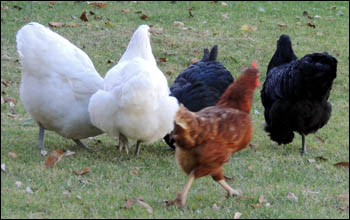
Lottie does like to boss the Orpingtons around, though.
Lottie does like to boss the Orpingtons around.

The four new Orpington hens have settled well alongside our three Red Shavers.  Lottie is the boss of all seven, and every so often has to assert her dominance, usually by pushing in on a choice item of food, or by chasing one of the stragglers.  They all choose to sleep in the same hen house nowadays, often trying to squeeze onto the same perch!

Francesca, Pearl, Fatima and Hannah (the four Orpingtons) mostly stick together and if Lottie isn’t around, Leila and Lulu will often be found nearby.  Their favourite spot on these hot Autumn days is to sleep and dust bathe under the shade of the Feijoa trees.

Hannah and Fatima
Hannah and Fatima

When the Black Orpingtons were little, they looked so cute running around.  From a distance they looked like they were wearing burqa – hence the name Fatima.  We named the other Black Orpington, Hannah, to maintain balance.

The Red Shavers are very naughty.  Lottie has taken to ‘disappearing’ in the mornings and not returning until sometime in the afternoon.  One day I spotted her hurrying across the road and into the trees on the other side.  We think that perhaps the house down the road may have something interesting to attract her – a rooster, maybe, but we’re not sure.  I’ve taken to not letting the hens out until after 10.00 am or so, to be sure they have laid all their eggs before one of them heads off further afield.

Yesterday Leila caught a small field-mouse which must have strayed from the maize field.  Poor wee thing – all three red hens set upon it – it didn’t have a chance.
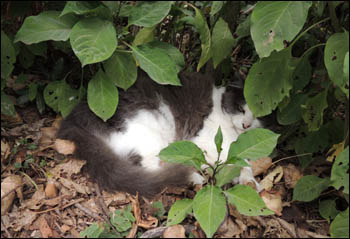
Molly often watches the hens from a secluded spot.

Molly and the hens have developed a ‘kind’ of respect for each other.  But to me it seems like the only advantage Molly has, is that she is allowed inside the house and the hens aren’t.  Sometimes they look through the living room window at Molly, looking out.

I’ve seen them peck at her if she comes too close to them, but I’m sure she could defend herself if she had to.  When I go into the hen’s enclosed area in the morning to collect their eggs, Molly always accompanies me.  She has a good look around their area when they aren’t there.  I find this amusing.

Garden Critters and Hidey-Holes

The 'hidey-hole', looking in.
The ‘hidey-hole’, looking in.

Forest Semilooper

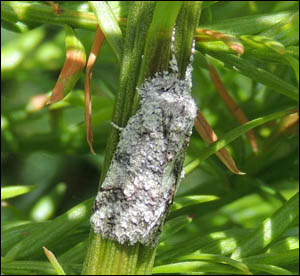
Forest Semilooper (Declana floccosa)

I spotted this charming little moth (above) when I was trimming the ‘hidey-hole’ this afternoon.  I wasn’t able to identify it, so posted it on NZ’s NatureWatch website, where it was ID’d.  It wasn’t until I looked at the photo that I realised how pretty it is.  It looks to me like it is garbed in a crocheted cloak, woven in shades of silver grey.

The Forest Semilooper is a moth of the Geometridae family, and native to New Zealand.

Hidey-Hole

Left to Right: View heading towards the hidey-hole; looking inside; view from other side.
Left to Right: Looking inside the hidey-hole; view from above; view from the other side.

Regarding the ‘hidey-hole’ – this is being created from the fresh stump of a redwood.  When we moved here, the tree itself was in poor shape, having been smothered in nasty ivy for several years – it had a great deal of die-back and the limbs were distorted and many, while still alive, lacked any needles.  It was also blocking the Eastern sun from our solar panels. 🙂

We arranged to have it cut down a couple of months back, but when it started to sprout new growth from the base, I decided to fashion it into a hidey-hole for any little visitors (of the human kind) that we may have.

On the topic of ‘redwoods and regeneration’, I read on the internet that due to the fact that seed germination is very low, most redwoods grow more successfully from sprouts that form around the base of a tree, utilising the nutrients and root system of a mature tree.  When the parent tree dies, a new generation of trees rise, creating a circle of trees that are often called fairy rings.

This amused me as this is exactly what I thought of when I saw the new growth around the sawn-off stump.

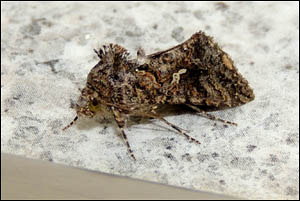
Scar Back Gem (Ctenoplusia limbirena)

Scar Back Gem moth
Scar Back Gem moth

This exotic noctuid moth originally hails from Europe and was first sighted in New Zealand in 2011 (Auckland).  It was not considered enough of a pest to warrant special attention and has been removed from the Unwanted Organism Register.  We have found a couple indoors in the past couple of days.  They are pretty cute with the frilly tufts on the top of the thorax.

Green Vegetable Bug

Green Vegetable Bug on Calendula spp. seed-head
Green Vegetable Bug on Calendula seed-head

Green vegetable bugs (Nezara viridula) are back in the garden again.  This one is sitting on the seed head of a marigold (Calendula Officinalis ‘Indian Prince’).  Our first three hens (who have sadly left us for the free range in the sky) loved to eat these bugs and I used to collect them from around the garden for them.  But current three red shavers don’t seem to recognise them as a food item, and I think the Orpingtons are still too young to be given these to try.

Asian Paper Wasp

Asian Paper Wasps on jade plant
Asian Paper Wasps on a Jade Plant (Crassula ovata)
This is the third Asian Paper Wasp nest we have found this season.  According to the Department of Conservation, they are tolerant of human activity unless their nest is physically disturbed, and feed mostly on caterpillars.  There is also anecdotal evidence that they decimate monarch caterpillars and may therefore do likewise to native butterflies and moths.
As far as ‘unwelcome visitors’ are concerned, the Asian Paper Wasp is the most recent, having been first found in New Zealand (Auckland, again) in 1979.  Attempts to eradicate it failed as it was too well-established and it has since been found throughout the North Island and at the top of the South Island. 
The nests of paper wasps (both Asian and Australian Paper varieties) can be found hanging from small shrubs and trees, fences and walls, and under the eaves of buildings.
Monarch Butterfly Caterpillar
Caterpillar of the Monarch Butterfly, on a Swan Plant
The comments about monarch butterfly caterpillars interested me, as we have many on our swan plants at the moment.  The plants have self-sown incredibly successfully and are growing all over the property – in my flower beds, in the dry gravel of the drive-way, in the vegetable garden, cottage gardens, etc. 
The first year we had only 6 baby plants and they were almost completely eaten up by caterpillars, but I don’t think we’ll have that problem again.

Sparrows and Kawakawa Tea

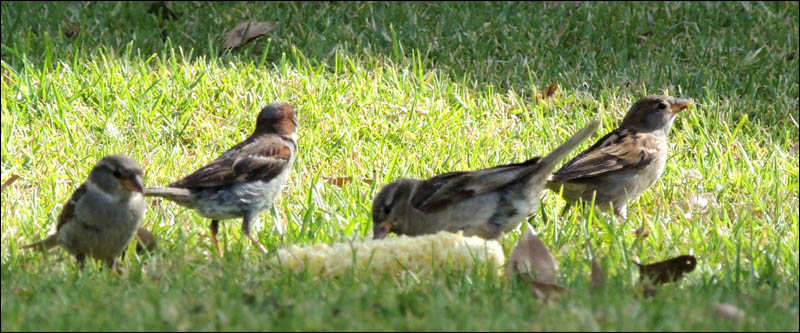
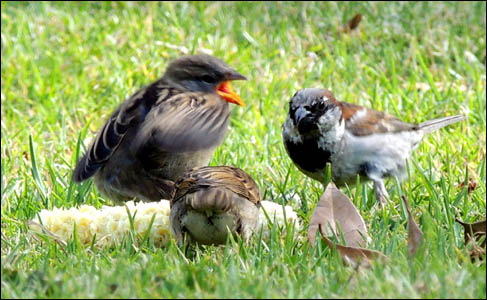
Sparrows eating corn

I think that sparrows are the rabbits of the sky.

On the branch so high,
A grey sparrow and her mate
Flutter, joined as one.

Mating house sparrows are everywhere, this summer.

Chattering in twos and threes on the guttering of the house, romping on the grass, sipping tepid water from the bird bath, dusting themselves in small leafy hollows under the feijoa trees, dangling (joined) from slim, twiggy branches, coupling in flight (just about!).

At around 6.30 am, the tui announces the imminent dawn.  This wakes up the sparrows, which then start up a loud chirruping and whistling chorus in surround-sound.  The only direction the sound doesn’t seem to come from is under the house.

Do we have a sparrow problem?  Perhaps, but I can’t be cross with these small grey bundles of feathers, as they are so endearing.

Sparrows eating corn

The sparrows are almost as well-trained as our hens.  They fly in from all directions when the hens are called for wheat or a cob of corn, and they’ll fly down to the pellet feeder when one of the hens puts her foot on it to open the lid.  Sometimes they fly out from the feeder when we’ve opened the lid to check on food levels.   And we once found a dead sparrow in the feeder – a young one.

They also help out with keeping control of the caterpillars and grubs.  A green caterpillar wriggling in a sparrow’s beak is a common sight – the avian equivalent of a pizza delivery.  Fast food, but not fast enough!

Male house sparrow
Male house sparrow

House Sparrows were liberated in New Zealand in the 1860s and soon inhabited most localities apart from forests and mountain ranges.  Moon, Lynette, Know Your New Zealand… Birds (2006), New Holland Publishers (NZ) Ltd.

Kawakawa Tea

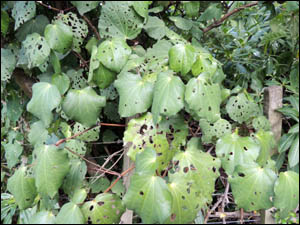
Kawakawa  growing in our garden
Kawakawa growing in our garden

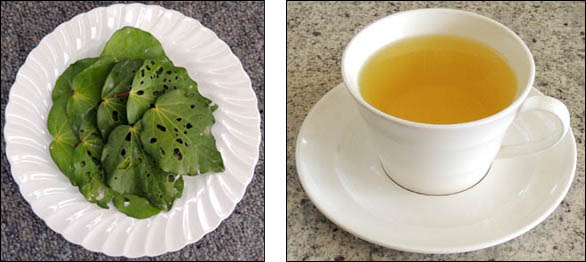
I decided to try kawakawa tea this afternoon.  I picked a handful of kawakawa (Macropiper excelsum) leaves and simmered them for 10 minutes in enough water to make two cups.

The holes in the leaves are made by the caterpillar of the kawakawa looper moth (Cleora scriptaria) and interestingly, the leaves with holes are especially suitable for tea as they have the most concentrated medicinal properties.

Left to right: kawakawa leaves, kawakawa tea

The resulting tea was surprisingly enjoyable.  I’m not really a herbal tea person, but the flavour was very refreshing and hard to define.  The aroma of the hot tea was especially tempting, too.

Project for the future:  Make a batch of soap using strong kawakawa tea.

Surpluses, Beetles, Moths and Soap

Zucchini Surplus

Last Wednesday was a very warm day at South Head, becoming unbearably hot as the day progressed.  After work at 1.00 pm I went outside to check on the state of the garden but didn’t last in the heat for long.  I had taken some fresh water and a cup of pullet food to the new Orpingtons and then made my usual rounds.

Overgrown zucchinis, hiding in the vege patch

It clearly doesn’t pay to leave zucchinis unchecked for more than a couple of days as I found some monsters vying for space under one of the plants.  When I brought them inside I discovered that the two largest weighed 1600 and 1200 grams respectively.

Sauteed zucchini with fresh ricotta

I am definitely getting to the stage of being ‘over’ zucchinis!  We have pickled, grated, fried, sauteed and stuffed them.  We’ve covered them in garlic, crispy sage, tomatoes, mushrooms, vinegars and spices.  I’m getting fussy now and am loath to use them once they’ve grown too fat.

Zucchini Pickle
Zucchini Pickle

However, having said this, I did come across a really good zucchini pickle recipe  which required 1 kg of diced zucchini.  I made a batch on Sunday, as I also had some more gherkins to pickle.  The other ingredients are chopped onions, turmeric, white vinegar, sugar, water and celery seeds and the result was a particularly yummy, sweet pickle, not unlike a sweet gherkin pickle, but (dare I say it) better.

I’ll definitely make this again and will type up the recipe at some point.

Freshly-picked peas
Freshly-picked peas

It’s great that our peas are have been coming along nicely, despite the paucity of rain.  We’ve had two meals from them so far this week, and (of course) have eaten quite a few straight from the vine.  That’s the only trouble with peas – having to resist the temptation to eat them straight from the plant – if you want to have enough left for a meal.

I’m glad now that I sowed another row a couple of weeks back.

Sparrow Zone

Sparrow Riviera in late Winter

Talking of surpluses, we had named the long edge of the garage roof closest to the house ‘Sparrow Riviera’ as there are always so many sparrow families nesting there.  From just before dawn until well beyond dusk, the sound of sparrows going about their daily life is a constant.  They seem to be continually building new nests and raising new batches of babies.

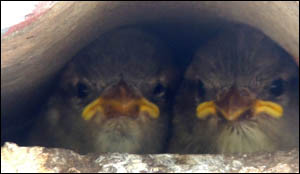
Baby sparrows peeping out from under the roof

The young ones are learning to fly at the moment and have amused us with their antics.  We know that if we see a fledgling flying towards us, we need to move aside or duck, as they haven’t quite honed up their skills sufficiently to avoid an unexpected obstacle.  They fly into windows and fall to the grass, temporarily stunned, or chirp plaintively from the roof, hoping a parent will come by and feed them.

Molly snoozing in the living room

If Molly has caught any of these new flyers, she must have devoured them completely as we haven’t seen any partially-eaten bodies.

Beetles and Moths

I’m always on the look-out for new bugs to identify.

Burnt pine longhorn beetle

Last Tuesday evening, when I went to take note of the solar power readings (I keep them on a spread-sheet) there was a Burnt Pine Longhorn Beetle (Arhopalus ferus) sitting on our back porch.

Apple Looper moth and Cabbage Tree moth
Left to right: Apple Looper moth; Cabbage Tree moth

I’ve also managed to photograph a couple of different moths – the tiny (15 mm wing-span) Apple Looper Moth (Phrissogonus laticostatus) and the endemic Cabbage Tree moth (Epiphryne verriculata)

Coffee Soap

For some time I’ve been meaning to mix up a new batch of soap.  In particular, some soap suitable for our vegans.  I finally found the time to doing this on Sunday.

I had already decided to try a Coffee Soap recipe that I’d come across thanks to being on David Fisher’s Candle and Soap-making mailing list.  It seemed like this would be a nice change from the usual scented soaps I’ve experimented with, and I’d also read that coffee-scented soap was useful for cooks, as it helped remove the odours of garlic and fish.

Soap isn’t that difficult to make and and can either be made traditionally, using different fats (i.e. beef or mutton), or by using vegetable oils.  The only ingredient you need to take care with when making soap, is lye, as this can be a very volatile and dangerous item to work with.  Special attention must be paid when adding the lye to the water, and one should always don protective glasses and gloves, and work in an area with good air circulation.  Lye is critical for soap making and soap cannot be made without it.  It reacts with the oils to form soap and glycerin.

Spicy Mandarin and Lemon Grass / Kaffir Lime soaps
Left to right: Spicy Mandarin soap; Lemon Grass/Kaffir Lime soap

Soaps I’ve made in the past are rosemary, cranberry/oatmeal, lavender, spicy mandarin and lemon grass/kaffir lime.   One batch makes quite a few individual soaps so I tend not to make soap too often.

Home-made soap has no preservatives and supposedly doesn’t last as long as commercial soaps, but some of our soaps are around 2-years old and still haven’t deteriorated noticeably.  I keep them in a dark drawer.

Basic Soap-Making Process

The soap-making process involves the careful measuring of the proportions of all the ingredients.  My basic vegan soap recipe includes water, canola oil, caster oil, olive oil, coconut oil and lye.  There are very good calculators online that help you work out the exact proportion of lye to use, based on the fats/oils in your recipe.

Coffee Mixture, Lye & Coffee, Melted Oils
Left to Right: Strong fresh coffee; Lye and coffee solution; Melted oils

The powdered lye is added carefully to the cold water (in this case to the coffee).   Adding lye to water causes a chemical reaction that generates a great deal of heat, so this has to then cool down.   Care must be taken not to inhale any fumes, too, and to avoid being burnt by the lye or the lye/water mixture.

While the lye/water mixture is cooling down, the oils are brought to within the 10 degrees of the same heat – you are aiming for between 90 and 110 F for both mixtures.  Once they have reached this range, the lye/water mixture can be carefully stirred into the oils.

Left to Right: Ready soap, finished soap
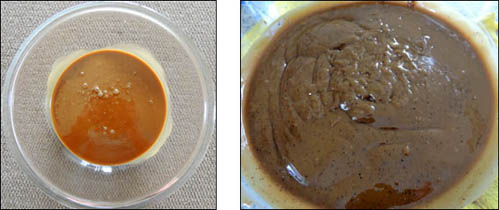
Left to Right: Coffee/Lye solution added to the oils; Mixture at trace consistency

The next step involves using a stick blender to stir the mixture until it reaches a thin pudding or gravy-like consistency (known as having ‘traced’).  When it’s ready, the drippings will leave a pattern on the surface if you lift the blender out of the mixture.  You could also use a whisk or a regular egg-beater, but thank goodness for technology as this would take ages!

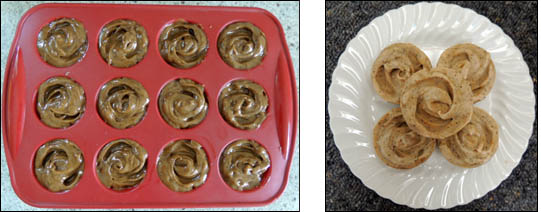
Left to right: Soap poured into muffin tray; Finished soaps

I’ve been using a muffin tray as a soap mould as it’s easy to pop them out once they have set.  Soaps made using this method have to be left for two days, after which they should be ready for turning out of their moulds or cutting into blocks, etc.   The finished product should then be left to ‘cure’ for 3-4 weeks before use.

Hen Update

The four new pullets have settled in well.  We are thinking of opening the ‘door’ between the two parts of the run in about a week’s time.

Our red shavers are as mischievous as ever.  They will slip inside the back door if we leave it open, making straight for Molly’s cat-food or milk.  Once caught, they will meekly let us carry them back outside.  Lottie and Lulu are the most common culprits.

Actually, it can be very annoying.  Imagine a hot day with all the doors and windows open – I’ll be working away at some project and will hear the ‘tap, tap, tap’ of beak on plate, and will have to stop what I’m doing to chase the little biddy out.

Ben & Lottie
Ben & Lottie

Hatchlings, Pullets, Cheese and Lake Water

Lake Ototoa, South Head

Life has been busy over the past week or so.  We have saved a nest of hatchlings (of the avian kind), we have purchased some black and white Orpington pullets, I have made a batch of feta cheese and we have discovered that the nearby lake is beautifully clear and warm for swimming in.

Baby Sparrows

It hadn’t been a particularly windy day but towards sunset last Wednesday, Ben discovered a rotund, bushy shape bathed in late afternoon light, lying on the grass beneath the Golden Totara.  He picked it up to investigate and heard a faint ‘peeping’ coming from inside.  Ben hasn’t always been too keen on birds, but has become more accustomed to them since we’ve had our own hens.  However, he was holding the nest very gingerly when he brought it inside for me to check the contents.

My first view inside the nest.

The nest was deep with a small opening at the top, so I had to part this and open the nest out a bit before I could see anything.  Inside, there were at least two yellow beaks in a tangle of soft grey baby-bird body parts – sparrow hatchlings.  I could count three little ones, with a possible fourth.

I’d raised a hatchling to almost adulthood once before when I was 10 or 11 (with an unfortunate outcome associated with our pet cat), but these were very young babies, with not even the first tufts of feathers showing on their smooth little bodies, so I felt somewhat daunted at the prospect.

There is a good deal of advice on the internet about what to do with baby birds, including the advice that where possible, one should try to put the nest back in the tree, as the parents would invariably still be around, wondering where their little ones were.  Apparently birds don’t have very strong sense of smell, so the fact that I’d touched the nest and poked around with the opening wouldn’t deter them from continuing to feed their babies.

With this in mind, Ben and I took the nest outside in the gathering dusk to where he’d found it, and looked up into the tall branches of the totara.  It didn’t look promising.  The stronger branches were positioned too far up the tree for us to be able to reach them, even with a ladder.  And we couldn’t think of any way to attach the nest to the nearest branch, even if we could reach it.  So, it was back to the drawing board.

A tiny sparrow chick in my hand

I mixed up some boiled egg yolk with a little milk (a recipe I’d found on the internet) and fed each chick in turn using a pipette.  We could see now that there were four babies.  One looked very poorly and could hardly open its mouth, but the other three were perky and squeaked and squawked with surprising loudness once I started to feed them.  The two loudest jostled around trampling on their quieter siblings.

A fortuitous phone call from my daughter Immi reminded me that the Bird Rescue Centre, in Green Bay, Auckland, would take and raise these little orphans for us.  She had rescued a young rock pigeon a few weeks back and had taken it there.

Founded in 1984, the NZ Bird Rescue Charitable Trust has bird rescue centres all over New Zealand, and will accept and care for any rescued birds, whether they are native, non-native or pet.  They assist thousands of birds each year, many being the victims of cat attacks, road accidents, pollution (such as fishing line and nylon entanglements and botulism) or human cruelty.  So we decided to think about taking the wee ones there.  The centre is about 84 km from where we live, and Ben would have to divert to Green Bay on the way to work in Auckland the next day.

In the end, this is what happened.  When I fed the chicks their last ‘meal’ for the night, the sickly one had died, which made me realise how difficult it would be to raise the remaining three successfully.  Even if we did manage to get them to fledgling stage, there was the question of how to avoid them becoming too familiar with humans, and the fact that we have our cat, Molly… it just didn’t seem worth the risk.

Hens

On Saturday, we took a return trip of almost 400 km to collect four new pullets.  Our current three hens (Leila, Lottie and Lulu) are Red Shavers, which are a relatively recent breed (related to Rhode Island Reds).  In New Zealand, the red shaver is the breed that is predominately used in battery hen farming and they are the easiest hens to find if you wish to purchase point-of-lay hens for your farm or smaller property.

Since introducing the red shavers to our family, I’d become interested in adding to our small clutch with one of the older, more traditional breeds.  We decided on Orpingtons as (1) I wanted a breed that would lay white eggs to go with the brown eggs the red shavers produce, and (2) everything we read about Orpingtons mentions their docile nature and the fact that they make good good pets.  They also look very cute.  This breed is raised for eating as well as for their eggs, (but we would never consider eating our own hens!).

So we purchased two black and two white Orpingtons, as well as 20 kg of pullet food and brought them back to South Head.

Earlier in the day Ben had assembled our smaller hen-house and separated this from the other part of the run with a wire-netting fence.  It was a very hot drive back home and we were worried about the babies’ state of health, but they survived the trip okay and at around 5.00 pm we introduced them to their new home.

Our new white Orpington hens
Our new white Orpington pullets

There appears to be quite a difference in age between the two whites and the two blacks.  The white pullets have long legs and are much taller, with a slimmed-down body.  They’ve also been in a group of hens that have pecked each other, and one in particular has quite a few feathers missing and bare, raw patches.

The new black Orpington pullets

The two little dark pullets are like balls of fluff, with shorter, stumpier legs (in proportion) and a mop of black feathers with glints of iridescence.  It would be so easy to love these two the best as they look so much cuter, but I’m sure I’ll love them all equally when they grow to the same size.

I don’t think these little chickens had ever been in an area with trees, shrubs, weeds, grasses and dry leaves, before.  The little black girls immediately took to scratching around in the leaf mulch, peeping away happily.  The white ones are a little more proprietorial – they seem to be looking out and about a lot, and are more aware of our older girls in the next door ‘pen’.

I was happy to see one of the white hens taking a dust bath yesterday.  Happiness turned to horror when when the second white pullet started pecking quite hard at the bare patches at the base of the first one’s tail.  This behaviour seemed to persist, so we separated the protagonist into the other side of the run, and shut the door so that Leila, Lottie and Lulu couldn’t come back in.

Ben purchased some Stockholm Tar on the way home from work today, and has applied this to the bare patches on the two white pullets to hopefully deter future pecking.  The tar provides a healing coating on the skin and if the other bird pecks her again, she will get the tar stuck on her beak which will distract her from pecking her again – instead she’ll have to spend time trying to clean the tar off her own beak.  Let’s hope it works!
Cheese Diary

Just to keep up with things on the cheese-making front, I made my first batch of cow’s milk feta cheese yesterday.  On Saturday, we had purchased another 4 litres of fresh cow’s milk from the farm in Helensville, after which I pasteurised it and used it to make the cheese.

The feta curds after being cut up in the pan

I had a problem with finding moulds to rest the cheese in, once the curd had been cut up, then had the bright idea of using the basket from our lettuce spinner, as well as the small ricotta mould I already had.  This is why my cheese pieces comprise of one little round cheese, and four ‘quarters’ of a larger round.

Feta cheese after it had rested overnight

After the curds had set and been transferred to a mould, I rested them overnight, and then added them to a 10-15% solution brine this afternoon.  The 4 litres of milk produced 1089 grams of cheese.

The pieces have been sealed in an air-tight container in the brine and placed in the fridge.  They will stay there for at least 10 days to mature.  Ideally we should resist the temptation to eat the cheese until 21 days have passed, after which we can cube and store into jars of olive oil or (of course) eat.  Full maturity will occur after 4 – 6 weeks.

We tasted a tiny sample tonight and it already tastes very good.

I also finished salting my Ricotta Salata, today, and this can now be stored in the fridge for at least 2 weeks, to mature.

Lake Ototoa

Lake Ototoa, South Head

Lake Ototoa is a dune lake, the correct Maori name for which being Lake Rototoa.  According to the NZ Department of Conservation, it is the largest, most pristine freshwater lake in the Auckland region.  The lake covers around 110 hectares and has a catchment of approximately 525 hectares.  At 29 metres deep, it is also the deepest.  Unfortunately, due to the introduction of exotic fish and weeds, the lake is now beginning to suffer.

A tui feeding from harakake flowers
A tui feeding on harakeke flowers

It differs from most other dune lakes in that it is formed by a depression in rock, rather than by the trapping of water behind sand dunes formed adjacent to the West coast.  It is rich in local flora and fauna.

Lake Rototoa is situated about 6 km from where we live.  The lake supplies water to many of the properties in the area, including our own.  Ben and I had visited it a few times since we moved to South Head, and although we had heard you could swim there, we hadn’t really investigated this.

Yesterday we decided to take a walk along the pathway that leads around the left of the lake from the road.  The path is narrow and follows the contours of the lake edge.  At times it is a little steep and there is prickly wild gorse to contend with, but it’s not a difficult walk.  As well, it was calm and overcast, and warm enough to make the water look increasingly  inviting.

First swim in Lake Rototoa

When we came upon a small sandy crescent of a beach, we knew we’d have to hop in.  The water has a sandy, silty bottom and after about 10 metres, drops sharply.

The water was warm and very clear.  There were a few other people on the water – swimming and kayaking at a bay a little further along.  The noise of loud laughing and splashing affected the beauty of the scene somewhat, but we could see that if it wasn’t the weekend, it would be the most beautiful place to spend a few hours on a hot summer’s afternoon.

Caterpillars, Leaves and Seeds

Image

Today started out clear, sunny and calm, but it clouded over as the day progressed.  It’s clearer now, but there is a storm traveling up from the South Island, and although it’s unlikely to travel this far north, we have been experiencing very strong South-Westerly winds, as can be seen by the cloud patterns to the west.

Our planned excursion to Helensville this morning was aborted half way there, as the road was closed due to a truck having rolled on one of the corners.  Rather than wait around for an hour or more for the tow truck to arrive and sort things out, we decided to head back home.

I spent some time this afternoon cutting back the ratty leaves on my tomatoes.  I spotted a couple of cabbage looper caterpillars, Trichoplusia ni, and picked them off.  I’ve posted images of these on the Nature Watch NZ site.  I love this site as it’s helped me to identify many of the unfamiliar bugs and plants I’ve come across since we’ve lived at South Head.

But I digress.  Last summer these caterpillars wrought havoc on my tomatoes – not only did they eat the leaves, which isn’t too much of a problem in itself, but they also like to tunnel into the actual tomatoes and many were spoiled.  From what I’ve read, I suspect that my tomato plants are becoming vulnerable due to there not having been any rainfall since Christmas.  It’s supposed to rain tomorrow, but if not, we’ll have to give our garden a decent watering.

Our hens like to eat the caterpillars, so it is with some satisfaction that I feed them any that I find.

Garlic

Image

The photo above shows how little garlic we have left!  But the garlic we harvested around this time in 2013 has lasted all year so we haven’t had to purchase any.

Image

Our garlic plants aren’t looking that amazing …  again, the soil has become very dry.  We did dig in a decent amount of compost during the year, but with our light soil, it just seems to become absorbed really quickly.  And of course, I’ve been lazy about weeding. The garlic bulbs will be ready to lift and dry when the foliage dries off and turns brown.

Leaf Mulch

The tawny leaves that can be seen lying on the the soil amongst the plants are from the huge Lilly Pilly trees that line our back fence.  There doesn’t seem to be one time of the year that they don’t shed their leaves.  At first this used to drive me mad, but I’m accustomed to them now.  Every so often I make the effort to sweep them all up and add them to our compost heap.

Image

We’d also started a bag of leaves for leaf mulch – but I must admit that although I started out really keen to keep the leaves separate, I lost interest within a few days of starting the bag.

Image

Lemon Grass

Another garden task we tackled today was the removal of an overgrown lemon grass plant.  I must admit that when we purchased it as a precious, tiny plant three years ago, I thought that a spot in the vegetable garden would be just fine, but it’s grown out of proportion to what I’d expected.  And I worry when it’s seeding (as it has been for the last several weeks).

I use lemon grass from time to time when marinating prawns or cooking up something Asian, but I don’t tend to use it often enough to allow it free reign in my garden.

Image

So, Ben had the task of digging up this unfortunate plant and we’ll buy a new one at some point and decide on a more appropriate place somewhere else on the property.

Seed-Sowing

Other than that, I’ve had a pretty lazy day.  Ben had pulled out a row of bolting celery a couple of days ago, so we’ve sowed the following seeds in the space freed up by its removal: –

Carrot ‘Touchon’ (Daucus carota var sativa) , Mesclun Lettuce Mix (Lactuca sativa), Radish ‘Easter Egg’ (Raphanus sativus), Pea ‘Easy Peasy’ (Pisum sativum) and Organic Rocket (Eruca sativa).

For those not familiar with botanical names, you’ll notice the use of the word ‘sativa’ or versions of this in the names of all the seeds.  Sativum, Sativus, and Sativa are Latin botanical adjectives meaning ‘cultivated’, applied to certain seed-grown domestic crops.

Rum, plums, corn and squash

ImageRum Pots and Cherries

What a hot day it’s been!  One of my plans for today was to find a use for the remaining plums along with some of the strawberries, now that latter are ripening up nicely.

I had been reading about rum pots, also known as rumtopf and romkrukke.  This seemed like a really cool way to preserve some of our fruits as they come to fruition on our trees.  I’ve mostly missed the boat re the plums, but starting now, I should be able to use our strawberries, pears, tamarillo and feijoa.  I also collected a few Cape gooseberries, as these grow like weeds around our property.

Image

The ideal container for a rum pot is a ceramic container or a dark jar, as the fruit should be protected from bright light.  I was also looking for something that would hold a decent amount of fruit.  In the end, the best containers I could find were some tall, glass spaghetti jars, enclosed in a metal sleeve, with a wee window on one side.  Into these I layered the fruit with 1/2 their weight in white sugar, then topped them up with dark rum until the fruit was just covered.

Sad Cherry Tale

Some years ago, my daughter Amiria had brought me back a small bucket of export quality lapin cherries from Summerfruit Orchards in Central Otago, where she had been employed fruit-picking.  I saved a few of the finest specimens, added them to a sturdy glass jar and covered them with brandy.  I kept this jar of cherries for 3 to 4 months, having placed it in a shady place at the corner of my kitchen bench – I’d rotate the jar regularly to keep the alcohol circulated through the fruit.

Ben was washing dishes one day and thought the jar of cherries something old to be discarded, so he tipped them into my compost bucket.  I didn’t notice that they were missing until it was too late.  I’m sure I’d have scooped them out of the compost bucket if I’d known straight away!

I still wonder about those cherries – what they would have tasted like…  But it’s a lesson on letting people know about the strange concoctions we have in our kitchens.

Asparagus

Image

It’s time to allow our asparagus plants to produce their ferny foliage so that they can grow strong and healthy for our Spring 2014 crop.  These plants have been in place for 4 years now, and this year we were eating spears continually from the end of September through to the end of December.  We had put in some plants of the regular green variety as well as having sown seeds of the purple, Asparagus Sweet Purple.

Freshly-picked asparagus, lightly steamed and served with melted butter is one of the special flavours of a spring garden.

Sweet Corn

Image

It’s been a busy time for Ben, collecting as much sweet corn as he can, before he runs out of energy.  Over the past 2 days, he’s harvested around 150 ears and has spent a good proportion of the day scraping off the kernels and freezing them free-flow for winter use.  It’s a time-consuming task and not much fun when it’s so hot outside, but well worth it.  He’s also frozen some of our runner beans.

I mixed up a batch of corn fritters for lunch – couldn’t resist it!  They were yummy!

Other Garden Tasks

Image

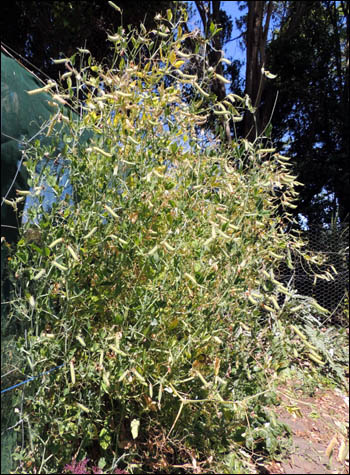
Other garden tasks undertaken today included cutting back the spent sweet peas from the back fence of our main vegetable garden.

Image

Around February last year I collected seeds from a patch of sweet peas I had sown the previous Winter.   We sowed these this year to see how they would turn out.  The blooms haven’t been as strong, nor as fragrant, and are in a very narrow range of colours: scarlet, vermillion and shades of pink, none of them particularly vivid.

This was disappointing on a couple of levels as (1) I’m not a pink or a red kind of a girl, and (2) I prefer my flowers to have a fragrance.

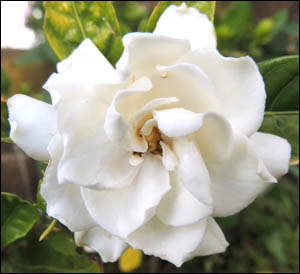
gardenia

The same can’t be said for our gardenia which has been flowering very well this year compared with last year.  We saved this shrub from our previous property in Titirangi, where it struggled with the paucity of sunlight.  I do love the beautiful waxy flowers with their creamy, honeysuckle fragrance.

bougainvillea

Another plant currently providing brilliant colour to the garden is the bougainvillea, Scarlet O’Hara.  This is another plant we saved from Titirangi.  There, it barely produced a single new shoot, and failed utterly to produce the beautiful crimson bracts.

Hibiscus Golden Oriel

We also recently planted a very garish looking hibiscus, Hibiscus Golden Oriel, a Hawaiian hybrid.  I couldn’t resist it, but usually don’t like flowers that combine the colour yellow with red!

Other tasks for today have involved checking on how the vegetables are progressing.  I have a habit of walking around my garden at least once a day, but often go back again in the late afternoon, mainly to check on what needs pruning or cutting back, or which vegetables are ready for harvest, which need to be pulled out, etc.  To be honest, there is not enough hours in the day, so I tend to just do the things that interest me at the time.

Buttercup & Butternut Squash

Today I was especially pleased with the progress of my squashes, Burgess Buttercup and Butternut Chieftain.  I’ve grown these two as I particularly like the taste of their flesh.  Also,  they are extremely prolific, which means we’ll be provided with many individual squashes of a perfect size for two people.

Thelma Saunders Sweet Potato

I’ve also grown a new pumpkin this year, Thelma Saunders Sweet Potato.  According to information I have read, this is the sweetest of the heirloom acorn squashes and is named after Thelma Sanders of Adair County, Missouri.  It is renowned for its cooking qualities and has won many a harvest bake-off competition in the USA.

It doesn’t seem to be producing as many pumpkins as I’d hoped, but there is still plenty of time until the end of the season.

I obtained seed for both the pumpkin and the squashes from Kings Seeds.

fruits

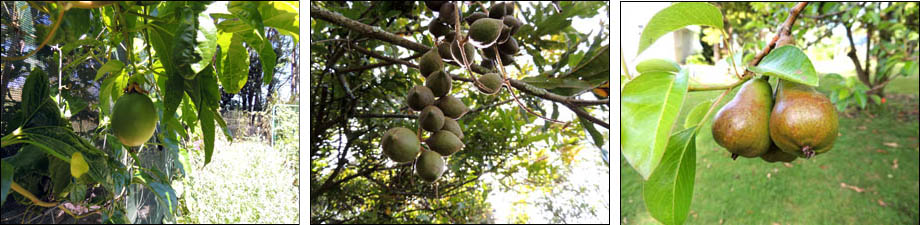
The passion fruit, macadamia nuts and pears are developing as expected.   I really need to somehow get to the top of the pear tree to thin the pears… ideally there should only be 2 – 3 fruit per bunch to allow them to grow properly.

The passion fruit are very fat and healthy looking, and the macadamia nuts look to be producing a good crop this year.

let_tom

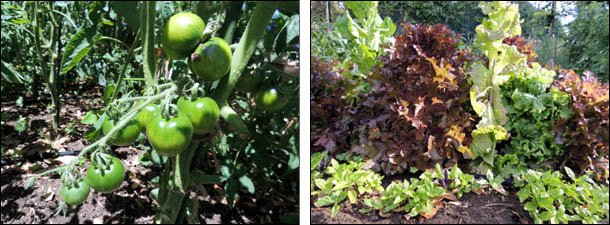
The tomatoes are fine, although they seem to be a bit slower to ripen than at the same time  last year.  I have grown several varieties from seed: Mortgage Lifter, Cherokee Purple, Bloody Butcher, Black from Tula, Black Krim and Sun Cherry.  I especially like the ‘black’ tomatoes, but am always interested in trying new varieties.

The lettuces are bolting and I’ll have to compost them soon.  The basil is slow to grow, too.  I’m thinking this is to do with the lack of rain prior to Christmas, but they should put on good growth now that the weather has settled.

sunset

When the sun set today, we had generated a very respectable 14.59 KWh.  Not bad for our 11 panel / 2 KW system.  There is something so very satisfying about generating our own power from the sun.  I’ll never take this for granted!

Pumpkins and cherry slugs

We’ve had a few sunny days in a row and this has been reflected in the growth in the pumpkin & squash patch.  This year, I raised three varieties from seed and they are all doing really well (‘Thelma Saunders Sweet Potato’, ‘Burgess Buttercup’ and ‘Butternut Chieftain’).  There are quite a few pumpkins set already, some growing quite round and fat.  We planted and sowed most of our cucurbits in the native garden this year, and already I can see that it was a very sensible choice.  In previous years we’ve tried the back paddock (too dry and windy), in the main vegetable garden (too invasive) and on the grass in front of the barn (became overgrown with grass).  The native garden is sheltered and sunny, with very rich loamy soil.  The worst two weeds are convolvulus and madeira vine.  But I feel that I can control these two by digging them out when they come up and either leaving in the sun to shrivel up (convolvulus) or putting out in the rubbish collection (madeira vine).

Our zucchini ‘Costasta Romanesco‘ is huge, the fat yellow and green fruit remind me of smooth alien guinea pigs.  The hens have stirred up the wood chips around them and the zucchinis are difficult to find until they have grown too big for my liking.  Costasta Romanesco is a variety grown especially for their huge male flowers, which can be stuffed, coated in batter and deep fried.  But the zucchinis themselves also taste really good sliced thickly and fried in olive oil with sage leaves – they are much starchier than the commonly-grown zucchinis, with a lovely nutty flavour, and the sage leaves turn all crispy.

Ben has been collecting plums by the tray load, halving them and freezing them free flow.  This particular old prunus was here when we moved in and is quite gnarly and covered in lichen.  There wasn’t much fruit last year in comparison with 2011, but this year it is completely laden with beautiful red-skinned, golden-fleshed plums.  They taste the best if you can pick them when they turn purple but before they drop to the ground.  Each morning when we let the hens out, they hurry over to feast on the plums that have fallen over night.  There are more than we can keep up with.  I eat them whenever I walk past the tree but it barely makes a difference.  In the past we’ve made plum wine and plum sauce.  At least if we manage to freeze a good deal of them, I’ll still have the option to do this when life isn’t so busy.

Cherry slugs on my cherry Stella

The big shock yesterday was when I discovered that the leaves of our tiny dwarf cherry tree ‘Stella’ were covered in slimy little slugs.  We picked them all off and offered them to the hens, but they weren’t interested.  I later identified them as larvae of the sawfly (caliroa cerasi).  Many of the leaves had been converted over night from healthy green to lacy brown.  Thank goodness I do tend to walk around the complete garden on a daily basis.  When I checked again this morning there was only a solitary slug, so it seems that the crisis has been averted.

White-tailed Spider
White-tailed Spider

I also saw my very first ‘white-tailed’ spider, (Lampona spp.)  I’m always looking for different and interesting bugs and plants so when I saw this particular spider sitting near the ceiling of our porch, I rushed to fetch my camera and a stool.  I had to get really close up to take the photo and was surprised when I saw the white tip on its abdomen when I looked at the image later on.  There is quite a bit of negative hype about these spiders, but from what I have read, they are somewhat maligned.

It’s been a good day for power generation.  At the time of writing (7.30 pm), our 2KW system has generated just under 14KWh.  It has been a very hot and calm day, with the temperature ranging from 18C when I arose at 7.30 am and reaching over 30C in the sheltered patch by the bromeliad garden at around 3.00 pm this afternoon.  The sweet corn is ripening in the paddock behind the barn and the maize that stretches away to the north is very tall and lush.

Sitting here I can see across the Kaipara to the East.  The distant hills are a hazy blue grey, sandwiched between the palest blue sky and the silvery forget-me-not blue of the water.  In the foreground are our harakeke, which have flowered for the first time, sending straight spurs of rusty red flowers towards the sky.

Tomorrow I have to head to Wellington for an overnight meeting.  A major garden task for when I return will be to attempt to sort out part of our vegetable garden that is filled with scattered sweet-corn plants (a blackbird hen dug up most of them), self-sown Cleome (I want to plant these around the climbing beans), a few pumpkins and squashes, and other self-sown vegetables.  We are going to try to move all the corn to one end before they get too tall, rescue the Cleome and make some sense of the array of other vegetables that are growing there.